

 Katso seinällä
 Lähetä
 Jaa
Jaa
 Tarkemmat tiedot
 Opas
Opas

 Lataa kuva
 Samanlaisia kohteita
 Röntgenkuvaus
 Diaesitys
 Tilastot
Idilio campero


 Lue lisää
Käsinmaalattu öljyvärinen jäljennös
Käsinmaalattu öljyväri kankaalle haluamassasi koossa ja kehyksissä, taiteilijoidemme valmistamana tilauksesta. ( Vaihda tulosteeseen Siirry digitaaliseen kuvaan)




P118B $10

P118H $10

P118W $10

P438Z $10

P508JH $12

P508YH $12

P805H $10

P805Z $10

P919BZ $10

P919G $10

P919XJ $10

P959ZH $10

P968JZ $12

W106C $8

W218G $10

W218JH $8

W218Y $10

W307PJ $10

W316G $10

W316PJ $8

W316Y $10

W398PJ $8

W4111J $10

W500HY $15

W500JH $15

W692G $12

W849H $8

W940BG $15

W953PJ $8




Valitse valmiista mitoistamme sellaiset, jotka vastaavat teoksen alkuperäisiä mittasuhteita.

Voit syöttää omat mitat sopimaan tiettyyn kehykseen tai tilaan. Jos valitsemasi koko ei vastaa alkuperäisen kuvan mittasuhteita, rajaamme taideteoksen tai jatkamme maalausta käsin maalatuilla elementeillä. Digitaalinen esikatselu lähetetään hyväksyttäväksi ennen tuotannon aloittamista.
Huomioithan, että näytöllä oleva esikatselu ei vastaa todellista rajausta tai jatkamista. Vain digitaalinen mallikuva näyttää lopullisen sommittelun tarkasti.
Vaikka mittatilaustyöt ovat mahdollisia, suosittelemme valitsemaan mitan ennalta määritetystä listasta alkuperäisten mittasuhteiden säilyttämiseksi.
Tilauksen jälkeen OriginalUniqueArt.com -tiimi lähettää asiakkaalle sähköpostitse ohjeet ja esikatselukuvan.
Maailmanlaajuinen toimitus () 3–4 viikossa tavallisen 5 viikon sijaan. (26 syyskuu). Laadusta ei tingitä.

Ilmainen pikatoimitus ympäri maailman

Korkealaatuinen pellavakangas

Kattava kuljetusvakuutus

Tulliveron palautustakuu

Takuu täydellisestä värien vastaavuudesta

100 päivän palautusoikeus valmistusvirhetapauksissa

100% rahat takaisin -takuu

Määräalennus saatavilla
 Lasivaihtoehto on saatavilla vain alle 110 cm kokoisille teoksille

Idilio campero
Reproduktiotapa
Replikaatin koko
-


Kokonaishinta
$ 300
A Pastoral Symphony in Brushstrokes
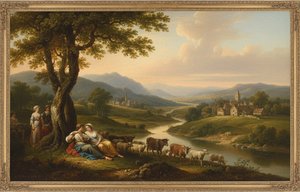
In the evocative masterpiece Idilio campero, painted in 1935, the Uruguayan master Pedro Figari invites us into a nostalgic realm where time seems to slow to the rhythm of the countryside. The painting presents a breathtaking tableau of rural life, centered around a majestic, sprawling tree that serves as both a physical and emotional anchor for the composition. Beneath its protective canopy, two figures share a quiet moment of intimacy, their presence framed by the soft, atmospheric light that characterizes Figari’s late period. This central vignette is not merely a depiction of a landscape, but a profound meditation on connection and the enduring peace found within the natural world.
As the eye wanders from the central figures, it discovers a lively, breathing ecosystem of movement and life. In the middle ground, horses graze peacefully, adding a sense of depth and pastoral authenticity to the scene. The presence of other figures—scattered subtly across the canvas—imbues the landscape with a gentle vitality, suggesting a community that exists in perfect harmony with the land. Each person, positioned with deliberate care, contributes to a narrative of shared existence, turning a simple landscape into a rich tapestry of social and natural interaction.
The Soul of Uruguayan Modernism
To understand Idilio campero, one must understand the unique spirit of Pedro Figari. A polymath who transitioned from law and politics to the canvas in his sixties, Figari brought a deep, intellectual empathy to his work. His style is a captivating blend of post-impressionist influence and a deeply personal, almost dreamlike memory. He did not merely paint what he saw; he painted the essence of what he remembered about the gaucho culture and the traditional customs of Uruguay. This technique creates a soft, blurred edge to reality, where forms emerge from a hazy, luminous atmosphere, making the painting feel less like a photograph and more like a cherished, fading memory.
The technique employed in this work relies on a masterful use of light and texture to evoke emotion. The brushwork is fluid and expressive, eschewing rigid lines in favor of organic shapes that mimic the undulating terrain of the pampas. For collectors and interior designers, this piece offers an unparalleled emotional depth; it possesses a warmth that can transform a room, providing a focal point that is both sophisticated and deeply comforting. It is a work that does not demand attention through aggression, but rather captures it through a quiet, irresistible charm.
A Timeless Addition to the Modern Collection
For those seeking to curate a space filled with character and historical resonance, Idilio campero stands as an exquisite choice. The painting’s palette—earthy, warm, and harmonious—complements a wide variety of interior aesthetics, from classic traditionalism to contemporary minimalist settings. It serves as a window into a lost era, offering a sense of tranquility and a connection to the roots of Latin American modernism.
Owning a high-quality reproduction of this work allows for the preservation of Figari's legacy within a private collection or a curated design project. The piece functions not just as decoration, but as a conversation starter—a soulful tribute to the beauty of simplicity and the enduring magic of the pastoral idyll. It is an invitation to pause, to breathe, and to reconnect with the serene rhythms of life that Figari so lovingly immortalized on canvas.
Taiteilijan elämäkerta
A Life Imbued with Uruguayan Essence
Pedro Figari, a name that echoes through the halls of Latin American art history, was far more than simply a painter; he was a complex and deeply felt embodiment of his nation’s soul. Born in Montevideo in 1861, his life unfolded not as a straightforward progression but as a rich tapestry woven from legal practice, political engagement, literary pursuits, and ultimately, an extraordinary artistic awakening. Initially drawn to the structured world of law – earning his degree in 1886 – Figari’s early career exposed him to the realities of Uruguayan society, particularly the struggles faced by its impoverished citizens. This experience, far from being a mere backdrop, profoundly shaped his perspective and fueled a desire to capture the essence of everyday life on canvas. A marriage in the same year led to travels in France, an encounter that proved pivotal as he immersed himself in the vibrant world of post-impressionism – absorbing the bold colors and emotive brushstrokes of artists like Van Gogh and Gauguin. However, it wasn’t until 1921, at the remarkable age of sixty, that Figari truly embraced painting, unleashing a torrent of creativity that would forever alter his legacy and redefine Latin American art.From Legal Chambers to Artistic Visions
For decades prior to this transformative moment, Figari had engaged in various intellectual endeavors, serving as a member of Parliament, directing the Escuela Nacional de Artes y Oficios (National School of Arts and Crafts), and contributing significantly to public discourse through his writings on law, education, aesthetics, and even utopian ideals. These diverse commitments weren’t distractions from his artistic potential; rather, they enriched it, providing him with a keen observational skill honed by years of legal practice and a deep understanding of human nature cultivated through his interactions with the marginalized. His legal training instilled in him an acute awareness of social dynamics and a sensitivity to the complexities of human relationships – qualities that would later find expression in his paintings. The move to Buenos Aires in 1921 proved to be a catalyst, providing him with a fresh start and a space to shed the constraints of earlier, more academically-influenced styles. It was here, amidst the bustling energy of Argentinean life, that he began to forge a truly unique artistic voice – one rooted in memory, emotion, and an unwavering commitment to capturing the spirit of his homeland.A Pioneer’s Palette: Style and Subject Matter
Figari's artistic style is immediately recognizable for its vibrant color palettes, bold brushstrokes, and seemingly naïve simplicity. He wasn’t interested in creating illusions of depth or photographic accuracy; instead, he treated his canvases as studies in color and form, reconstructing Uruguayan scenes from the fragments of his memory. His paintings weren’t attempts to replicate reality but rather distillations of experience – capturing the essence of a moment, a feeling, or a social interaction. His subjects were drawn almost exclusively from the world he knew intimately—the gauchos roaming the vast pampas, the lively celebrations of carnival, the quiet rituals and daily life of Montevideo’s black community, and the intimate scenes unfolding within colonial patios. These weren't merely picturesque depictions; they were poignant reflections on Uruguayan identity, social customs, and a disappearing way of life. He captured fleeting moments – a dance in progress, a gathering of friends, a street scene bathed in sunlight – with an immediacy that felt both timeless and deeply rooted in place. His technique, often employing *impasto*—thickly applied paint creating visible brushstrokes—further emphasized the expressive power of color and texture, creating paintings that pulsated with energy and emotion.Breaking with Tradition: A Latin American Voice
Pedro Figari emerged during a crucial period in Latin American art history – a time when artists were actively seeking to break free from European artistic dominance and define their own unique aesthetic identities. Traditional academic painting often focused on historical or religious subjects, prioritizing technical skill over genuine expression. Figari challenged this convention by embracing a more direct, unpretentious style that allowed him to subtly critique social norms and celebrate the vibrancy of Uruguayan culture. He believed in the power of art to connect with the everyday experiences of ordinary people, rejecting elitism in favor of authenticity. His work resonated with a growing sense of national pride and a desire to reclaim indigenous roots. He wasn’t alone in this endeavor—artists like Diego Rivera and Tarsila do Amaral were also forging new paths—but Figari's unique blend of memory, color, and social commentary established him as a pivotal figure in the development of Latin American modernism. He anticipated later modernist developments with his expressive brushwork and rejection of mechanistic representation.Legacy and Enduring Influence
Pedro Figari’s legacy extends far beyond his individual artistic achievements. He is remembered not simply as a painter but as one of the first Latin American artists to successfully forge a distinctly regional style, prioritizing feeling and essence over strict realism. His work continues to inspire artists and art lovers alike with its vibrant energy, emotional depth, and unwavering commitment to capturing the spirit of Uruguay. He demonstrated that true modernity wasn’t about imitating European trends but about finding one's own voice—a lesson that resonated throughout Latin America and beyond. He died in 1938, leaving behind a body of work that stands as a testament to his artistic vision, intellectual curiosity, and enduring love for his homeland. His paintings are not merely representations of Uruguayan life; they *are* Uruguay – its colors, its rhythms, its soul – preserved on canvas for generations to come.
Pedro Figari
1861 - 1939 , Uruguay
Tietoa taiteilijasta
- Artistic Movement Or Style: Latinalaisen modernismin edelläkävijä
- Artists Or Movements Influenced By This Artist: ['Post-impressionismi']
- Artists Who Influenced This Artist: ['Godofredo Sommavilla']
- Date Of Birth: 29.6.1861
- Date Of Death: 24.7.1938
- Full Name: Pedro Figari Solari
- Nationality: Uruguaylainen
- Notable Artworks:
- Pericón
- Rincón De Negros
- Place Of Birth: Montevideo, Uruguay
Aiheeseen liittyvät artikkelit

Evocations of Place: A Historical Journey Through Landscape Art
Explore the rich history of landscape art with OriginalUniqueArt. Discover renowned artists, movements like Impressionism & Romanticism, and expert guidance for collecting timeless pieces. Find your perfect serene escape today!

Idyllic Visions: Exploring the Pastoral Scene in Art History – From Arcadia to Modern Interpretations
Explore the captivating history of pastoral art from classical Arcadia to modern masterpieces. Discover key artists like Millet & Cole at OriginalUniqueArt. Find serene landscape paintings for your home.
Idyllic Visions: Exploring the Pastoral Tradition in Western Art – Themes, Techniques & Enduring Appeal
Explore the rich history of pastoral art from classical Arcadia to contemporary interpretations. Discover key artists, themes & collecting tips at OriginalUniqueArt.

Romanttisen maisemamaalauksen mestariteokset: Taidetta ja inspiraatiota kotiin
Uppoudu romanttisen maisemamaalauksen maailmaan! Tutustu Caspar David Friedrichin, Turnerin ja muiden mestareiden ikonisiin teoksiin. Löydä inspiraatiota kotiisi taiteen avulla OriginalUniqueArt.comista – laadukkaat taideprintit ja sisustusideoita.

John Constablein 25 mestariteosta: Taidetta ja tunnelmaa kotiisi – OriginalUniqueArt.com
Tutustu John Constable'n 25 mestariteokseen – romanttisia maisemamaalauksia, jotka vangitsevat englantilaisen luonnon tunnelman. Taidehistoriaa ja inspiraatiota kotiisi OriginalUniqueArt.com:ssa. Löydä kaikki taideteokset verkossa!
