Katso seinällä
 Lähetä
 Jaa
Jaa
 Tarkemmat tiedot
 Opas
Opas

 Lataa kuva
 Samanlaisia kohteita
 Röntgenkuvaus
 Diaesitys
 Tilastot
Oranssi ja keltainen


 Lue lisää
Tällä sivulla esitettyä taideteosta suojaa tekijänoikeuslaki, mikä tarkoittaa, ettemme voi laillisesti luoda tai myydä täsmälleen samanlaista jäljennöstä. Tämä suoja toteutetaan kansainvälisten sopimusten, kuten esimerkiksi Berne-konventio ja kansallisilla laeilla, mukaan lukien niillä määritellyt Yhdysvaltain tekijänoikeuslaki – Luku 17. Kaikki oikeudet pidätetään. Luvaton kopiointi tai jäljittely on kielletty.
Kunnioittavana ja laillisena vaihtoehtona tarjoamme alkuperäisestä inspiroituneita, yksilöllisiä ja käsinmaalattuja taideteoksia. Taitavat ja ammattimaiset taiteilijamme tutkivat huolellisesti alkuperäisen teoksen tyyliä, tunnelmaa ja taiteellista ydintä luodakseen uuden, ainutlaatuisen teoksen, joka herättää saman tunteen – säilyttäen samalla oman itsenäisen alkuperäisyytensä.
Tämä menetelmä noudattaa täysin tekijänoikeussäännöksiä, sillä se ei sisällä suojatun taideteoksen kopioimista tai jäljentämistä. Sen sijaan kyseessä on luova uudelleentulkinta – uusi maalaus, joka ammentaa vaikutteita alkuperäisestä, mutta ei ole sen identtinen kopio.
Käsinmaalattu öljyvärinen jäljennös
Käsinmaalattu öljyväri kankaalle haluamassasi koossa ja kehyksissä, taiteilijoidemme valmistamana tilauksesta. ( Vaihda tulosteeseen Siirry digitaaliseen kuvaan)




P118B €10

P118H €10

P118W €10

P438Z €10

P508JH €12

P508YH €12

P805H €10

P805Z €10

P919BZ €10

P919G €10

P919XJ €10

P959ZH €10

P968JZ €12

W106C €8

W218G €10

W218JH €8

W218Y €10

W307PJ €10

W316G €10

W316PJ €8

W316Y €10

W398PJ €8

W4111J €10

W500HY €15

W500JH €15

W692G €12

W849H €8

W940BG €15

W953PJ €8




Valitse valmiista mitoistamme sellaiset, jotka vastaavat teoksen alkuperäisiä mittasuhteita.

Voit syöttää omat mitat sopimaan tiettyyn kehykseen tai tilaan. Jos valitsemasi koko ei vastaa alkuperäisen kuvan mittasuhteita, rajaamme taideteoksen tai jatkamme maalausta käsin maalatuilla elementeillä. Digitaalinen esikatselu lähetetään hyväksyttäväksi ennen tuotannon aloittamista.
Huomioithan, että näytöllä oleva esikatselu ei vastaa todellista rajausta tai jatkamista. Vain digitaalinen mallikuva näyttää lopullisen sommittelun tarkasti.
Vaikka mittatilaustyöt ovat mahdollisia, suosittelemme valitsemaan mitan ennalta määritetystä listasta alkuperäisten mittasuhteiden säilyttämiseksi.
Tilauksen jälkeen OriginalUniqueArt.com -tiimi lähettää asiakkaalle sähköpostitse ohjeet ja esikatselukuvan.
Maailmanlaajuinen toimitus () 3–4 viikossa tavallisen 5 viikon sijaan. (11 lokakuu). Laadusta ei tingitä.

Ilmainen pikatoimitus ympäri maailman

Korkealaatuinen pellavakangas

Kattava kuljetusvakuutus

Tulliveron palautustakuu

Takuu täydellisestä värien vastaavuudesta

100 päivän palautusoikeus valmistusvirhetapauksissa

100% rahat takaisin -takuu

Määräalennus saatavilla
 Lasivaihtoehto on saatavilla vain alle 110 cm kokoisille teoksille

Oranssi ja keltainen
Reproduktiotapa
Replikaatin koko
-


Kokonaishinta
€ 259
Varhainen Elämä ja Taiteellisen Visioinnin Siemenet
Mark Rothko, syntynyt Daugavpilessä, Latviassa vuonna 1903, kantoi sisällään jo nuoresta iästä lähtien muuttumatonta tunnetta poikkeavuudesta, joka syvästi muokkaisi hänen taiteellista matkaansa. Hänen varhaiset vuotensa olivat merkittyjä ihmisten kärsimyksen huolesta, erityisesti juutalaisten perheen elämässä Pale of Settlementissa, varjostettuna pogromien ja poliittisen epävakauden vaikutuksilla. Tämä ilmapiiri herätti syvän herkkyyden ihmiskunnan tuskaa kohtaan, teema joka resonoisi hänen teoksissaan koko elämänsä ajan. 1913 emigraatio Portlandiin, Oregonin osavaltioon, ei ollut pelkästään maantieteellinen muutos vaan kulttuurillinen mullistus nuorelle Rothkolle. Hänen isänsä, farmaseutti ja älykkö, joka edisti perheessä keskustelua ja oppimista, loi kodin, jossa oli varjo menetyksen aiheuttamaa surua. Nuoren Rothkon menettämä Jacob Rothkowitz heti heidän saapumisensa jälkeen heikensi perheen taloudellisia resursseja ja syvensi tunnetta epävarmuudesta. Tämä varhainen kokemus menetyksestä, yhdistettynä sopeutumisen haasteisiin, ruokki jatkuvaa pyrkimystä löytää merkitystä ja ymmärrystä maailmassa. Rothko oli lapsena hyvin altis pelolle, mikä vaikutti hänen myöhempään taiteelliseen kehitykseen. Hänen isänsä marxistinen näkemys ja juutalaisuuden vastainen asenne olivat keskeisiä tekijöitä, jotka muokkasivat nuoren Rothkon maailmankuvaa.Värimaailman Synty – Color Fieldin Nousu
Rothko ei ollut kiinnostunut perinteisestä taiteen esittämisestä, vaan hän etsi uusia tapoja ilmaista tunteita ja kokemuksia. Hän oli vaikuttanut abstrakteihin ekspressionisteihin, mutta halusi luoda jotain täysin erilaista. Color Field -maalaus syntyi abstraktin ekspressionismin energian keskellä, ja sen tavoitteena oli poistaa gestaaliset siveltimien vedot ja narratiivinen sisältö, keskittyen sen sijaan värin itsensä voimaan. Taiteilijat kuten Rothko uskoivat, että väri voi ohittaa älyllisen tulkinnan ja puhua suoraan alitajuntaan, herättäen syvän tunteen ihmisessä. Tämä oli tarkoituksellinen siirtymä – *poistuminen* taiteilijan sisäisen ahdistuksen ilmaisemisesta (kuten paljon abstraktissa ekspressionismissa) ja *suuntaaminen* katsojan kokemiseen. Rothko ei halunnut maalata "kuvia" perinteisessä mielessä, vaan luoda kokemuksen – tilaa katsojille kohdata perustavanlaatuisia ihmisen tunteita.Kompositiot ja Tekniikka: Pohdinnan Kerroksia
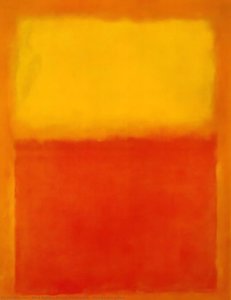
”Orange and Yellow” -maalauksessa Rothko käyttää tunnusomaista tekniikkaansa, jossa suuret, suorakulmaiset värialueet asetetaan toisiinsa nähden. Nämä eivät ole teräviä muotoja vaan niissä on pehmeitä, hämärtyneitä reunoja, jotka tuntuvat hengittävän ja väräjäsevän toistensa ympärillä. Oranssi- ja keltaiset kentät eivät ole vain asetettu kankaalle vaan ne näyttävät syntyvän siitä, luoden valoa säteilevän syvyyden. Rothko saavutti tämän efektin ohuilla öljykerroksilla, jotka levitettiin useita kerroksia, mahdollistaen värien hienovaraisen sekoittumisen ja vuorovaikutuksen. Tämä tekniikka kannustaa pitkäaikaista pohdintaa – katsojan ei tarvitse löytää yhtä keskeistä pistettä vaan hänelle annetaan mahdollisuus vaeltaa pinnan yli, kokien värien suhteiden vivahteita.Emotionaalinen Resonanssi ja Symbolismi
Rothko ei ollut kiinnostunut maalaamaan "kuvia" perinteisessä mielessä. Hän pyrki luomaan kokemuksen – tilaa katsojille kohdata perustavanlaatuisia ihmisen tunteita. Hän puhui halustaan, että hänen maalauksensa herättäisivät surua, ekstaasia ja tuhoa. Vaikka tulkinnat ovat subjektiivisia, ”Orange and Yellow” herättää usein tunnetta lämpöä, rauhaa ja jopa hengellistä kaipuuta. Värit itsessään kantavat symbolista painoa: oranssi edustaa energiaa ja intohimoa, keltaisuus viittaa toivoon ja valoon. Rothko vastusti kuitenkin määrättyjä tulkintoja, uskoen että tunteen vaikutus tulisi olla syvästi henkilökohtainen jokaiselle katsojalle. *Hän väitti kuuluvan: "Ne, jotka kyselevät ennen minun maalauksiani, kokevat samanlaisen hengellisen kokemuksen kuin minä, kun maalasin ne."*Historiallinen Konteksti ja Perintö
Luotu sodan jälkeisen optimismin ja ahdistuksen aikaan, ”Orange and Yellow” heijastaa aikakauden etsimistä merkityksestä ja hengellisestä yhteydestä. Rothkon teoksen vaikutus on nähtävissä minimalismissa, post-painterly abstraktiossa ja sen jälkeen. Maalaus oli alun perin tarkoitettu katsottavaksi lähietäisyydeltä – melkein ympäröivä katsojan – Rothko uskoi, että maalauksen suuri mittakaava oli keskeinen sen vaikutuksen kannalta, mahdollistaen värien täyden ympäröimisen ja uppoamisen katsojaan. Tämä uppoutumisen kokemus on avain työn tunteen voiman avaamiseen.Kokeminen Skaalassa ja Vaikutuksessa
”Orange and Yellow” -maalaus on suuri abstrakti maalaus, jonka hallitsevat lämpimät oranssit ja keltaiset sävyt. Se esittää kerroksellisen komposiiton, jossa selkeät värialueet siirtyvät saumattomasti toisiinsa. Maalauksessa on vähän yksityiskohtia; keskittyminen on värien suhteissa ja sävyeroissa. Tausta on syvä musta, joka luo vahvan kontrastin yläpuolella oleville väreille. Maalaus on tyyliltään Color Field -maalaus, jossa käytetään abstraktia ekspressionismia.Kysymykset ja vastaukset
Minä vuonna teos Mark Rothko:n "Oranssi ja keltainen" on luotu?
Mark Rothko:n "Oranssi ja keltainen" on luotu vuonna 1956.
Miten "Oranssi ja keltainen" tasapainottaa valon ja varjon?
Teoksen Mark Rothko:n "Oranssi ja keltainen" mitatut arvot ovat: kirkkaus loistava, luminanssi Pehmeä luminanssi.
Kuka on luonut "Oranssi ja keltainen"?
Teos "Oranssi ja keltainen" on yhdistetty Mark Rothko.
Kuinka harmonisia ovat teoksen Mark Rothko:n "Oranssi ja keltainen" värit?
Teoksen "Oranssi ja keltainen" väriharmonia on merkitty muodossa Vahva väriharmonia.
Miksi teoksen "Oranssi ja keltainen" tekijänoikeustila on sellainen kuin se on?
Mark Rothko teos "Oranssi ja keltainen" on on edelleen tekijänoikeuden suojaama. Tekijänoikeusajat lasketaan taiteilijan kuolinvuodesta, ja Mark Rothko kuoli vuonna 1970.
Mikä sijoittelu sopii teoksen Mark Rothko:n "Oranssi ja keltainen" formaattiin?
Mark Rothko:n "Oranssi ja keltainen" -teoksen Pystyasento -muoto on suositeltava Olohuone-tilaan. Muoto ja tila ohjaavat yhdessä reproduktion sijoittelua.
Kuinka vanha Mark Rothko oli, kun "Oranssi ja keltainen" luotiin?
Mark Rothko oli 53 vuotias luodessaan teoksen "Oranssi ja keltainen" vuonna 1956. Ikä on laskettu taiteilijan syntymävuodesta 1903.
Taiteilijan elämäkerta
Early Life and the Seeds of Artistic Vision
Mark Rothko, born Markus Yakovlevich Rothkowitz in Dvinsk, Latvia, in 1903, carried within him from the outset a sense of displacement that would profoundly shape his artistic journey. His early years were marked by the anxieties of a Jewish family living within the Pale of Settlement, shadowed by pogroms and political unrest. This atmosphere instilled a deep sensitivity to human suffering, a theme that would resonate throughout his oeuvre. The 1913 immigration to Portland, Oregon, represented not just a geographical shift but a cultural upheaval for the young Rothko. While his father, a pharmacist and intellectual with socialist leanings, fostered a home filled with debate and learning, the loss of Jacob Rothkowitz shortly after their arrival cast a long shadow. This early experience of loss, coupled with the challenges of assimilation, fueled a lifelong exploration of existential themes – mortality, trauma, and the search for meaning in a chaotic world. Though he excelled academically at Yale University, Rothko found himself drawn more to the vibrant energy of New York City, abandoning formal studies to pursue his passion for art at the Art Students League. These formative years laid the groundwork for an artistic vision that would ultimately challenge conventional notions of painting and redefine the emotional power of color.From Figurative Beginnings to Abstract Expressionism
Rothko’s initial artistic explorations were firmly rooted in realism, depicting urban scenes and portraits with a keen eye for detail. However, these early works already hinted at the psychological depth that would become his hallmark. As the 1940s unfolded, and the world grappled with the horrors of World War II, Rothko’s art underwent a dramatic transformation. Influenced by Surrealism and mythology, he began to move away from representational imagery, seeking instead to express universal human emotions through symbolic forms. This period saw the emergence of multi-form paintings – canvases populated by ambiguous, biomorphic shapes that seemed to hover between figuration and abstraction. These works were not merely experiments in form; they were deeply felt responses to the anxieties and uncertainties of a world at war. By the late 1940s, Rothko had arrived at his signature style: large-scale canvases featuring rectangular blocks of color that appeared to float and resonate with one another. He stripped away all vestiges of recognizable imagery, focusing instead on the pure emotional impact of color and form. This marked a pivotal moment in the development of Abstract Expressionism, and established Rothko as a leading figure in this groundbreaking movement.The Color Field and the Pursuit of Transcendence
Rothko’s mature work is defined by what came to be known as “Color Field” painting – vast expanses of luminous color that envelop the viewer in an immersive experience. These paintings are not about *what* they depict, but rather *how* they make you feel. Rothko believed that art should engage the viewer viscerally, bypassing intellectual analysis and speaking directly to the emotions. He meticulously layered thin washes of paint, creating subtle variations in tone and texture that seemed to emanate from within the canvas. The edges of his rectangular forms are often blurred, allowing them to blend and interact with one another, creating a sense of depth and movement. Rothko deliberately avoided titles beyond numbers – “No. 1,” “No. 6” – encouraging viewers to confront the paintings without preconceived notions and allow their own emotional responses to guide their experience. He sought to create a space for contemplation, a sanctuary where viewers could connect with something larger than themselves. His ambition was nothing less than to evoke profound spiritual experiences through the language of color.Major Achievements and Lasting Legacy
Among Rothko’s most significant achievements are “No. 10 (1950),” a pivotal work that exemplifies his evolving style, and the Seagram Murals (1958). Commissioned for the Four Seasons restaurant in New York City, these murals were ultimately rejected by Rothko, who felt they would be compromised by their intended environment. He instead donated them to the Tate Gallery in London, where they continue to inspire awe and contemplation. Perhaps his most ambitious project was the Rothko Chapel (1971) in Houston, Texas – a non-denominational sanctuary housing fourteen of his paintings. Designed as a space for quiet reflection, the chapel is considered a sacred place by many, embodying Rothko’s belief in the spiritual power of art. Rothko's influence on subsequent generations of artists has been immense. He paved the way for Minimalist art and continues to inspire contemporary painters who explore the emotional possibilities of abstraction. Despite struggling with depression throughout his life, culminating in his tragic suicide in 1970, Mark Rothko remains one of the most important and influential artists of the 20th century – a master of color whose work continues to resonate with audiences around the world. ## The Enduring Power of Emotional Resonance- Rothko’s paintings are celebrated for their ability to convey universal human emotions—tragedy, ecstasy, despair, and hope.
- His exploration of color as a vehicle for emotional expression revolutionized abstract painting.
- The Rothko Chapel stands as a testament to his belief in the spiritual power of art.
- He remains a pivotal figure in Abstract Expressionism and a major influence on contemporary artists.

Mark Rothko
1903 - 1970 , Latvia
Tietoa taiteilijasta
- Artistic Movement Or Style: Abstrakti ekspressionismi
- Artists Or Movements Influenced By This Artist: ['Minimalismi']
- Date Of Birth: 25. syyskuuta 1903
- Date Of Death: 25. helmikuuta 1970
- Full Name: Mark Rothko
- Nationality: Venäläinen imperiumi-Amerikan kansalainen
- Notable Artworks:
- Ei. 10 (1950)
- Seagram Murals
- Rothko Chapel
- Place Of Birth: Dvinsk, Latvia
Aiheeseen liittyvät artikkelit

The Sublimity of Color: Exploring the Emotional Landscapes of Mark Rothko's Abstract Expressionism
Explore the profound emotional depth of Mark Rothko's abstract expressionism. Discover the history, techniques & lasting impact of this pivotal Color Field painter. Expert insights for collectors and art enthusiasts.

Abstraktin ekspressionismin mestariteokset: Taidetta ja inspiraatiota kotiisi
Tutustu abstraktin ekspressionismin 10 mestariteokseen! Jackson Pollock, Mark Rothko ja muut taiteilijat inspiroivat tunteellisuudellaan. Löydä upeita taidemaalauksia kotiisi OriginalUniqueArt.comista – museolaatuista laatua ja sisustusehdotuksia.

Chromatic Atmospheres: Exploring the Evolution & Impact of Color Field Painting
Explore the captivating world of Color Field painting! Discover its origins, key artists like Rothko & Newman, philosophical depth, and lasting influence on modern art. Expert insights for collectors.
Chromatic Atmospheres: Exploring the Philosophical Foundations of Color Field Painting
Explore the philosophical and aesthetic foundations of Color Field painting with OriginalUniqueArt. Discover key artists like Rothko & Newman, its spiritual influences, and lasting impact on modern art. Expert insights for collectors.
Mark Rothkon 25 mestariteosta: Värien syvyydessä – Taidetta kotiisi OriginalUniqueArtilta
Tutustu Mark Rothkon 25 mestariteokseen ja syvälliseen maailmaan abstraktin ekspressionismin parissa. Löydä tunteelliset väritaulut, taidehistorian helmet ja inspiraatiota kotiisi OriginalUniqueArtilta. Tutki kokoelma verkossa!