 Esikatselu
 Jaa
Jaa Jaa
Jaa
 Tarkemmat tiedot

 Lataa
Lataa
 Samanlaisia
 Röntgenkuva
 Diaesitys
Sonata


 Näytä lisää
Giclée-printit ja taideprintit
Museolaatuisia giclée- tai kankaitaulun tulosteita nopealla tuotannolla ja joustavilla viimeistelyvaihtoehdoilla. ( Osta käsintehty maalaus Osta kuva)




P118B $10

P118H $10

P118W $10

P438Z $10

P508JH $12

P508YH $12

P805H $10

P805Z $10

P919BZ $10

P919G $10

P919XJ $10

P959ZH $10

P968JZ $12

W106C $8

W218G $10

W218JH $8

W218Y $10

W307PJ $10

W316G $10

W316PJ $8

W316Y $10

W398PJ $8

W4111J $10

W500HY $15

W500JH $15

W692G $12

W849H $8

W940BG $15

W953PJ $8




Valitse valmiista mitoistamme sellaiset, jotka vastaavat teoksen alkuperäisiä mittasuhteita.

Voit syöttää omat mitat sopiaksesi tiettyyn kehykseen tai tilaan. Jos valittu koko ei vastaa alkuperäisen kuvan mittasuhteita, rajaamme teosta tai laajennamme kuvaa peilatulla tai yhtenäisellä reunalla. Digitaalinen mallikuva lähetetään hyväksyttäväksi ennen tuotannon aloittamista.
Huomaathan, että näytöllä näkyvä esikatselu ei vastaa lopullista rajausta tai laajennusta. Vain mallikuva näyttää lopullisen sommittelun tarkasti.
Vaikka räätälöityjä kokoja on saatavilla, suosittelemme valitsemaan mitat valmiista listasta alkuperäisten mittasuhteiden säilyttämiseksi.
Toimitus maailmanlaajuisesti () kahdessa viikossa tavallisen 4–5 viikon sijaan. (19 elokuu)

Ilmainen pikatoimitus ympäri maailman

Korkealaatuinen pellavakangas

Kattava kuljetusvakuutus

Tulliveron palautustakuu

Täydellinen värien vastaavuustakuu

60 päivän palautusoikeus (vain valmistusvirheet)

100% rahat takaisin -takuu

Määräalennus tarjous
 Lasivaihtoehto on saatavilla vain alle 110 cm kokoisina teoksina

Sonata
Giclée-printit ja taideprintit
Replikaatin koko
-


Kokonaishinta
$ 80
Teoksen kuvaus
A Symphony of Fractured Light
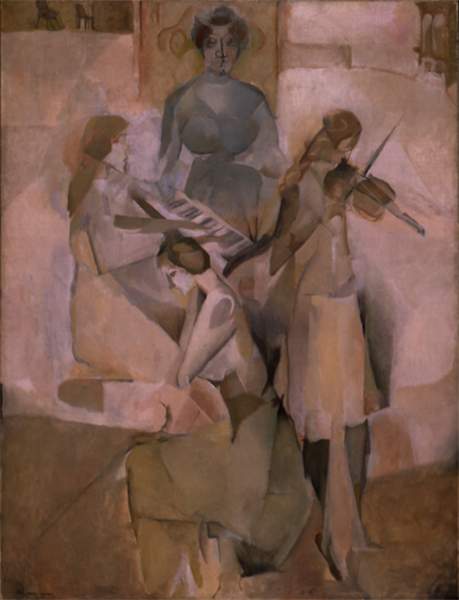
In the quiet evolution of modernism, few moments capture the tension between tradition and revolution as poignantly as Marcel Duchamp’s 1911 watercolor, Sonata. At first glance, the viewer is invited into an intimate domestic scene—a musical gathering where four women are immersed in the rhythmic beauty of performance. Yet, as the eye lingers, the familiar boundaries of reality begin to dissolve. This is not merely a depiction of a concert; it is a profound exploration of proto-Cubist thought, where the artist begins to dismantle the physical world to reveal its underlying geometric soul. The composition breathes with a sense of spatial dynamism, as if the very air in the room is vibrating in harmony with the instruments being played.
Duchamp’s technique in Sonata serves as a bridge between the soft, atmospheric legacies of Impressionism and the sharp, intellectual rigor of Cubism. Using the delicate medium of watercolor, he employs a palette of muted, earthy tones—predominantly browns and whites—interspersed with strategic, luminous yellow accents that guide the viewer through the fractured landscape. The artist utilizes orthogonal lines and intersecting planes to break the figures into geometric segments, creating a visual puzzle that challenges the eye to reconstruct the scene. This deliberate fragmentation allows for a simultaneous viewpoint, where the depth of the room and the solidity of the chairs are reimagined through a lens of abstraction, offering a sense of movement that feels both structured and ethereal.
The Architecture of Sound and Spirit
Beyond its technical brilliance, Sonata carries a deep symbolic weight, representing the transition from "retinal art"—art intended only for the eye—to a more conceptual mode of expression. The musical theme is not incidental; it serves as a metaphor for the mathematical and rhythmic precision found within the Cubist movement. Just as a sonata is composed of structured movements that coalesce into a unified whole, Duchamp arranges his subjects—the violinist, the pianist, and their companions—into a carefully orchestrated arrangement of shapes and shadows. The presence of the two chairs, positioned to anchor the composition, provides a structural counterpoint to the fluid, breaking forms of the musicians, grounding the experimental abstraction in a recognizable human experience.
For the discerning collector or interior designer, this piece offers an unparalleled opportunity to introduce a sense of intellectual depth and historical significance into a space. Sonata is more than a decorative element; it is a conversation starter that evokes the avant-garde spirit of early 20th-century Paris. Its sophisticated use of neutral tones and geometric rhythm makes it a versatile masterpiece, capable of complementing both minimalist contemporary settings and richly textured classical interiors. To possess a reproduction of this work is to hold a fragment of the moment when art decided to break free from the mirror of reality and begin dreaming in geometry.
Taiteilijan elämäkerta
Marcel Duchamp: A Revolutionary Spirit
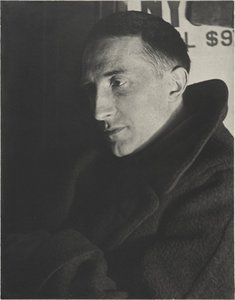
Marcel Duchamp, born Henri-Robert-Marcel Duchamp in 1887 in Blainville-Crevon, Normandy, was more than an artist; he was a philosophical provocateur who fundamentally altered the course of modern art. His early life, though seemingly conventional – nurtured within a family that appreciated artistic expression with both brothers pursuing successful careers as artists – hinted at the iconoclasm to come. Duchamp initially pursued formal training, mastering traditional techniques and experimenting with post-impressionist styles. However, this academic foundation served not as an end in itself, but as a springboard for questioning the very nature of art, its purpose, and its definition. He wasn’t content merely to depict the world; he sought to challenge how we perceive it, and what constitutes artistic value. This restless intellectual curiosity would become the defining characteristic of his prolific career.Early Artistic Explorations: Cubism and Impressionism
Duchamp's initial foray into art began with a fascination for Impressionism, absorbing influences from artists like Monet and Sisley. He diligently honed his painting skills, capturing fleeting moments of light and color with meticulous detail – a technique that would later inform his approach to more conceptual endeavors. Yet, he quickly recognized the limitations of representational art, perceiving it as an attempt to impose order onto a chaotic reality. This realization propelled him toward Cubism, spearheaded by Picasso and Braque, where he embraced fragmented forms and multiple perspectives. *Portrait of Chess Players* (1911) exemplifies this stylistic shift, demonstrating Duchamp’s willingness to experiment with innovative visual strategies. The influence of Cézanne's geometric simplification further solidified his commitment to exploring new artistic possibilities.The Dadaist Rebellion: Challenging Artistic Conventions
The horrors of World War I profoundly impacted Duchamp’s worldview, fueling a deep disillusionment with societal values and artistic traditions. He abandoned academic pursuits altogether, joining the ranks of Dadaists – artists who vehemently rejected logic, reason, and bourgeois morality. This movement sought to dismantle established norms and expose the absurdity of cultural pretensions. Within Dadaism, Duchamp unleashed his subversive genius, rejecting beauty as an aesthetic criterion and prioritizing conceptual provocation. His aim wasn’t to create aesthetically pleasing objects; it was to disrupt viewers' perceptions and incite critical reflection. The infamous *Fountain* (1917), a porcelain urinal signed “R. Mutt,” epitomized this radical stance—a deliberate affront to artistic conventions that sparked considerable controversy and cemented Duchamp’s place in art history.The Birth of Conceptual Art: Beyond Representation
Duchamp's groundbreaking contribution to the art world was arguably his pioneering role in establishing Conceptual Art. He dismantled the traditional distinction between artwork and object, arguing that the artist’s idea—the concept behind the work—was paramount. This perspective fundamentally shifted artistic priorities away from visual appearance toward intellectual inquiry and philosophical exploration. Works like *The Large Glass* (1915–1923), a monumental assemblage incorporating glass panels, mirrors, and enamel paint, exemplify this preoccupation with complex symbolism and intricate craftsmanship. The meticulous construction of the Glass underscored Duchamp’s belief in the transformative power of artistic process—a deliberate rejection of spontaneous creativity in favor of carefully considered conceptual frameworks.Legacy and Enduring Influence
Marcel Duchamp's impact on subsequent generations of artists is undeniable. He irrevocably altered our understanding of art, advocating for a shift from visual representation to intellectual contemplation. His unwavering conviction that art should reside in the mind—not merely in the eye—continues to inspire artists today.- Cubism: Early exploration of fractured forms and spatial representation.
- Dadaism: Rejection of logic, reason, and traditional artistic values in response to World War I.
- Conceptual Art: Emphasis on the idea behind the artwork rather than its aesthetic qualities.
Marcel Duchamp
1887 - 1968 , Ranska
Pikatiedot
- Artistic Movement Or Style:
- Kubismi
- Dadaismi
- Artists Or Movements Influenced By This Artist: ['Kubismi']
- Date Of Birth: 28 heinäkuuta 1887
- Date Of Death: 2 oktoberia 1968
- Full Name: Marcel Duchamp
- Nationality: Ranskalainen-Amerikkalainen
- Notable Artworks:
- Fontana
- L.H.O.O.Q.
- Suuri lasi
- Place Of Birth: Blainville, Ranska
Liittyvät artikkelit

10 Vesivärimaalausta, Jotka Muuttivat Taiteen – Inspiroi Sisustuksesi OriginalUniqueArtilla
Tutustu 10 legendaariseen vesivärimaalaukseen, jotka muuttivat taiteen historiaa! Inspiroiva tarina Turnerista Monetiin. Löydä upeita akvarelleja ja sisustusideoita OriginalUniqueArtilla. Tutki kokoelma verkossa!

Ephemeral Visions: Exploring the Artistic Legacy & Contemporary Practice of Watercolor Painting
Explore the captivating world of watercolor painting! Discover its rich history, essential techniques, influential artists & collecting tips. A comprehensive guide for art enthusiasts from OriginalUniqueArt.

Ephemeral Visions: Exploring the History & Emotional Resonance of Watercolor Painting
Explore the captivating history of watercolor painting, from ancient techniques to modern masters like Kandinsky & Blake. Discover essential artists, collecting tips & the emotional power of this luminous medium. Expert insights for art enthusiasts.

Ephemeral Visions: Exploring the Artistic Legacy & Nuances of Watercolor Painting
Explore the captivating world of watercolor painting! Discover its rich history, essential techniques, influential artists & collecting tips from art experts. A comprehensive guide for enthusiasts.
Harmonies on Canvas: Exploring the Visual Representation of Music in Art History
Explore the fascinating history of music's visual representation in art! From ancient symbolism to modern abstraction, discover how artists have captured sound and emotion on canvas. Expert insights & stunning examples.