
 Esikatselu
 Jaa
Jaa Jaa
Jaa
 Tarkemmat tiedot

 Lataa
Lataa
 Samanlaisia
 Röntgenkuva
 Diaesitys
 Stats
StatsRotary demisphere


 Näytä lisää
Käsinmaalattu öljykopio
Käsinmaalattu öljyväri kankaalle haluamassasi koossa ja kehyksissä, taiteilijoidemme valmistamana tilauksesta. ( Switch to Print Switch to Digital Image)




P118B $10

P118H $10

P118W $10

P438Z $10

P508JH $12

P508YH $12

P805H $10

P805Z $10

P919BZ $10

P919G $10

P919XJ $10

P959ZH $10

P968JZ $12

W106C $8

W218G $10

W218JH $8

W218Y $10

W307PJ $10

W316G $10

W316PJ $8

W316Y $10

W398PJ $8

W4111J $10

W500HY $15

W500JH $15

W692G $12

W849H $8

W940BG $15

W953PJ $8




Valitse valmiista mitoistamme sellaiset, jotka vastaavat teoksen alkuperäisiä mittasuhteita.

Voit syöttää omat mitat sopimaan tiettyyn kehykseen tai tilaan. Jos valitsemasi koko ei vastaa alkuperäisen kuvan mittasuhteita, rajaamme taideteoksen tai jatkamme maalausta käsin maalatuilla elementeillä. Digitaalinen esikatselu lähetetään hyväksyttäväksi ennen tuotannon aloittamista.
Huomioithan, että näytöllä oleva esikatselu ei vastaa todellista rajausta tai jatkamista. Vain digitaalinen mallikuva näyttää lopullisen sommittelun tarkasti.
Vaikka mittatilaustyöt ovat mahdollisia, suosittelemme valitsemaan mitan ennalta määritetystä listasta alkuperäisten mittasuhteiden säilyttämiseksi.
Tilauksen jälkeen OriginalUniqueArt.com -tiimi lähettää asiakkaalle ohjeet ja esikatselukuvan.
Maailmanlaajuinen toimitus () 3–4 viikossa tavallisen 5 viikon sijaan. (8 syyskuu). Laadusta ei tingitä.

Ilmainen pikatoimitus ympäri maailman

Korkealaatuinen pellavakangas

Kattava kuljetusvakuutus

Tulliveron palautustakuu

Täydellinen värien vastaavuustakuu

100 päivän palautusoikeus (vain valmistusvirheet)

100% rahat takaisin -takuu

Määräalennus tarjous
 Lasivaihtoehto on saatavilla vain alle 110 cm kokoisina teoksina

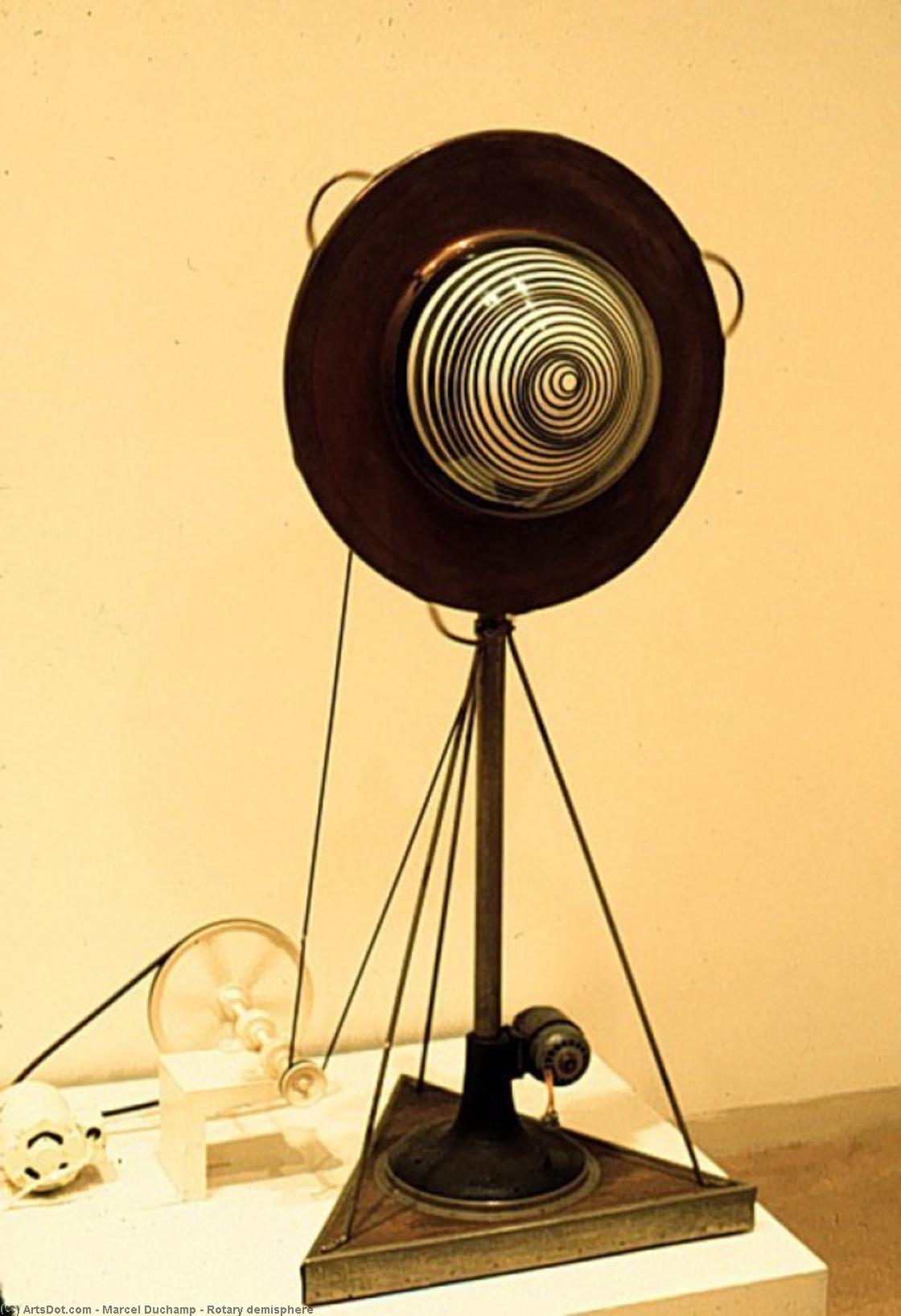
Rotary demisphere
Reproduktiotekniikka
Replikaatin koko
-


Kokonaishinta
$ 300
The Enigmatic Geometry of Rotary Demisphere
Marcel Duchamp’s Rotary Demisphere, created in 1925, isn't merely a painting; it’s an invitation to dismantle the very foundations of visual perception. This remarkable work, rendered in papier-mâché and meticulously assembled, transcends the boundaries of traditional art by challenging our ingrained assumptions about representation and spatial relationships. The piece immediately commands attention with its arresting circular form – a large, metallic demisphere reminiscent of an antique fan or perhaps a forgotten light fixture. However, it’s not the object itself that holds the primary intrigue, but rather the dynamic illusion it generates when rotated.
The photograph captures a moment frozen in time, revealing a complex interplay of elements. A clock, subtly positioned near the top left corner, and another clock towards the bottom right, serve as anchors within this shifting landscape, grounding the viewer while simultaneously emphasizing the work’s temporal dimension. Two small figures, their identities deliberately ambiguous, are nestled amongst the machinery – they could be observers, participants in a silent performance, or perhaps simply symbolic representations of the human experience caught within the mechanics of perception. Duchamp masterfully employs a copper collar and plexiglass dome to contain and amplify this visual effect, creating a contained spectacle that draws the eye into its mesmerizing spiral.
Dadaism’s Challenge to Artistic Conventions
Rotary Demisphere is deeply rooted in the spirit of Dadaism, the anti-art movement that emerged during World War I. Duchamp, along with fellow Dadaists, sought to reject established artistic norms and challenge the very definition of art itself. Rather than aiming for aesthetic beauty or skillful execution, they prioritized conceptual ideas and explored the role of chance, absurdity, and critique. This piece embodies this ethos perfectly – it’s not about creating a visually pleasing image but about provoking thought and disrupting conventional ways of seeing. Duchamp's intention wasn’t to depict reality faithfully; instead, he aimed to expose the mechanisms by which our brains construct meaning from sensory input.
The work’s creation coincided with Duchamp’s exploration of optical devices and his fascination with creating illusions. He was deeply interested in how vision operates – not as a passive reception of external stimuli but as an active, interpretive process. As documented in archival audio (available via the MoMA link), Duchamp described the experience of viewing the rotating demisphere: “Vision is produced internally, and what Duchamp is doing with the *Rotary Demisphere* is creating a kind of vision that doesn’t have anything to do with what’s out there in the world.” This statement encapsulates the core of his artistic strategy – to shift the focus from representation to perception itself.
A Testament to Precision and Conceptual Innovation
Despite its seemingly simple form, Rotary Demisphere represents a remarkable feat of engineering and craftsmanship. The intricate arrangement of gears, pulleys, and motors within the copper collar demonstrates Duchamp’s meticulous attention to detail and his willingness to embrace technological innovation as a means of artistic expression. The use of papier-mâché, combined with the polished metal components, creates a fascinating juxtaposition of materials – suggesting a dialogue between industrial precision and handmade artistry.
Furthermore, the inclusion of the engraved French phrase—"Rrose Sélavy et moi esquivons les ecchymoses des esquimaux aux mots exquis"—adds another layer of complexity to the work. This playful pun, referencing Duchamp’s pseudonym Rrose Sélavy and his exploration of language as a tool for subversion, underscores the artist's intellectual rigor and his commitment to challenging established conventions. Rotary Demisphere remains a pivotal work in the history of modern art, a testament to Duchamp’s revolutionary spirit and his enduring influence on generations of artists.
Taiteilijan elämäkerta
Marcel Duchamp: A Revolutionary Spirit
Marcel Duchamp, born Henri-Robert-Marcel Duchamp in 1887 in Blainville-Crevon, Normandy, was more than an artist; he was a philosophical provocateur who fundamentally altered the course of modern art. His early life, though seemingly conventional – nurtured within a family that appreciated artistic expression with both brothers pursuing successful careers as artists – hinted at the iconoclasm to come. Duchamp initially pursued formal training, mastering traditional techniques and experimenting with post-impressionist styles. However, this academic foundation served not as an end in itself, but as a springboard for questioning the very nature of art, its purpose, and its definition. He wasn’t content merely to depict the world; he sought to challenge how we perceive it, and what constitutes artistic value. This restless intellectual curiosity would become the defining characteristic of his prolific career.Early Artistic Explorations: Cubism and Impressionism
Duchamp's initial foray into art began with a fascination for Impressionism, absorbing influences from artists like Monet and Sisley. He diligently honed his painting skills, capturing fleeting moments of light and color with meticulous detail – a technique that would later inform his approach to more conceptual endeavors. Yet, he quickly recognized the limitations of representational art, perceiving it as an attempt to impose order onto a chaotic reality. This realization propelled him toward Cubism, spearheaded by Picasso and Braque, where he embraced fragmented forms and multiple perspectives. *Portrait of Chess Players* (1911) exemplifies this stylistic shift, demonstrating Duchamp’s willingness to experiment with innovative visual strategies. The influence of Cézanne's geometric simplification further solidified his commitment to exploring new artistic possibilities.The Dadaist Rebellion: Challenging Artistic Conventions
The horrors of World War I profoundly impacted Duchamp’s worldview, fueling a deep disillusionment with societal values and artistic traditions. He abandoned academic pursuits altogether, joining the ranks of Dadaists – artists who vehemently rejected logic, reason, and bourgeois morality. This movement sought to dismantle established norms and expose the absurdity of cultural pretensions. Within Dadaism, Duchamp unleashed his subversive genius, rejecting beauty as an aesthetic criterion and prioritizing conceptual provocation. His aim wasn’t to create aesthetically pleasing objects; it was to disrupt viewers' perceptions and incite critical reflection. The infamous *Fountain* (1917), a porcelain urinal signed “R. Mutt,” epitomized this radical stance—a deliberate affront to artistic conventions that sparked considerable controversy and cemented Duchamp’s place in art history.The Birth of Conceptual Art: Beyond Representation
Duchamp's groundbreaking contribution to the art world was arguably his pioneering role in establishing Conceptual Art. He dismantled the traditional distinction between artwork and object, arguing that the artist’s idea—the concept behind the work—was paramount. This perspective fundamentally shifted artistic priorities away from visual appearance toward intellectual inquiry and philosophical exploration. Works like *The Large Glass* (1915–1923), a monumental assemblage incorporating glass panels, mirrors, and enamel paint, exemplify this preoccupation with complex symbolism and intricate craftsmanship. The meticulous construction of the Glass underscored Duchamp’s belief in the transformative power of artistic process—a deliberate rejection of spontaneous creativity in favor of carefully considered conceptual frameworks.Legacy and Enduring Influence
Marcel Duchamp's impact on subsequent generations of artists is undeniable. He irrevocably altered our understanding of art, advocating for a shift from visual representation to intellectual contemplation. His unwavering conviction that art should reside in the mind—not merely in the eye—continues to inspire artists today.- Cubism: Early exploration of fractured forms and spatial representation.
- Dadaism: Rejection of logic, reason, and traditional artistic values in response to World War I.
- Conceptual Art: Emphasis on the idea behind the artwork rather than its aesthetic qualities.
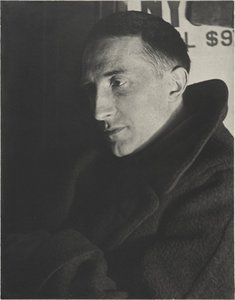
Marcel Duchamp
1887 - 1968 , Ranska
Pikatiedot
- Artistic Movement Or Style:
- Kubismi
- Dadaismi
- Artists Or Movements Influenced By This Artist: ['Kubismi']
- Date Of Birth: 28 heinäkuuta 1887
- Date Of Death: 2 oktoberia 1968
- Full Name: Marcel Duchamp
- Nationality: Ranskalainen-Amerikkalainen
- Notable Artworks:
- Fontana
- L.H.O.O.Q.
- Suuri lasi
- Place Of Birth: Blainville, Ranska
Liittyvät artikkelit

10 legendaarista pronssiveistosta, jotka mullistivat taiteen – OriginalUniqueArt.com
Tutustu 10 legendaariseen pronssiveistokseen, jotka ovat muokanneet taiteen historiaa! Michelangelo, Rodin ja muut mestarit. Löydä inspiraatiota sisustukseesi ja tutki upeita taideteoksia OriginalUniqueArt.com-sivustolta.
Alexander Calder: Kinetic Sculpture, Mobile Art & the Poetics of Chance
Explore the revolutionary world of Alexander Calder's kinetic sculptures & mobiles. Discover insights for collectors, acquisition advice, and the enduring legacy of this modern master. Expert analysis & art valuation.

The Enduring Form: Sculpture Across History, Technique & Emotional Resonance
Explore the rich history of sculpture with OriginalUniqueArt. Discover key techniques, influential artists & investment potential for discerning collectors. Expert insights into valuing and collecting timeless masterpieces.

10 legendaarista pronssiveistosta, jotka mullistivat taiteen – OriginalUniqueArt.com
Tutustu 10 legendaariseen pronssiveistokseen, jotka ovat muuttaneet taiteen historiaa! Rodinista Michelangeloon – opi mestareiden tarinat ja löydä täydellinen taideteos kotiisi OriginalUniqueArt.com:ssa. Laadukkaat jäljennökset & sisustusideat.

The Enduring Form: Exploring Themes & Techniques in Sculpture Across Historical Periods
Explore the rich history of sculpture from ancient masterpieces to contemporary innovations. Discover key techniques, influential artists & investment potential for discerning art collectors.


