

 Katso seinällä
 Lähetä
 Jaa
Jaa
 Tarkemmat tiedot
 Opas
Opas

 Lataa kuva
 Samanlaisia kohteita
 Röntgenkuvaus
 Diaesitys
 Tilastot
Beethoven


 Lue lisää
Giclée- ja taideprintit
Museolaatuisia giclée- tai kankaitaulun tulosteita nopealla tuotannolla ja joustavilla viimeistelyvaihtoehdoilla. ( Tilaa käsinmaalattu jäljennös Siirry digitaaliseen kuvaan)




P118B €10

P118H €10

P118W €10

P438Z €10

P508JH €12

P508YH €12

P805H €10

P805Z €10

P919BZ €10

P919G €10

P919XJ €10

P959ZH €10

P968JZ €12

W106C €8

W218G €10

W218JH €8

W218Y €10

W307PJ €10

W316G €10

W316PJ €8

W316Y €10

W398PJ €8

W4111J €10

W500HY €15

W500JH €15

W692G €12

W849H €8

W940BG €15

W953PJ €8




Valitse valmiista mitoistamme sellaiset, jotka vastaavat teoksen alkuperäisiä mittasuhteita.

Kirjoita tarvitsemasi leveys ja korkeus, jotta tuloste sopii kehyskokoon tai seinällesi. Tulostetta voidaan vain leikata, sitä ei voi koskaan tehdä suuremmaksi kuin alkuperäinen kuva, joten eri muotoinen koko aiheuttaa osan kuvasta katoamisen. Lähetämme sinulle digitaalisen mallikuvan hyväksyttäväksi ennen kuin aloitamme tulostuksen. Tällä sivulla näkyvä kuva ei näytä lopullista leikkausta — vain mallikuva näyttää sen.
Maailmanlaajuinen toimitus () 2 viikossa tavallisen 4–5 viikon sijaan. (25 lokakuu)

Ilmainen pikatoimitus ympäri maailman

Korkealaatuinen pellavakangas

Kattava kuljetusvakuutus

Tulliveron palautustakuu

Takuu täydellisestä värien vastaavuudesta

100 päivän palautusoikeus valmistusvirhetapauksissa

100% rahat takaisin -takuu

Määräalennus saatavilla
 Lasivaihtoehto on saatavilla vain alle 110 cm kokoisille teoksille

Beethoven
Giclée- ja taideprintit
Replikaatin koko
-


Kokonaishinta
€ 70
Johann Nepomuk Maelzelin Beethoven – Een Symfonie van Materiaal en Licht
Johann Nepomuk Maelzel, een naam die misschien minder bekende is dan sommige van zijn tijdgenoten, staat als een belangrijke pionier in de ontwikkeling van Nederlandse landschapskunst en zeevaartschilderkunst tijdens de 18e eeuw. Geboren rond 1772 in Londen, begon hij een kunstzinnige reis die uiteindelijk leidde tot het vestigen van zichzelf als een gerespecteerde kunstenaar werkend voornamelijk in Nederland. Zijn carrière werd gekenmerkt door een fascinerende evolutie van maritieme scènes – het vastleggen van het drama van zeegevechten – naar een meer contemplatieve betrokkenheid bij de natuurlijke wereld, wat een verschuiving binnen Nederlandse kunst weerspiegelde richting grotere realisme en atmosferische diepte. Zijn stijl werd sterk beïnvloed door het werk van Willem van de Velde de Oude, een kunstenaar die ook voor zijn aandacht voor detail staat en een gevoel voor licht en kleur bezit.- Het Onderwerp: Het schilderij vertegenwoordigt een prachtige reproductie van een oude horenstrument – een bijzonder stuk kunst uit het jaar 1813. Een eerbetoon aan de muziek van Ludwig Beethoven, wiens stijl Maelzel probeerde te imiteren.
- De Stijl: De stijl is karakteristiek voor de Nederlandse natuurlijke kunst van zijn tijd, waarbij een hoog niveau van detail en aandacht voor licht wordt nagestreefd. Het schilderij draagt het stempel van een periode waarin kunstenaars streven naar een authentieke weergave van de natuur en haar schoonheid.
- De Techniek: Maelzel gebruikte een combinatie van olie op doek, waardoor hij een rijke textuur en kleurintensiteit kon bereiken die essentieel zijn voor het vastleggen van de nuances van licht en schaduw. Zijn aandacht voor precisie is zichtbaar in elke penseelstreep, wat bijdraagt aan de kwaliteit van het kunstwerk.
- Historische Context: Het werk werd gemaakt tijdens een tijd waarin wetenschappelijke observaties en natuurlijke wetenschap een belangrijke rol speelden in de kunstwereld. De kunstenaar wilde een beeld geven van de natuur zoals hij deze zag, zonder enige vorm van romantische idealisering.
Kysymykset ja vastaukset
Mistä voin löytää tilastoja teoksesta Johann Nepomuk Maelzel:n "Beethoven"?
Johann Nepomuk Maelzel:n "Beethoven" -teoksen Tilastot esittää julkiset käyntitilastot: teoksen kuukausittaiset vierailut, vertailun taiteilijan katsotuimpiin teoksiin sekä tiedot siitä, mistä vierailijat ovat kotoisin.
Miten taidesuuntaus ja aikakausi kohtaavat teoksessa Johann Nepomuk Maelzel:n "Beethoven"?
Teoksessa Johann Nepomuk Maelzel:n "Beethoven" Dutch Landscape Realism-suuntaus ja 19th Century-aikakausi kohtaavat.
Onko Johann Nepomuk Maelzel:n "Beethoven" maalaus, piirros vai grafiikan lehti?
Luettelossa teos Johann Nepomuk Maelzel:n "Beethoven" on luokiteltu tyypiksi Seinätaide. Kategoria auttaa löytämään samankaltaisia teoksia.
Taiteilijan elämäkerta
Samuel Scott: A Pioneer of Dutch Landscape and Maritime Art
Samuel Scott, a name perhaps less familiar than some of his contemporaries, stands as a pivotal figure in the development of Dutch landscape and marine painting during the 18th century. Born around 1702 in London, he embarked on an artistic journey that ultimately led him to establish himself as a respected artist working primarily in the Netherlands. Scott’s career was marked by a fascinating evolution from maritime scenes – capturing the drama of naval engagements – to a more contemplative engagement with the natural world, reflecting a shift within Dutch art towards greater realism and atmospheric depth. Scott's early training remains somewhat shrouded in mystery; records indicate he began his artistic pursuits around 1720 without documented formal instruction. This self-taught approach fostered an independent spirit and allowed him to develop a distinctive style heavily influenced by the works of Willem van de Velde the Younger, a master of naval painting known for his dynamic compositions and meticulous detail. Scott’s initial focus was on depicting ships at sea – men-of-war engaged in battle, merchant vessels navigating treacherous waters – all rendered with a remarkable sense of movement and realism. These early works demonstrate a keen eye for observation and a skillful command of brushwork, capturing the textures of water, sailcloth, and timber with impressive accuracy. Notably, he collaborated with George Lambert on a series of paintings illustrating scenes from the East India Company’s voyages, showcasing his ability to combine technical skill with narrative storytelling.The Transition to Landscape and the Influence of London
Around the early 1740s, a significant shift occurred in Scott's artistic practice. He began dedicating himself to landscape painting, driven by observations of the burgeoning cityscape of London. The construction of landmarks like Westminster Bridge provided him with an endless source of inspiration, and he meticulously documented these changes through a series of paintings that offer invaluable insights into the visual culture of the era. These works are characterized by their atmospheric quality – Scott skillfully employed light and shadow to create a sense of depth and perspective, capturing the mood and character of the city. His depictions of London Bridge, particularly those painted in the late 1740s and early 1750s, stand as remarkable achievements, accurately portraying the bridge’s structure and the surrounding environment before its eventual demolition. The influence of Canaletto, a Venetian painter renowned for his urban views, is evident in Scott's approach to landscape painting. Like Canaletto, Scott sought to capture not just the physical appearance of a scene but also its overall atmosphere and character. Furthermore, Scott’s artistic journey was intertwined with social circles; he posed for Thomas Hudson, a prominent portrait painter, around 1732, solidifying his position within London's artistic community.A Journey to the River Medway and Early Collaborations
In 1732, Scott embarked on a significant excursion – a “Five Days’ Peregrination” along the River Medway and the Isle of Sheppey in company with William Hogarth and other notable figures. This journey provided him with an unparalleled opportunity to study coastal landscapes, shipbuilding techniques, and maritime activities firsthand. The resulting account, published in 1782, documented this experience and included drawings by Hogarth and Scott themselves. This collaborative effort not only showcased Scott’s artistic talent but also highlighted his ability to work effectively within a group setting. His meticulous observations during the trip are reflected in subsequent landscape paintings that demonstrate an increased understanding of natural forms and atmospheric effects.Later Years and Legacy
Scott continued to paint throughout his life, producing a substantial body of work encompassing both maritime scenes and landscapes. He exhibited works at the Society of Artists of Great Britain until 1761, demonstrating his ongoing commitment to artistic practice. His later years saw him embracing Romanticism, incorporating more dramatic storytelling and evoking emotional responses in his viewers. Despite facing periods of relative obscurity, Samuel Scott’s contributions to Dutch art are now recognized as significant. He played a crucial role in bridging the gap between earlier maritime painting traditions and the rise of landscape painting, establishing a foundation for future generations of artists. His meticulous observation, skillful technique, and atmospheric rendering continue to resonate with viewers today, offering a captivating glimpse into 18th-century Dutch society and its relationship with the natural world. Scott’s legacy lies not only in his individual works but also in his pioneering role as a landscape painter who brought a new level of realism and emotional depth to the genre.
Johann Nepomuk Maelzel
1772 - 1838 , Germany
Tietoa taiteilijasta
- Full Name: Jan Maurits Quinkhard
- Nationality: Dutch
- Date Of Birth: 1772
- Date Of Death: 1838
- Place Of Birth: Reims, Germany
- Notable Artworks:
- Familiar scenes
- Allegorical works
- Mythological paintings
- Artistic Movement Or Style: Portraiture, History, Mythology
- Artists Who Influenced This Artist:
- Julius Quinkhardt the elder
- Arnold van Boonen
- Artists Or Movements Influenced By This Artist: ['Amsterdam Museum']
Aiheeseen liittyvät artikkelit

Romanttisen maisemamaalauksen mestariteokset: Taidetta ja inspiraatiota kotiin
Uppoudu romanttisen maisemamaalauksen maailmaan! Tutustu Caspar David Friedrichin, Turnerin ja muiden mestareiden ikonisiin teoksiin. Löydä inspiraatiota kotiisi taiteen avulla OriginalUniqueArt.comista – laadukkaat taideprintit ja sisustusideoita.

Jan van Goyen: Master of Dutch Landscape & Atmospheric Perspective
Discover Jan van Goyen, the master of Dutch landscape painting. Explore his subtle technique, atmospheric realism & lasting influence on art history. Learn about this 17th-century pioneer at OriginalUniqueArt.

Golden Light & Dutch Skies: The Timeless Magic of Dutch Golden Age Landscapes
Discover the breathtaking beauty of Dutch Golden Age landscapes. Explore the mastery of light, chiaroscuro, and 17th-century realism through an expert art history lens, celebrating the enduring legacy of the Dutch Masters for discerning collectors and art lovers.
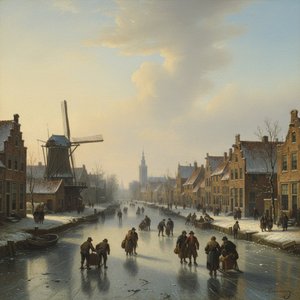
Charles Leickert: Capturing the Dutch Golden Age Light – A Comprehensive Study of Technique, Context, and Legacy
Explore the captivating winter landscapes of Charles Leickert, a master of Dutch Golden Age light & atmosphere. Discover his techniques, symbolism, and lasting legacy – a comprehensive study for art enthusiasts and collectors.

Golden Light & Dutch Skies: Bringing the Magic of Dutch Golden Age Landscapes into Your Home
Transform your home with the breathtaking light of Dutch Golden Age landscapes. Discover how hand-painted oil reproductions of masterworks like Ruisdael and Vermeer bring timeless elegance, atmosphere, and soulful texture to modern interiors. Elevate your space with museum-quality art.
