

 Lähetä
 Jaa
Jaa
 Tarkemmat tiedot
 Opas
Opas

 Lataa kuva
 Samanlaisia kohteita
 Diaesitys
 Tilastot
Robert Fulton


 Lue lisää
Giclée- ja taideprintit
Museolaatuisia giclée- tai kankaitaulun tulosteita nopealla tuotannolla ja joustavilla viimeistelyvaihtoehdoilla. ( Tilaa käsinmaalattu jäljennös Siirry digitaaliseen kuvaan)




































Valitse valmiista mitoistamme sellaiset, jotka vastaavat teoksen alkuperäisiä mittasuhteita.

Kirjoita tarvitsemasi leveys ja korkeus, jotta tuloste sopii kehyskokoon tai seinällesi. Tulostetta voidaan vain leikata, sitä ei voi koskaan tehdä suuremmaksi kuin alkuperäinen kuva, joten eri muotoinen koko aiheuttaa osan kuvasta katoamisen. Lähetämme sinulle digitaalisen mallikuvan hyväksyttäväksi ennen kuin aloitamme tulostuksen. Tällä sivulla näkyvä kuva ei näytä lopullista leikkausta — vain mallikuva näyttää sen.
Maailmanlaajuinen toimitus () 2 viikossa tavallisen 4–5 viikon sijaan. (25 lokakuu)

Ilmainen pikatoimitus ympäri maailman

Korkealaatuinen pellavakangas

Kattava kuljetusvakuutus

Tulliveron palautustakuu

Takuu täydellisestä värien vastaavuudesta

100 päivän palautusoikeus valmistusvirhetapauksissa

100% rahat takaisin -takuu

Määräalennus saatavilla
 Lasivaihtoehto on saatavilla vain alle 110 cm kokoisille teoksille

Robert Fulton
Giclée- ja taideprintit
Replikaatin koko
-


Kokonaishinta
€ 70
The Essence of Innovation Captured in Marble
In the quiet dignity of Jean-Antoine Houdon’s 1803 bust of Robert Fulton, we encounter more than just a likeness of a man; we witness the very pulse of the Enlightenment. To gaze upon this sculpture is to step into an era where human reason and scientific inquiry began to reshape the physical world. Fulton, the visionary engineer whose mastery of steam power would forever alter the course of global commerce and travel, is rendered here not as a mere inventor, but as a symbol of intellectual triumph. Houdon, a master of the Neoclassical style, avoids the superficial flourishes of the preceding Rococo period, opting instead for a profound clarity that mirrors the precision of Fulton’s own mechanical genius. The sculpture serves as a bridge between the theoretical brilliance of the age and its tangible, transformative progress.
The artistry lies in Houdon's unparalleled ability to breathe life into stone. Through a meticulous application of technique, the sculptor captures the subtle nuances of a mind at work. One can almost sense the weight of thought behind the furrowed brow and the piercing, contemplative gaze that seems to look beyond the immediate surroundings toward a future of steam and steel. By employing contrapposto, Houdon introduces a delicate sense of movement into the static medium, creating a dynamic tension that prevents the bust from feeling like a mere monument. Every detail—from the intricate texture of the short, curly hair to the crisp, formal lines of the high-collared shirt and cravat—is executed with a precision that demands the viewer's full attention, inviting an intimate connection with the subject.
A Neoclassical Masterpiece for the Discerning Collector
For the art enthusiast or the interior designer seeking to infuse a space with historical gravity and intellectual depth, this reproduction offers an unparalleled opportunity. The sculpture embodies the Neoclassical ideal of restrained beauty and emotional resonance. It does not shout for attention through excessive ornamentation; rather, it commands the room through its serene presence and the sheer quality of its modeling. The play of light across the smooth, polished surfaces evokes a sense of timelessness, making it an exquisite centerpiece for a library, a study, or a sophisticated gallery setting. It is a piece that speaks to the values of stability, wisdom, and the enduring legacy of human achievement.
Integrating such a profound work into a contemporary or classical interior allows for a dialogue between the past and the present. The dark, contrasting pedestal and the dramatic focus on the subject's facial features provide a striking visual anchor that can complement both minimalist modern aesthetics and richly layered traditional decors. Owning a high-quality reproduction of Houdon’s work is not merely about acquiring an object of beauty; it is about hosting a piece of history—a tribute to the era of reason and the indomitable spirit of innovation that continues to inspire our modern world.
Kysymykset ja vastaukset
Kuinka voimakkaita ovat teoksen "Robert Fulton" värit?
Teoksessa Jean-Antoine Houdon:n "Robert Fulton" on Muted kylläisyys ja Monochromatic voimakkuus.
Kuka on luonut teoksen "Robert Fulton" ja minä vuonna?
Teoksen "Robert Fulton" tekijä on Jean-Antoine Houdon, ja se on vuodelta 1803.
Mikä on teoksen Jean-Antoine Houdon:n "Robert Fulton" yleinen tunnelma?
Teoksen Jean-Antoine Houdon:n "Robert Fulton" yleinen tunnelma on Elegant. Tunnelma kuvaa teoksen yleistä ilmapiiriä.
Taiteilijan elämäkerta
A Sculptor of the Enlightenment
Jean-Antoine Houdon, born in Versailles in 1741, stands as a pivotal figure bridging the Rococo and Neoclassical eras—a sculptor whose work embodies the intellectual fervor and evolving aesthetic sensibilities of the eighteenth century. His life unfolded amidst dramatic shifts in French society, from the waning opulence of the monarchy through the revolutionary upheaval and Napoleonic ascendance. Yet, Houdon remained remarkably consistent in his artistic vision: to capture not merely a likeness, but the very essence of his subjects—their intellect, character, and inner lives—in enduring marble and bronze. This dedication stemmed from an early aptitude for sculpture, nurtured by formal training at the Académie Royale de Peinture et de Sculpture beginning in 1752 under esteemed sculptors like René-Michel Slodtz, Jean-Baptiste Lemoyne, and Jean-Baptiste Pigalle. His subsequent enrollment at the École Royale des Élèves Protégés from 1761 to 1764 solidified his foundation, culminating in a triumphant win of the Prix de Rome competition in 1761—an award that granted him invaluable study time with classical art firsthand in Italy, an experience profoundly shaping his aesthetic sensibilities.The Art of Verisimilitude and Psychological Insight
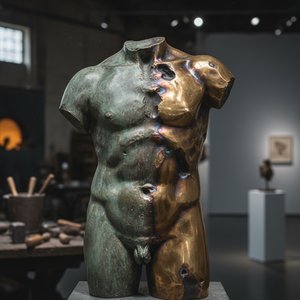
Houdon’s sculptures are immediately recognizable for their breathtaking realism and meticulous attention to detail. He wasn't content with simply replicating physical features; he sought to penetrate the surface, revealing the personality and intellect within. This commitment to verisimilitude arose from a deep fascination with anatomy—evident in his celebrated *Muscleman Sideview* bronze sculpture—and an unwavering dedication to observation. Unlike many contemporaries who idealized their subjects, Houdon embraced imperfections, believing they contributed to a more truthful and compelling portrayal. He employed innovative techniques, including taking casts directly from life, allowing him to capture minute details with unparalleled accuracy. This approach was particularly evident in his portrait busts, which became his signature achievement. These weren’t merely static representations; they were dynamic studies of character, imbued with psychological depth and emotional resonance. Houdon's ability to convey not just *how* someone looked, but *who* they were, set him apart. He achieved this through subtle nuances in expression, posture, and the rendering of details like the eyes—often carved with a slight concavity to capture the play of light and suggest inner thought. This meticulous attention to detail wasn’t merely stylistic; it reflected Houdon's belief that sculpture could illuminate the human condition, capturing not just appearance but also spirit and intellect.Immortalizing an Era: A Pantheon of Enlightenment Figures
The breadth of Houdon’s clientele reads as a veritable who’s who of the Enlightenment. He immortalized some of the most influential thinkers, writers, politicians, and leaders of his time. His terracotta portrait of Denis Diderot captures the philosopher’s intellectual intensity and unconventional spirit with remarkable sensitivity. Benjamin Franklin, portrayed during his diplomatic mission to France, appears as a man of wisdom and pragmatism, his gaze both shrewd and benevolent. Jean-Jacques Rousseau, sculpted with characteristic empathy, embodies both the passion and melancholy that defined his philosophy. Perhaps most famously, Houdon sculpted Voltaire—creating multiple versions of the celebrated writer, including a dynamic seated figure for the Comédie-Française that captures his wit and intellectual energy. Beyond these intellectual giants, Houdon also received commissions from royalty, notably Louis XVI, and rising political figures like Napoleon Bonaparte. However, it was his sculpture of George Washington, commissioned by the Virginia General Assembly, that secured his place in American iconography. This life-size marble statue—based on meticulous measurements and a life mask taken during Washington’s presidency—became the definitive image of the nation's first president, serving as the model for countless engravings and reproductions, even appearing on U.S. postage stamps for decades. He also sculpted Thomas Jefferson, furthering cementing his legacy across the Atlantic.Technique and Innovation: Mastering Marble and Bronze
Houdon’s sculptural method was revolutionary for its time. Rejecting traditional idealized representations, he prioritized anatomical accuracy and psychological insight above all else. His groundbreaking technique involved taking casts directly from life—a practice unheard of in France at the time—allowing him to capture the subtle nuances of human musculature and expression with astonishing precision. This meticulous process demanded an exhaustive understanding of anatomy and a profound sensitivity to observation. Houdon’s mastery extended beyond mere replication; he skillfully manipulated marble and bronze to convey emotion and character. He experimented with innovative polishing techniques, achieving surfaces that shimmered with luminosity and captured the texture of skin and fabric. Furthermore, Houdon's use of *L'Écorché*, a technique where the torso was sculpted in a partially dissected pose—revealing underlying musculature—was considered daring and groundbreaking for its time. This bold approach demonstrated Houdon’s unwavering commitment to pushing artistic boundaries and elevating sculpture to new heights of realism and expressive power.Legacy and Enduring Influence
Jean-Antoine Houdon’s impact on the world of sculpture is undeniable. He elevated portraiture to an art form capable of profound psychological insight and historical documentation. His dedication to realism, combined with his ability to capture the essence of his subjects, set a new standard for sculptural representation. Throughout his life, he received widespread recognition, being named a Chevalier de la Légion d'Honneur in 1804 and a Chevalier de l’Empire in 1809—testaments to his esteemed status within French society. Even in his later years, Houdon continued to create significant works, demonstrating an unwavering commitment to his craft until his death in Paris on July 15, 1828. His sculptures remain highly valued today, not only for their artistic merit but also for the invaluable glimpses they provide into the lives and times of the Enlightenment era. Houdon’s work serves as a powerful reminder of the enduring power of art to capture the human spirit and preserve it for generations to come. His influence can be seen in the works of countless artists who followed, solidifying his position as a master sculptor whose legacy continues to inspire awe and admiration.
Jean-Antoine Houdon
1741 - 1828 , Ranska
Tietoa taiteilijasta
- Artistic Movement Or Style: Neoklassismi
- Artists Who Influenced This Artist:
- René-Michel Slodtz
- Jean-Baptiste Lemoyne
- Jean-Baptiste Pigalle
- Date Of Birth: 1741
- Date Of Death: 1828
- Full Name: Jean-Antoine Houdon
- Nationality: Ranska
- Notable Artworks:
- George Washington
- Voltaire
- Benjamin Franklin
- Place Of Birth: Versailles, France
Aiheeseen liittyvät artikkelit

The Enduring Form: Sculpture Across History, Technique & Emotional Resonance
Explore the rich history of sculpture with OriginalUniqueArt. Discover key techniques, influential artists & investment potential for discerning collectors. Expert insights into valuing and collecting timeless masterpieces.

10 legendaarista pronssiveistosta, jotka mullistivat taiteen – OriginalUniqueArt.com
Tutustu 10 legendaariseen pronssiveistokseen, jotka ovat muokanneet taiteen historiaa! Michelangelo, Rodin ja muut mestarit. Löydä inspiraatiota sisustukseesi ja tutki upeita taideteoksia OriginalUniqueArt.com-sivustolta.

10 legendaarista pronssiveistosta, jotka mullistivat taiteen – OriginalUniqueArt.com
Tutustu 10 legendaariseen pronssiveistokseen, jotka ovat muuttaneet taiteen historiaa! Rodinista Michelangeloon – opi mestareiden tarinat ja löydä täydellinen taideteos kotiisi OriginalUniqueArt.com:ssa. Laadukkaat jäljennökset & sisustusideat.
Pronssiveistosten kestävä perintö: Historiaa, tekniikoita ja nykyaikaisia tulkintoja
Tutustu pronssiveistosten kiehtovaan maailmaan! Opi historiasta, tekniikoista ja konservoinnista. Vinkkejä taidekeräilijöille ja tietoa nykytaiteen pronssitrendeistä.

The Enduring Form: Exploring Themes & Techniques in Sculpture Across Historical Periods
Explore the rich history of sculpture from ancient masterpieces to contemporary innovations. Discover key techniques, influential artists & investment potential for discerning art collectors.


