() ·

A painting made for you, by hand

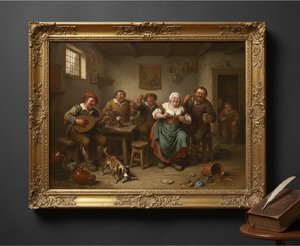
Bacchanal with Silenus

Käsinmaalattu öljyvärinen jäljennös

Käsinmaalattu öljyväri kankaalle haluamassasi koossa ja kehyksissä, taiteilijoidemme valmistamana tilauksesta. ( Vaihda tulosteeseen Siirry digitaaliseen kuvaan)

Keräilykohteen kuvaus

Jan Gerritsz van Bronchorst’s Bacchanal with Silenus captures a lavish 17th-century Dutch family reveling in a Bacchus celebration, showcasing Mannerist style and opulent detail. Explore this dynamic scene and bring home a unique piece of art history.

Taiteilijan elämäkerta

Jan Gerritsz van Bronckhorst (1603-1661) was a Dutch Golden Age painter of the Utrecht Caravaggisti movement. Known for lively 'merry company' scenes, allegorical works & stained glass designs blending Baroque drama with sensuality. Explore his paint

from ·

Chapter 1

How large should it be?

Slide to change the size; the picture on the left shows the frame at its real width. The proportions of the original are kept.

Vakiokoko
räätälöity
CM
INCH

Valitse valmiista mitoistamme sellaiset, jotka vastaavat teoksen alkuperäisiä mittasuhteita.

leveys
korkeus

Kirjoita tarvitsemasi leveys ja korkeus, jotta teos sopii kehyksiisi tai seinällesi. Koska kyseessä on käsinmaalattu teos, taiteilija voi maalata hieman enemmän kuvan ympärille tai rajata sitä hieman, jos haluat eri muotoisen koon — valinta on sinun. Lähetämme sinulle digitaalisen mallikuvan hyväksyttäväksi ennen kuin maalaus alkaa. Tällä sivulla näkyvä kuva ei vastaa lopullista tulosta — vain mallikuva näyttää sen.

Chapter 2

How should it arrive?

Choose the edges of the stretched canvas

Choose your frame

Corner sample of the WhiteWrap canvas edge finish, stretched on massiivipuu bars
White €1
Corner sample of the BlurSideWrap canvas edge finish, stretched on massiivipuu bars
Blurside €1
Corner sample of the ExtendedWrap canvas edge finish, stretched on massiivipuu bars
Extended €1
Corner sample of the P118B picture frame: valettu polystyreeni, 5 cm wide and 3 cm thick
P118B €10
Corner sample of the P118H picture frame: valettu polystyreeni, 5 cm wide and 3 cm thick
P118H €10
Corner sample of the P118W picture frame: valettu polystyreeni, 5 cm wide and 3 cm thick
P118W €10
Corner sample of the P438Z picture frame: valettu polystyreeni, 5.5 cm wide and 3.5 cm thick
P438Z €10
Corner sample of the P508JH picture frame: valettu polystyreeni, 7 cm wide and 3.5 cm thick
P508JH €12
Corner sample of the P508YH picture frame: valettu polystyreeni, 7 cm wide and 3.5 cm thick
P508YH €12
Corner sample of the P805H picture frame: valettu polystyreeni, 5 cm wide and 3.5 cm thick
P805H €10
Corner sample of the P805Z picture frame: valettu polystyreeni, 5 cm wide and 3.5 cm thick
P805Z €10
Corner sample of the P919BZ picture frame: valettu polystyreeni, 7 cm wide and 3.5 cm thick
P919BZ €10
Corner sample of the P919G picture frame: valettu polystyreeni, 7 cm wide and 3.5 cm thick
P919G €10
Corner sample of the P919XJ picture frame: valettu polystyreeni, 7 cm wide and 3.5 cm thick
P919XJ €10
Corner sample of the P959ZH picture frame: valettu polystyreeni, 5 cm wide and 3 cm thick
P959ZH €10
Corner sample of the P968JZ picture frame: valettu polystyreeni, 6 cm wide and 4 cm thick
P968JZ €12
Corner sample of the W106C picture frame: massiivipuu, 5 cm wide and 3 cm thick
W106C €8
Corner sample of the W218G picture frame: massiivipuu, 5 cm wide and 3 cm thick
W218G €10
Corner sample of the W218JH picture frame: massiivipuu, 5 cm wide and 3 cm thick
W218JH €8
Corner sample of the W218Y picture frame: massiivipuu, 5 cm wide and 3 cm thick
W218Y €10
Corner sample of the W307PJ picture frame: massiivipuu, 6 cm wide and 3 cm thick
W307PJ €10
Corner sample of the W316G picture frame: massiivipuu, 6 cm wide and 3 cm thick
W316G €10
Corner sample of the W316PJ picture frame: massiivipuu, 6 cm wide and 3 cm thick
W316PJ €8
Corner sample of the W316Y picture frame: massiivipuu, 6 cm wide and 3 cm thick
W316Y €10
Corner sample of the W398PJ picture frame: massiivipuu, 5 cm wide and 3 cm thick
W398PJ €8
Corner sample of the W4111J picture frame: massiivipuu, 6.5 cm wide and 3.5 cm thick
W4111J €10
Corner sample of the W500HY picture frame: massiivipuu, 7 cm wide and 5 cm thick
W500HY €15
Corner sample of the W500JH picture frame: massiivipuu, 7 cm wide and 5 cm thick
W500JH €15
Corner sample of the W692G picture frame: massiivipuu, 8 cm wide and 4 cm thick
W692G €12
Corner sample of the W849H picture frame: massiivipuu, 5 cm wide and 3 cm thick
W849H €8
Corner sample of the W940BG picture frame: massiivipuu, 7.5 cm wide and 4.5 cm thick
W940BG €15
Corner sample of the W953PJ picture frame: massiivipuu, 6 cm wide and 3.5 cm thick
W953PJ €8
Corner sample of the H24-GOLD picture frame: kaiverrettua puuta ja gessoa, 10 cm wide and 6 cm thick
H24-GOLD €30
Corner sample of the H24-SILVER picture frame: kaiverrettua puuta ja gessoa, 10 cm wide and 6 cm thick
H24-SILVER €30
Corner sample of the H36-GOLD picture frame: kaiverrettua puuta ja gessoa, 15 cm wide and 6.5 cm thick
H36-GOLD €45
Corner sample of the H36-SILVER picture frame: kaiverrettua puuta ja gessoa, 15 cm wide and 6.5 cm thick
H36-SILVER €45
Kehyksen esikatselu
Kehystetty

Moulding: . Overall size with the frame: .

Chapter 3

Who paints it, and should anything change?

Examples of what can be changed: Replace face with customer photo; Add pet (e.g., replace cat with dog); Include hidden message in background; Change background landscape or elements.
After order, OriginalUniqueArt.com team will email client for instructions and provide a mockup preview

Maailmanlaajuinen toimitus () 3–4 viikossa tavallisen 5 viikon sijaan. (1 marraskuu). Laadusta ei tingitä.

Chapter 4

The finishing touches

A nameplate, as in a museum?

Kaiverretun pronssilaatan tiedot

This elegant plaque features the artist's name and the title of the artwork, finely engraved for a timeless presentation.

It is made from bronze with a refined, elegant finish. The text is precisely laser-engraved for a sharp and permanent result. Measuring 9x2 cm, the plaque is compact yet easy to read. It's built to be durable and scratch-resistant, offering a professional, museum-quality look. Mounting is simple thanks to the included adhesive backing.

Läpinäkyvän akryylilaatan tiedot

The plaque includes essential engraved details such as the artist's name, the title of the artwork, the date it was created, the type of media used-like oil on canvas or watercolor-a brief description of the piece, and a QR code that links to the complete artwork information.

It is crafted from clear acrylic, offering a sleek, modern appearance. The text is UV-engraved in black to ensure strong visual contrast. With a size of 10x15 cm, it ensures optimal readability. It comes equipped with two metal hooks for secure wall mounting. The plaque is designed to be weather-resistant, making it suitable for various environments, and it includes interactive features that work seamlessly with smartphone scanning.

Mustan akryylilaatan tiedot

This elegant plaque includes engraved information such as the artist's name, the title of the artwork, the date it was created, the type of media used (like oil on canvas or watercolor), a short description of the artwork, and a QR code for quick access to more information.

The plaque itself is made from refined black acrylic with a premium finish. The text is laser-engraved in white for high contrast and readability. Its size is 10x15 cm, designed to be easy to read. It comes with two metal hooks for professional mounting. The design is sleek and fits any interior style. It is also weather-resistant and durable, with built-in digital integration for mobile compatibility.

A protective varnish?

When do you need it?

Chapter 5

Your painting, as you ordered it

Bacchanal with Silenus

Reproduktiotekniikka

Replikaatin koko

-

Kokenut huipputaiteilija

Lisää yksityiskohtia, hienostuneisuutta ja enemmän aikaa tuotantoon

-

Reproduktion kehystysvaihtoehdot

-

-

Teoksille tai reproduktioille, joiden mikä tahansa sivu on suurempi kuin 105 cm (noin 41 tuumaa), kehys toimitetaan osina purettuna sarjana. Tämä menetelmä varmistaa turvallisen toimituksen ja ehkäisee vaurioita kuljetuksen aikana.

Vaatii ammattimaista kokoamista – kyseessä ei ole tee-se-itse-tuote.
Sarja on koottava ja kangas kiristettävä kokeneen kehystysammattilaisen toimesta käyttäen puuliimaa (ei sisälly pakkaukseen), kangaspinnetteitä ja puristimia, jotta kehyksen kulmat pysyvät suorina liiman kuivuessa. Virheellinen kokoaminen tai epätasainen kankaan kiristys voi vaurioittaa teosta pysyvästi, eikä tällaiset vauriot ala takuun piiriin.

  • Kaikki massiivipuupalat sisältyvät, tarkasti mittojen mukaan leikattuina.

  • Kootaan mukana tulevilla ruuveilla sekä kulmaliitoksia varten tarvittavalla puuliimalla, jota ei toimiteta, joten se on hankittava kehystäjältä.

  • Vaatii ammattilaisvälineitä, jotka eivät sisälly pakkaukseen: kankaan venytyspihdit (kiristin) ja puristimet, joilla pidetään kehyksen puut suorassa liiman kuivuessa.

Tärkeää:
Kulmaliitoksissa tarvitaan puuliimaa, kehyksien osat on pidettävä puristimilla, kunnes liima on täysin kuivunut, ja koottuun kehykseen jännitettävän kankaan kiristämiseen tarvitaan kangaspenssipihti. Mikään näistä ei sisälly pakkaukseen. Suosittelemme varmistamaan kokeneen kehystäjän saatavuuden ennen tämän kokoisen kehyksen tilaamista.

Nimilaatta

-

-

Suojalakkaus

Kiiltävä lakka (syventää värejä, suojaa valolta ja kosteudelta)

-

Mukauta taideteokseni

Esimerkkejä muokattavista asioista: Vaihda kasvot asiakkaan omaan valokuvaan; Lisää lemmikki (esim. vaihda kissa koiraan); Lisää taustalle piilotettu viesti; Muuta taustan maisemaa tai elementtejä.

-

Pikatoimitus

Maailmanlaajuinen toimitus () 3–4 viikossa tavallisen 5 viikon sijaan. (1 marraskuu). Laadusta ei tingitä.

-

Pikatoimitus

Maailmanlaajuinen toimitus () 5 viikon kuluessa. (8 marraskuu).

Sisältyy hintaan

Kokonaishinta

€ 267

Kokonaishinta € 267

Lasivaihtoehto on saatavilla vain alle 110 cm kokoisille teoksille

Included with every order

  • Ilmainen pikatoimitus ympäri maailman
  • Korkealaatuinen pellavakangas
  • Kattava kuljetusvakuutus
  • Tulliveron palautustakuu
  • Takuu täydellisestä värien vastaavuudesta
  • 100 päivän palautusoikeus (vain valmistusvirheet)
  • 100% rahat takaisin -takuu
  • Määräalennus tarjolla

A Dutch Bacchanal: Jan Gerritsz van Bronchorst’s *Bacchanal with Silenus*

Jan Gerritsz van Bronchorst's 1600 painting, *Bacchanal with Silenus*, is a captivating window into the opulent tastes and burgeoning artistic spirit of 17th-century Netherlands. This large-scale oil on canvas depicts a lavish scene – a family transformed into figures from the mythology of Bacchus, the god of wine – offering a potent blend of religious allegory, social commentary, and masterful technical execution. The painting’s immediate impact lies in its vibrant energy and the sheer indulgence of its subject matter; it's a celebration of wealth, pleasure, and the intoxicating power of the senses.

The composition is dominated by a group of twelve figures gathered around the patriarch, likely a successful wine merchant, who embodies Silenus, Bacchus’s perpetually drunken companion. His posture – leaning heavily on his supporter, raising a cup for more wine – immediately establishes the painting's central theme: unrestrained indulgence and the pursuit of sensory delight. The women surrounding him are equally striking, rendered with a sensual realism that reflects the artistic trends of the period while simultaneously hinting at the potential anxieties surrounding female sexuality within a conservative society.

Style and Technique: Bridging Mannerism and Baroque

Bronchorst’s style exemplifies a fascinating transitional moment in art history. Born in Utrecht in 1603, he emerged during a time of intense stylistic debate between the lingering influence of Mannerism and the ascendant naturalism of the Baroque. *Bacchanal with Silenus* showcases elements of both. The figures possess a certain elongated grace characteristic of Mannerist painting – particularly evident in the poses and drapery – yet Bronchorst skillfully employs light and shadow to create a palpable sense of volume and movement, anticipating the dramatic effects favored by Baroque artists.

The artist’s technique is characterized by meticulous detail and a rich palette. The use of impasto—thickly applied paint—adds texture and depth to the scene, particularly noticeable in the tambourine held by one of the women, suggesting a lively musical accompaniment to the revelry. Bronchorst's masterful handling of color – deep reds, golds, and blues – contributes significantly to the painting’s overall dramatic impact. The canvas itself, measuring 164 x 221 cm, allows for a grand scale that further enhances the immersive quality of the scene.

Symbolism and Context: Wealth, Status, and Religious Allegory

The choice of depicting a mythological scene within a domestic setting was not uncommon in Dutch portraiture during this era. It served as a means of demonstrating wealth, status, and familial piety – often subtly interwoven with religious symbolism. The inclusion of Silenus, a figure associated with intoxication and excess, could be interpreted as a veiled critique of societal vices or perhaps a celebration of the joys of earthly life.

  • Bacchus: Represents abundance, fertility, and the intoxicating pleasures of wine.
  • Silenus: Symbolizes folly, drunkenness, and the companion to Bacchus.
  • Togas & Costumes: Denote status and adherence to classical ideals.

Furthermore, the painting reflects the broader cultural context of the Dutch Republic – a burgeoning commercial power with a thriving wine trade and a growing appreciation for artistic patronage. Bronchorst’s work stands as a testament to this dynamic period, blending religious allegory with secular indulgence within a meticulously crafted visual narrative.

Emotional Impact and Reproduction

*Bacchanal with Silenus* evokes a powerful sense of immediacy and excitement. The painting's vibrant colors, dynamic composition, and the figures’ expressions of unrestrained joy create an immersive experience for the viewer. OriginalUniqueArt offers meticulously crafted hand-painted reproductions of this remarkable artwork, allowing you to bring its captivating energy into your home or office.

Our high-quality reproductions utilize archival materials and skilled artisans to faithfully recreate Bronchorst’s original masterpiece, ensuring that you receive a timeless work of art that will be treasured for generations to come. The 164 x 221 cm size ensures a substantial presence within any interior space, making it a truly impactful addition to your collection.

Kysymykset ja vastaukset

Onko teos Jan Gerritsz Van Bronchorst:n "Bacchanal with Silenus" koettu valoisaksi vai tummaksi?

Kokonaisuudessaan teoksen "Bacchanal with Silenus" kirkkaus on kirjattu arvoon deep_shadow. Koettu kirkkaus kuvaa sitä, kuinka vaaleana tai tummana teos vaikuttaa.

Mikä on teoksen Jan Gerritsz Van Bronchorst:n "Bacchanal with Silenus" luminanssi?

Teoksen Jan Gerritsz Van Bronchorst:n "Bacchanal with Silenus" luminanssi on Dark.

Kuka on luonut teoksen "Bacchanal with Silenus" ja minä vuonna?

Teoksen "Bacchanal with Silenus" tekijä on Jan Gerritsz Van Bronchorst ja se on vuodelta 1600.

More about this painting

Esikatselu Esikatsele AR-tilassa Vaihda tulosteeseen Siirry digitaaliseen kuvaan Jaa teos
Tiedot Opas Lisää suosikkeihin Lataa kuva Samanlaisia kohteita Röntgenkuvaus Diaesitys Q&A Tilastot

In numbers

  • 1600the year it was painted
  • 29frames to choose from
  • standard sizes, in its own proportions
  • 5weeks to paint and deliver it
Jan Gerritsz Van Bronchorst

Jan Gerritsz Van Bronchorst

1603 - 1661, Netherlands

Quick facts about Jan Gerritsz Van Bronchorst

  • Full Name: Aert van der Neer
  • Nationality: Dutch
  • Date Of Birth: 1603
  • Date Of Death: 1661
  • Place Of Birth: Utrecht, Netherlands
  • Notable Artworks:
    • Moonlit Landscape
    • Winter in Holland
  • Artistic Movement Or Style: Landscape painting
  • Artists Who Influenced This Artist: ['Rafel and Jochem Camphuysen']
  • Artists Or Movements Influenced By This Artist:
    • Terborch
    • Metsu

Taiteilijan elämäkerta

Santi di Tito: A Counterpoint to Mannerism

Santi di Tito (1603 – 1661) emerged from the vibrant, tumultuous artistic landscape of late Renaissance and early Baroque Rome, a period defined by intense stylistic debate. His life and career represent a fascinating case study in navigating evolving artistic conventions, ultimately forging a distinctive style that stands as a crucial bridge between Mannerism and the burgeoning naturalism of the Baroque. Born in Sansepolcro, a small town in Umbria, Santi’s early training remains somewhat shrouded in mystery, with accounts suggesting influences from figures like Bronzino and Baccio Bandinelli, though definitive proof is elusive. This lack of clear lineage contributed to his unique artistic trajectory – one that deliberately distanced itself from the established norms of the time.

Early Career and Roman Apprenticeship

Santi’s journey to Rome in 1558 marked a pivotal moment, placing him within the heart of the city's artistic ferment. He spent nearly a decade working alongside Giovanni de’ Vecchi and Niccolò Circignani on monumental frescoes within the Palazzo Salviati and the Sala Grande of the Belvedere at the Vatican – projects that showcased the grandeur and complexity of Mannerist painting. These early commissions exposed Santi to the prevailing stylistic trends, characterized by elongated figures, complex spatial arrangements, and a deliberate emphasis on elegance and refinement. However, rather than simply absorbing these influences, Santi began to subtly reshape them, introducing a greater sense of naturalism and a more restrained palette. The frescoes in the Belvedere, particularly *Homage of the People*, reveal his growing interest in classical forms and a desire for clarity and balance – qualities that would become hallmarks of his later work.

The Studiolo of Francesco I: A Defining Period

Santi’s most significant contribution to the Roman art scene occurred during his tenure at the Palazzo Vecchio, where he was commissioned to decorate the *Studiolo* (a private study) of Francesco I de' Medici, Grand Duke of Tuscany. This project proved transformative, solidifying Santi’s distinctive style and establishing him as a leading figure in the Counter-Mannerist movement. The two paintings created for this space – *Sisters of Phaeton* and *Hercules and Iole* – exemplify his innovative approach. Unlike the crowded, theatrical compositions typical of Mannerism, Santi's works are characterized by a remarkable clarity of form, a carefully considered use of light and shadow, and a focus on idealized beauty. He deliberately avoided the excessive ornamentation and artificiality that had become associated with Mannerist painting, opting instead for a more restrained and harmonious aesthetic. This shift was consciously intended as a reaction against the prevailing *maniera* of artists like Bronzino and Federico Zuccari, whom he viewed as overly elaborate and lacking in genuine naturalism.

A Reformist Style: Embracing Classical Ideals

Santi’s artistic philosophy can be understood within the broader context of the Counter-Reformation. The Catholic Church was actively seeking to reform its image and promote a more accessible form of religious art, one that emphasized clarity, piety, and emotional engagement. Santi's work reflects this desire for renewal, moving away from the complex intellectualism of Mannerism towards a more direct and emotionally resonant style. He drew inspiration from classical antiquity, particularly the works of Raphael, seeking to emulate his sense of grace, harmony, and balance. This commitment to classical ideals is evident in his careful attention to proportion, his use of idealized figures, and his avoidance of excessive detail. As S. J. Freedberg noted, Santi’s style was “Raphaelesque,” a deliberate attempt to recapture the perceived purity and elegance of Raphael's art.

Later Works and Legacy

Following his return to Florence in 1564, Santi continued to produce significant works throughout his career, including altarpieces for Santa Croce and frescoes for Volterra Cathedral. His *Resurrection of Lazarus* and *Supper at Emmaus*, particularly the latter, demonstrate his ability to convey profound emotion through subtle gestures and carefully rendered details. Despite his artistic achievements, Santi faced considerable financial difficulties, ultimately declaring bankruptcy in 1662. He died in poverty in 1661, largely unrecognized during his lifetime. However, his work gradually gained recognition in the 19th century, and today he is considered one of the most important figures in the Counter-Mannerist movement – a pivotal artist who helped to shape the course of European painting. His legacy lies not only in his individual masterpieces but also in his courageous challenge to established artistic conventions and his unwavering commitment to classical ideals.

Pikaista tietoa

  • Artist: Jan Gerritsz van Bronchorst
  • Year: 1600
  • Artistic style: Mannerism
  • Subject or theme: Bacchanalia
  • Medium: Oil on canvas