

 Esikatselu
 Jaa
Jaa Jaa
Jaa
 Tarkemmat tiedot

 Lataa
Lataa
 Samanlaisia
 Röntgenkuva
 Diaesitys
Landscape with a Ruined Tower
 Oil On Canvas
- WallArt
- Romantic Pastoral
 100.0 x 125.0 cm
 National Trust
 Näytä lisää
Käsinmaalattu öljykopio
Käsinmaalattu öljyväri kankaalle haluamassasi koossa ja kehyksissä, taiteilijoidemme valmistamana tilauksesta. ( Osta printti Osta kuva)




P118B $10

P118H $10

P118W $10

P438Z $10

P508JH $12

P508YH $12

P805H $10

P805Z $10

P919BZ $10

P919G $10

P919XJ $10

P959ZH $10

P968JZ $12

W106C $8

W218G $10

W218JH $8

W218Y $10

W307PJ $10

W316G $10

W316PJ $8

W316Y $10

W398PJ $8

W4111J $10

W500HY $15

W500JH $15

W692G $12

W849H $8

W940BG $15

W953PJ $8




Valitse valmiista mitoistamme sellaiset, jotka vastaavat teoksen alkuperäisiä mittasuhteita.

Voit syöttää omat mitat sopimaan tiettyyn kehykseen tai tilaan. Jos valitsemasi koko ei vastaa alkuperäisen kuvan mittasuhteita, rajaamme taideteoksen tai jatkamme maalausta käsin maalatuilla elementeillä. Digitaalinen esikatselu lähetetään hyväksyttäväksi ennen tuotannon aloittamista.
Huomioithan, että näytöllä oleva esikatselu ei vastaa todellista rajausta tai jatkamista. Vain digitaalinen mallikuva näyttää lopullisen sommittelun tarkasti.
Vaikka mittatilaustyöt ovat mahdollisia, suosittelemme valitsemaan mitan ennalta määritetystä listasta alkuperäisten mittasuhteiden säilyttämiseksi.
Tilauksen jälkeen OriginalUniqueArt.com -tiimi lähettää asiakkaalle ohjeet ja esikatselukuvan.
Maailmanlaajuinen toimitus () 3–4 viikossa tavallisen 5 viikon sijaan. (21 elokuu). Laadusta ei tingitä.

Ilmainen pikatoimitus ympäri maailman

Korkealaatuinen pellavakangas

Kattava kuljetusvakuutus

Tulliveron palautustakuu

Täydellinen värien vastaavuustakuu

60 päivän palautusoikeus (vain valmistusvirheet)

100% rahat takaisin -takuu

Määräalennus tarjous
 Lasivaihtoehto on saatavilla vain alle 110 cm kokoisina teoksina

Landscape with a Ruined Tower
Reproduktiotekniikka
Replikaatin koko
-


Kokonaishinta
$ 300
Teoksen kuvaus
George Barret the Elder’s “Landscape with a Ruined Tower”: A Vision of English Pastoral
“Landscape with a Ruined Tower,” painted circa 1762-1784 by George Barret the Elder, is more than just a depiction of a rural scene; it's a carefully constructed meditation on time, memory, and the fading grandeur of the English countryside. Barret, an Irish artist who established himself as a leading figure in London’s art world, masterfully captures a moment suspended between decay and enduring beauty, reflecting the philosophical currents of his era – particularly the influence of Edmund Burke's exploration of the sublime.
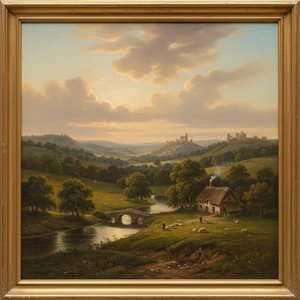
The painting immediately draws the eye to the imposing ruin itself: a weathered tower rising from a gently sloping hillside, partially obscured by a dense copse of trees. Its stones, rendered in muted ochres and browns, speak of centuries spent exposed to the elements, hinting at forgotten histories and lost power. The tower isn’t merely a structural element; it's a potent symbol – a visual representation of decline, yet simultaneously imbued with an undeniable sense of solemn dignity. This deliberate juxtaposition is central to Barret’s artistic vision.
A Painterly Echo of Burke’s Sublime
Barret’s approach to landscape painting was profoundly shaped by Edmund Burke's philosophical treatise, *A Philosophical Enquiry into the Origin of Our Ideas of the Sublime and Beautiful*. Burke argued that experiences of awe and terror – what he termed the “sublime” – could be found not just in dramatic events but also in the contemplation of vastness, decay, and solitude. Barret translates this philosophical concept onto canvas with remarkable skill.
Notice how the artist employs atmospheric perspective—the subtle blurring of distant elements to create a sense of depth and recession. The hazy blue sky, punctuated by wisps of cloud, contributes to the painting’s overall mood of melancholy and contemplation. The careful use of light and shadow further emphasizes the tower's weathered state, highlighting its vulnerability against the backdrop of the seemingly eternal landscape. This isn’t a vibrant celebration of nature; it’s an exploration of its quieter, more profound aspects.
Details of Technique and Composition
Barret was initially influenced by engravings of classical Italianate scenes, reworking them with his own distinctive style. The composition is carefully balanced, drawing the eye towards the tower while simultaneously establishing a sense of spaciousness. The placement of the trees, the gentle curve of the hillside, and the distant body of water all contribute to this harmonious arrangement.
The artist’s brushwork is remarkably controlled, particularly in rendering the textures of stone and foliage. He employs a delicate layering technique—thin glazes of paint applied over dry underlayers—to achieve a luminous quality that captures the subtle nuances of light and shadow. The details are meticulously observed, from the individual stones of the tower to the leaves rustling in the breeze. This attention to detail elevates the painting beyond mere representation, transforming it into a carefully considered work of art.
Symbolism and Emotional Resonance
Beyond its technical merits, “Landscape with a Ruined Tower” resonates deeply on an emotional level. The ruined tower evokes a sense of loss—the passing of time, the decline of empires, and the inevitable decay of all things. Yet, it also possesses a certain beauty in its weathered state, suggesting that even in ruin, there is still value to be found.
The painting invites us to contemplate our own mortality and the fleeting nature of existence. It’s a poignant reminder that beauty can be discovered not only in moments of triumph but also in the quiet contemplation of decay. It's a timeless image, speaking to universal themes of memory, loss, and the enduring power of the natural world – making it a compelling subject for collectors and interior designers seeking pieces with depth and emotional resonance.
Taiteilijan elämäkerta
George Barret Sr.: Life & Legacy
George Barret Sr., born around 1730 in Libertyville, Ireland – the son of a cloth merchant – stands as a pivotal figure in the history of British landscape painting and the establishment of the Royal Academy. His artistic journey began humbly, apprenticed initially as a staymaker before discovering an innate talent for drawing that would propel him to international acclaim. This early aptitude secured him a place at Robert West’s Academy in Dublin around 1747, where he honed his skills under royal patronage and fostered a lifelong friendship with Edmund Burke – a relationship that profoundly shaped his artistic vision and intellectual pursuits.Early Artistic Development & Influences
Barret's formative years were marked by exposure to the burgeoning philosophical currents of the Enlightenment, notably Edmund Burke’s *A Philosophical Enquiry into the Origin of Our Ideas of the Sublime and Beautiful*. Burke’s exploration of awe and terror deeply impacted Barret’s artistic sensibilities, informing his approach to landscape painting. He initially mastered the art of reworking engravings of classical Italianate scenes by artists like Claude Lorrain – demonstrating a meticulous understanding of established stylistic conventions. Despite depicting idealized Italian landscapes, there's scant evidence that Barret ever undertook personal expeditions to Italy itself; instead, he channeled his fascination with beauty into capturing the grandeur and tranquility of England and Ireland.Move to London and Rise to Prominence
Seeking greater artistic opportunities, Barret relocated to London in 1762 – a decisive step that cemented his position as one of the era’s foremost landscape artists. Within months, he gained recognition from influential art collectors and exhibited prominently at the Society of Artists of Great Britain, attracting considerable attention. However, Barret's ambition extended beyond mere commercial success; he actively participated in shaping British artistic culture. In 1768, he spearheaded a breakaway movement from the Society of Artists, alongside fellow luminaries like Benjamin West and Sir Joshua Reynolds – establishing the Royal Academy, which would become a cornerstone of British art history and championing a new generation of painters.Artistic Style and Themes
Barret’s artistic style underwent a significant transformation over time, progressing from stylized Italianate landscapes to more nuanced depictions of English and Irish scenery. He undertook extensive travels throughout Britain, Wales, Scotland, and Ireland – undertaking commissions and meticulously documenting the diverse beauty of these regions. Recurring themes in his oeuvre included idyllic vistas showcasing serene lakes and rolling hills; picturesque countryside scenes imbued with atmospheric haze; and detailed topographical representations capturing the grandeur of stately estates and gardens. Often incorporating figures within the landscape—particularly portraits of noble families—Barret’s paintings conveyed not only visual splendor but also a sense of narrative and social commentary. His masterful technique combined meticulous observation with expressive brushwork, resulting in images that resonate with both beauty and psychological depth.Later Life & Patronage
Despite achieving considerable financial success during his lifetime, Barret faced personal hardships – notably asthma which prompted him to relocate to Westbourne Green in 1772 for improved health conditions. Fortunately, he benefited from the unwavering support of Edmund Burke, who championed his artistic career and provided crucial assistance both professionally and financially. In 1782, Burke’s influential endorsement secured Barret a prestigious position as Master Painter of Chelsea Hospital – a role he held until his death in 1784. His legacy endures through the enduring beauty of his paintings—works that continue to inspire admiration and contribute significantly to our understanding of eighteenth-century British art and culture, now housed in collections such as the National Gallery of Ireland and Yale Center for British Art.
George Barret Sr.
1732 - 1784 , Irlanti
Pikatiedot
- Artistic Movement Or Style: Romanticism
- Artists Or Movements Influenced By This Artist: Claude Lorrain
- Artists Who Influenced This Artist: Edmund Burke
- Date Of Birth: 1732
- Full Name: George Barret Sr.
- Nationality: Irish
- Notable Artworks:
- The Powerscourt Waterfall
- A Prospect of Southwick Park
- Llyn Nantlle
- Place Of Birth: Libertyville, Ireland
Liittyvät artikkelit

Georges Braquen 25 mestariteosta: Taidetta kotiin OriginalUniqueArtilta
Tutustu Georges Braquen 25 mestariteokseen ja kubismin lumoihin! Taidehistoriaa, värejä ja inspiraatiota kotiisi. Laadukkaat taulut OriginalUniqueArtilta – löydä täydellinen seinätaulu nyt!
George Barret the Elder: Pioneering British Pastoral Painting & Landscape's Rise
Explore the life & art of George Barret Sr., a pioneer of British pastoral painting. Discover his influence on Romantic landscape art, patronage, and collecting tips from OriginalUniqueArt.

Georges Seurat: 25 mestariteosta – Valon ja värin lumoa taidossa | OriginalUniqueArt
Tutustu Georges Seuratin 25 mestariteokseen! Uppoudu pointillismia, valomaalausta ja väriteoriaa hyödyntävään taidemaailmaan. Löydä A Sunday on La Grande Jatte ja muut ikonit OriginalUniqueArt.comista – korkealaatuiset taidekopiot kotiisi.

Idyllic Visions: Exploring the Pastoral Scene in Art History – From Arcadia to Modern Interpretations
Explore the captivating history of pastoral art from classical Arcadia to modern masterpieces. Discover key artists like Millet & Cole at OriginalUniqueArt. Find serene landscape paintings for your home.
Idyllic Visions: Exploring the Pastoral Tradition in Western Art – Themes, Techniques & Enduring Appeal
Explore the rich history of pastoral art from classical Arcadia to contemporary interpretations. Discover key artists, themes & collecting tips at OriginalUniqueArt.



