- Etusivu

- Tuloste kankaalle
- Erich Mayer
- Zimbabwe Acropolis
 Preview
 Tilaa maalaus Osta kuva
 Jaa
Jaa
 Jaa
Jaa
 Tarkemmat tiedot
 Lisää suosikkeihin

 Lataa
Lataa
 Samanlaisia
 Röntgenkuva
 Diaesitys
Zimbabwe Acropolis
 Watercolor
- WallArt
- Contemporary Realism
 1939
1939- Modern
 29.0 x 42.0 cm
 University of Pretoria Museums
 Näytä lisää
Giclée-printit ja taideprintit
Museolaatuisia giclée- tai kankaitaulun tulosteita nopealla tuotannolla ja joustavilla viimeistelyvaihtoehdoilla.




P118B $10

P118H $10

P118W $10

P438Z $10

P508JH $12

P508YH $12

P805H $10

P805Z $10

P919BZ $10

P919G $10

P919XJ $10

P959ZH $10

P968JZ $12

W106C $8

W218G $10

W218JH $8

W218Y $10

W307PJ $10

W316G $10

W316PJ $8

W316Y $10

W398PJ $8

W4111J $10

W500HY $15

W500JH $15

W692G $12

W849H $8

W940BG $15

W953PJ $8




Valitse valmiista mitoistamme sellaiset, jotka vastaavat teoksen alkuperäisiä mittasuhteita.

Voit syöttää omat mitat sopiaksesi tiettyyn kehykseen tai tilaan. Jos valittu koko ei vastaa alkuperäisen kuvan mittasuhteita, rajaamme teosta tai laajennamme kuvaa peilatulla tai yhtenäisellä reunalla. Digitaalinen mallikuva lähetetään hyväksyttäväksi ennen tuotannon aloittamista.
Huomaathan, että näytöllä näkyvä esikatselu ei vastaa lopullista rajausta tai laajennusta. Vain mallikuva näyttää lopullisen sommittelun tarkasti.
Vaikka räätälöityjä kokoja on saatavilla, suosittelemme valitsemaan mitat valmiista listasta alkuperäisten mittasuhteiden säilyttämiseksi.
Toimitus maailmanlaajuisesti () kahdessa viikossa tavallisen 4–5 viikon sijaan. (28 heinäkuu)

Ilmainen pikatoimitus ympäri maailman

Korkealaatuinen pellavakangas

Kattava kuljetusvakuutus

Tulliveron palautustakuu

Täydellinen värien vastaavuustakuu

60 päivän palautusoikeus (vain valmistusvirheet)

100% rahat takaisin -takuu

Määräalennus tarjous
 Lasivaihtoehto on saatavilla vain alle 110 cm kokoisina teoksina

Zimbabwe Acropolis
Giclée-printit ja taideprintit
Replikaatin koko
-


Kokonaishinta
-
Teoksen kuvaus
A Window into the Soul of Southern Africa
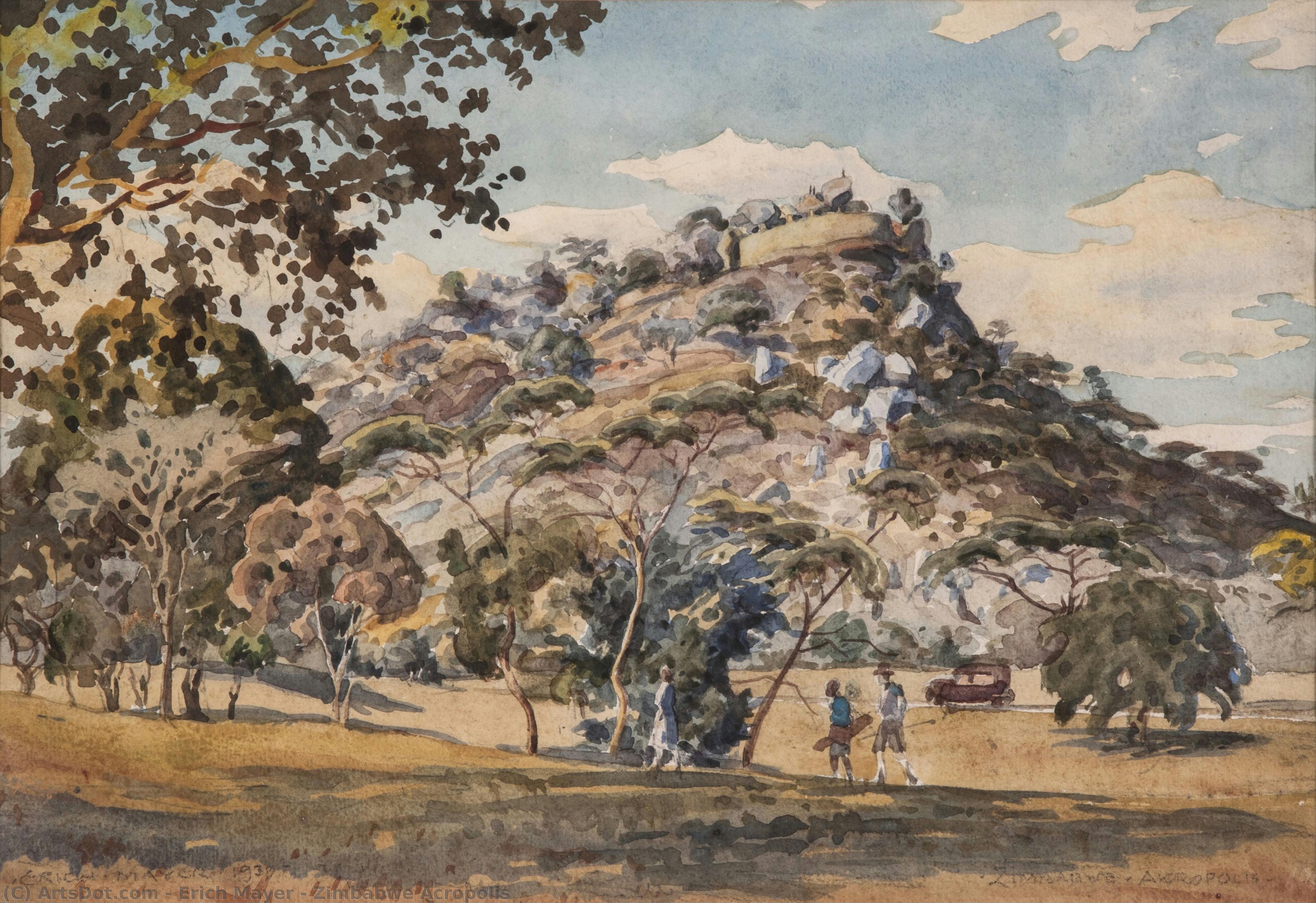
In the delicate, translucent layers of Erich Mayer’s watercolor "Zimbabwe Acropolis," we find more than just a landscape; we encounter a profound moment of stillness captured on the precipice of global upheaval. Painted in 1939, as the shadows of the Second World War began to lengthen across Europe, this work serves as a poignant testament to the enduring majesty of the African continent. Mayer, an artist whose life was defined by the turbulent shifts of history, uses the medium of watercolor to breathe life into the ancient stone structures and verdant hills of the Great Zimbabwe ruins. The painting invites the viewer to step into a serene assembly, where a small group of figures gathers amidst the sweeping grasses, their presence dwarfed by the monumental scale of the landscape, yet deeply connected to its rhythmic beauty.
The technique employed here is a masterclass in the subtle economy of watercolor. Mayer avoids heavy, oppressive strokes, opting instead for a fluid, atmospheric approach that allows light to permeate the paper itself. Through soft washes of earth tones—ochres, muted greens, and sun-bleached tans—he reconstructs the rugged topography of the Acropolis. The way the pigment settles into the grain of the paper mimics the natural textures of stone and vegetation, creating a sense of organic unity. There is a rhythmic quality to his brushwork; the scattered trees and the undulating terrain guide the eye through a composition that feels both expansive and intimate. For the collector, this piece offers a rare tactile quality, where the transparency of the medium evokes the very air of the Southern African veld.
Historical Resonance and Emotional Depth
To look upon "Zimbabwe Acropolis" is to engage with the complex biography of Erich Mayer himself. A man of German heritage living through the Anglo-Boer War and later facing internment during the World Wars, Mayer’s perspective was often that of an observer caught between worlds. This sense of being a witness is palpable in his work. The painting captures a peaceful, almost pastoral scene, yet knowing the historical context—the looming conflict that would soon disrupt such tranquility—adds a layer of bittersweet nostalgia to the viewing experience. The figures in the foreground, engaged in quiet companionship, represent a fleeting moment of human connection amidst the timelessness of the archaeological site.
For interior designers and art enthusiasts, this reproduction offers a sophisticated focal point that brings a sense of historical gravity and natural calm to any space. It is not merely a depiction of a place, but an evocative mood piece that speaks to themes of heritage, resilience, and the quiet dignity of the earth. The artwork functions beautifully in settings that value understated elegance and storytelling, providing a conversation piece that bridges the gap between the ancient past and the modern collector's eye. Owning a piece of Mayer’s legacy is an opportunity to preserve a fragment of a vanishing era, rendered with a sensitivity that remains as captivating today as it was in 1939.
Taiteilijan elämäkerta
Erich Mayer: A Pioneer of South African Art
- Born: Mussino, Italy (1876)
- Died: Pretoria, South Africa (1960)
Early Life and Influences
Erich Ernst Karl Mayer was born in Karlsruhe, Germany, in 1876. He received his early education in Berlin and initially pursued studies in architecture, earning a scholarship to the Charlottenburg Technische Hochschule. However, illness interrupted his architectural training, leading him to seek a healthier climate and relocate to South Africa in 1898. His initial work involved serving as an assistant land surveyor in the Orange Free State.
The Boer War and Artistic Development
Mayer's life took a significant turn when he joined a Boer commando during the Anglo-Boer War (1899-1902). While participating in the conflict, he began sketching the local farmers and landscapes where his unit was stationed. Captured by British forces at Mafeking, Mayer endured imprisonment on St. Helena. During this period of confinement, he dedicated himself to art, honing his skills and developing his artistic vision. Upon his return to Germany after the war, he formally studied art before eventually returning to South Africa.
Artistic Style and Contributions
Settling in Pretoria in 1912, Mayer became a prominent figure in the South African art scene. He is best known for his meticulous watercolor paintings and oil paintings depicting rural life and landscapes of South Africa. His work often focused on portraying the lives of farmers and their families, capturing the essence of the country's interior regions with sensitivity and detail. A notable subject in his works was the Baobab tree ("Kremetartboom"). Mayer actively advocated for a "National Art Identity" within South Africa, seeking to develop an artistic style that reflected the unique character of the nation.
- Mediums: Primarily watercolor and oil painting.
- Subjects: Rural landscapes, portraits of farmers and their families, depictions of everyday life in South Africa.
- Style: Representational, characterized by meticulous detail and a sympathetic portrayal of his subjects.
Legacy and Historical Significance
Erich Mayer's contribution to South African art is significant for several reasons. He played a crucial role in fostering an indigenous artistic identity during a period when European influences were dominant. His empathetic depictions of rural life provided valuable insights into the lives of ordinary people, preserving a visual record of a bygone era. Mayer also shared his knowledge and skills by teaching woodcut printing to other artists, including the renowned JH Pierneef. His murals in the Jeppe Street Post Office (Johannesburg) and Monument High School (Krugersdorp) stand as lasting testaments to his artistic legacy.
Erich Mayer
1940 - , Italy
Pikatiedot
- Artistic Movement Or Style: Watercolor painting
- Artists Or Movements Influenced By This Artist: ['Henk Pierneef']
- Artists Who Influenced This Artist:
- Winslow Homer
- Henri Matisse
- Date Of Birth: 1876
- Date Of Death: 1960
- Full Name: Erich Ernst Karl Mayer
- Nationality: German-South African
- Notable Artworks: ['Baobab study near to Mussina']
- Place Of Birth: Karlsruhe, Germany
Liittyvät artikkelit
Metropolitanin taidemestariklassikot: 25 unohtumatonta teosta kotiisi – OriginalUniqueArt.fi
Tutustu Metropolitan Museum of Artin 25 kuuluisimpaan teokseen! Uppoudu impressionismin, renessanssin ja modernin taiteen maailmaan. Löydä mestariteoksia Monétista Van Goghiin ja inspiroidu kodin sisustukseen OriginalUniqueArt.comissa. Tutki kokoelma verkossa!

10 Vesivärimaalausta, Jotka Muuttivat Taiteen – Inspiroi Sisustuksesi OriginalUniqueArtilla
Tutustu 10 legendaariseen vesivärimaalaukseen, jotka muuttivat taiteen historiaa! Inspiroiva tarina Turnerista Monetiin. Löydä upeita akvarelleja ja sisustusideoita OriginalUniqueArtilla. Tutki kokoelma verkossa!
National Galleryn 25 mestariteosta: Taidetta kotiisi OriginalUniqueArtilta
Tutustu National Galleryn 25 ikonista mestariteosta! Cézannen, Picasson ja Matissen tarinat sekä inspiraatiota kodin sisustukseen. Laadukkaat taideprintit OriginalUniqueArtilta – löydä suosikkisi nyt!

Katsushika Hokusain 25 mestariteosta: Ukiyo-e taidetta ja sisustuksen inspiraatiota
Tutustu Katsushika Hokusain 25 mestariteokseen! Ukiyo-e taidetta, Fuji-vuori ja ikoninen Suuri aalto Kanagawassa. Löydä japanilaisen estetiikan kauneus ja inspiroi sisustusta museolaatuisilla taideprintteillä OriginalUniqueArt.comissa.

John Constablein 25 mestariteosta: Taidetta ja tunnelmaa kotiisi – OriginalUniqueArt.com
Tutustu John Constable'n 25 mestariteokseen – romanttisia maisemamaalauksia, jotka vangitsevat englantilaisen luonnon tunnelman. Taidehistoriaa ja inspiraatiota kotiisi OriginalUniqueArt.com:ssa. Löydä kaikki taideteokset verkossa!

