Esikatselu
 Jaa teos
 Jaa
Jaa
 Tiedot
 Opas
Opas

 Lataa kuva
 Samanlaisia kohteita
 Röntgenkuvaus
 Diaesitys
 Kysymykset ja vastaukset
 Tilastot
Springtime


 Lue lisää
Giclée- ja taideprintit
Museolaatuisia giclée- tai kankaitaulun tulosteita nopealla tuotannolla ja joustavilla viimeistelyvaihtoehdoilla. ( Osta käsinmaalattu taideteos Siirry digitaaliseen kuvaan)




P118B €10

P118H €10

P118W €10

P438Z €10

P508JH €12

P508YH €12

P805H €10

P805Z €10

P919BZ €10

P919G €10

P919XJ €10

P959ZH €10

P968JZ €12

W106C €8

W218G €10

W218JH €8

W218Y €10

W307PJ €10

W316G €10

W316PJ €8

W316Y €10

W398PJ €8

W4111J €10

W500HY €15

W500JH €15

W692G €12

W849H €8

W940BG €15

W953PJ €8




Valitse valmiista mitoistamme sellaiset, jotka vastaavat teoksen alkuperäisiä mittasuhteita.

Syötä tarvitsemasi leveys ja korkeus, jotta tuloste sopii kehyksiisi tai seinällesi. Tulostetta voidaan vain leikata, sitä ei voida koskaan suurentaa alkuperäistä kuvaa suuremmaksi, joten eri muotoinen koko aiheuttaa osan kuvasta katoamisen. Lähetämme sinulle digitaalisen mallikuvan hyväksyttäväksi ennen kuin aloitamme tulostuksen. Tällä sivulla näkyvä kuva ei näytä lopullista rajausta — vain mallikuva näyttää sen.
Maailmanlaajuinen toimitus () 2 viikossa tavallisen 4–5 viikon sijaan. (10 marraskuu)

Ilmainen pikatoimitus ympäri maailman

Korkealaatuinen pellavakangas

Kattava kuljetusvakuutus

Tulliveron palautustakuu

Takuu täydellisestä värien vastaavuudesta

100 päivän palautusoikeus (vain valmistusvirheet)

100% rahat takaisin -takuu

Määräalennus tarjolla
 Lasivaihtoehto on saatavilla vain alle 110 cm kokoisille teoksille

Springtime
Giclée- ja taideprintit
Replikaatin koko
-


Kokonaishinta
€ 73
Charles Edward Conder’s “Springtime,” A Window into Heidelberg’s Soul
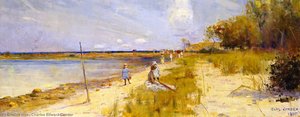
Charles Edward Conder's "Springtime," painted in 1888, isn’t merely a depiction of a rural scene; it’s a vibrant distillation of the Heidelberg School’s artistic philosophy – a celebration of light, color, and the fleeting beauty of the Australian landscape. This oil on canvas captures a moment of idyllic tranquility nestled within the rolling hills of New South Wales, yet it resonates with a deeper sense of observation and emotional resonance that distinguishes Conder's work from purely topographical representations.
The painting immediately draws the eye to the luminous quality of the light, characteristic of the Heidelberg School’s approach. Conder masterfully employs broken brushstrokes and a palette dominated by greens, blues, and yellows – not in a photographic realism, but rather as an expression of how these colors *feel* under the intense Australian sun. The composition is deceptively simple: a meandering dirt track cuts through a field dotted with grazing sheep and cows, leading towards distant trees that are rendered with a hazy, atmospheric quality. A small group of figures – likely children – are visible in the foreground, adding a touch of human presence to this otherwise serene vista.
The Heidelberg School and its Artistic Roots
To fully appreciate “Springtime,” it’s crucial to understand the context within which Conder was working. The Heidelberg School, emerging in Melbourne during the 1880s, represented a significant shift away from the academic traditions of European art that had previously dominated Australian painting. Artists like Conder, Tom Roberts, and Frederick McCubbin sought inspiration directly from the Australian landscape, rejecting idealized representations in favor of capturing its raw beauty and inherent drama. They embraced *plein air* painting – working outdoors directly from nature – a technique championed by Impressionist painters in Europe.
Conder’s early life, marked by his mother's death in India and subsequent relocation to England before returning to Australia, undoubtedly shaped his artistic sensibility. His experiences as a surveyor instilled a keen eye for detail and an appreciation for the natural world, while his time spent studying art in London exposed him to the burgeoning Impressionist movement. However, Conder ultimately forged his own unique style, blending European influences with a distinctly Australian perspective.
Symbolism and Emotional Resonance
Beyond its picturesque subject matter, “Springtime” is rich in symbolic meaning. The dirt track suggests a journey – perhaps a metaphorical one – while the grazing animals represent the bounty of the land. The figures in the foreground invite us to contemplate our relationship with nature and the simple pleasures of rural life. There’s an underlying sense of nostalgia for a bygone era, a yearning for connection with the earth and its rhythms.
The hazy atmosphere and diffused light contribute significantly to the painting's emotional impact. It evokes a feeling of warmth, tranquility, and perhaps even melancholy – a recognition that such moments of beauty are fleeting and precious. Conder’s use of color is particularly effective in conveying this mood, creating a sense of depth and luminosity that draws the viewer into the scene.
A Legacy of Australian Impressionism
“Springtime” stands as a pivotal work in the development of Australian Impressionism. It exemplifies the Heidelberg School’s commitment to capturing the essence of the Australian landscape with vibrant color, loose brushwork, and an emphasis on light and atmosphere. Conder's ability to imbue his paintings with both visual beauty and emotional depth cemented his place as one of Australia’s most important artists. Reproductions of this captivating work continue to resonate with audiences today, offering a glimpse into the soul of Heidelberg and the enduring appeal of the Australian landscape.
Kysymykset ja vastaukset
Minkälaisen tunnelman Charles Edward Conder:n "Springtime" välittää?
"Springtime" välittää Tranquil tunnelman. Emotionaalinen sävy kuvaa teoksen antamaa vaikutelmaa.
Kuinka tunnettu on Charles Edward Condern teos "Springtime"?
Teoksen Charles Edward Conder:n "Springtime" suosiotaso on Recognized.
Mikä on teoksen Charles Edward Conder:n "Springtime" valmistumisvuosi ja tyylisuunta?
Charles Edward Conder:n "Springtime" on peräisin vuodelta 1888 ja edustaa tyylisuuntaa Heidelberg School.
Taiteilijan elämäkerta
nuoruus ja taiteellinen matka
Charles Edward Conder, brittiläissyntyinen maalaaja, litografi ja suunnittelija, jätti peruuttamattoman jäljen taidemaailmaan. Tottenhamissa, Middlesexissä, 24. lokakuuta 1868 syntyneen Conderin varhaisvuosia varjosti äidin kuolema Intiassa, kun hän oli vasta neljävuotias.taiteellinen ura Australiassa
vuonna 1884, vain 16-vuotiaana, Conder muutti Sydneyyn, Australiaan, työskennellen setänsä alaisena maanmittaajana. Hän kuitenkin pian huomasi, että hänen todellinen intohimonsa ei ollutkaan maan mittaaminen, vaan maisemien maalaaminen. Vuoteen 1888 mennessä hänestä oli tullut Illustrated Sydney News -lehden taiteilija, työskennellen tunnettujen nimien, kuten Albert Henry Fullwoodin ja Frank Mahonyn, rinnalla.Heidelbergin koulu ja merkittävät teokset
Conderin mestariteos, Departure of the Orient – Circular Quay (1888), osoitti hänen uudenlaista hallintaansa muodon ja siveltimenkäytön suhteen. Tämä satamanäkymä, joka kuvaa vilkasta satamaa Sydney Covessa, ostettiin nopeasti New South Walesin taidegalleriaan, mikä teki siitä Conderin ensimmäisen julkiseen kokoelmaan päätyneen teoksen.- A Holiday at Mentone (1888), elämäniloista maalausta, joka esittää rannalla rentoutuvia miehiä ja naisia, on toinen merkittävä esimerkki Conderin työstä.
- Conderin suhde G. P. Nerliin, kiertävään italialaiseen maalaajaan, vaikutti merkittävästi hänen kehitykseensä taiteilijana.
- Hänen osallistumisensa Melbournen 9 by 5 Impression -näyttelyyn Tom Robertsin ja Arthur Streetonin rinnalla vahvisti hänen asemansa Heidelbergin koulukunnan liikkeessä.
perintö ja myöhemmät vuodet
Conderin myöhempiä vuosia vaivasi huono terveys, mukaan lukien halvaus ja delirium tremens -kohtaus. Tästä huolimatta hän jatkoi maalaamista jättäen jälkeensä perinnön Heidelbergin koulukunnan keskeisenä hahmona. Hänen taiteensa otettiin vastaan Englannissa paremmin kuin Pariisissa, ja vuonna 1892 Henri de Toulouse-Lautrec maalasi hänestä muotokuvan. Katso Conderin teoksia New South Walesin taidegalleriassa tai tutustu lisää Heidelbergin kouluun OriginalUniqueArtn Charles Edward Conder -sivulla.- Löydä lisää Conderin elämästä ja teoksista Wikipedian Charles Conder -sivulta.
- Tutustu OriginalUniqueArtn kokoelmaan Conderin maalauksia, mukaan lukien A Holiday at Mentone (188#8) ja Departure of the Orient – Circular Quay (1888), OriginalUniqueArtn verkkosivustolla.
johtopäätös
Charles Edward Conderin vaikutus australialaiseen impressionismiin on kiistaton. Hänen perintönsä, jota leimaavat lumoavat maalaukset ja yhteys Heidelbergin koulukuntaan, jatkaa inspiroimista taiteen ystävien keskuudessa ympäri maailmaa.
Charles Edward Conder
1868 - 1909 , Iso-Britannia
Pähkinänkuoressa
- Artistic Movement Or Style: Heidelberg School
- Artists Who Influenced This Artist:
- Alfred Daplyn
- Victor Mann
- Julian Ashton
- Date Of Birth: October 24, 1868
- Date Of Death: February 9, 1909
- Full Name: Charles Edward Conder
- Nationality: British
- Notable Artworks:
- Departure of the Orient – Circular Quay
- A holiday at Mentone
- Under The Southern Sun
- Place Of Birth: Tottenham, United Kingdom
Aiheeseen liittyvät artikkelit

The Sublime Landscape: Exploring the Hudson River School Movement
Explore the captivating world of the Hudson River School! Discover the history, artists, and defining characteristics of this iconic American art movement. Learn about Romanticism's influence & find inspiration for your collection.

Romanttisen maisemamaalauksen mestariteokset: Taidetta ja inspiraatiota kotiin
Uppoudu romanttisen maisemamaalauksen maailmaan! Tutustu Caspar David Friedrichin, Turnerin ja muiden mestareiden ikonisiin teoksiin. Löydä inspiraatiota kotiisi taiteen avulla OriginalUniqueArt.comista – laadukkaat taideprintit ja sisustusideoita.

Evoking Nature's Sublime: A Comprehensive Exploration of 19th-Century Landscape Painting
Explore the captivating world of 19th-century landscape painting! Discover renowned artists like Friedrich & Monet, key movements, and find the perfect artwork to bring nature's serenity into your home. Expert insights at OriginalUniqueArt.

Evocations of Place: A Historical Journey Through Landscape Art
Explore the rich history of landscape art with OriginalUniqueArt. Discover renowned artists, movements like Impressionism & Romanticism, and expert guidance for collecting timeless pieces. Find your perfect serene escape today!

Evocations of Place: A Historical Journey Through Landscape Art
Explore the rich history of landscape art with OriginalUniqueArt. Discover renowned artists, movements like Impressionism & tonalism, and expert guidance for collecting timeless pieces. Find your perfect serene escape today!