Esikatselu
 Jaa teos
 Jaa
Jaa
 Tiedot
 Opas
Opas

 Lataa kuva
 Samanlaisia kohteita
 Röntgenkuvaus
 Diaesitys
 Kysymykset ja vastaukset
 Tilastot
Dieppe


 Lue lisää
Giclée- ja taideprintit
Museolaatuisia giclée- tai kankaitaulun tulosteita nopealla tuotannolla ja joustavilla viimeistelyvaihtoehdoilla. ( Osta käsinmaalattu taideteos Siirry digitaaliseen kuvaan)




P118B €10

P118H €10

P118W €10

P438Z €10

P508JH €12

P508YH €12

P805H €10

P805Z €10

P919BZ €10

P919G €10

P919XJ €10

P959ZH €10

P968JZ €12

W106C €8

W218G €10

W218JH €8

W218Y €10

W307PJ €10

W316G €10

W316PJ €8

W316Y €10

W398PJ €8

W4111J €10

W500HY €15

W500JH €15

W692G €12

W849H €8

W940BG €15

W953PJ €8




Valitse valmiista mitoistamme sellaiset, jotka vastaavat teoksen alkuperäisiä mittasuhteita.

Syötä tarvitsemasi leveys ja korkeus, jotta tuloste sopii kehyksiisi tai seinällesi. Tulostetta voidaan vain leikata, sitä ei voida koskaan suurentaa alkuperäistä kuvaa suuremmaksi, joten eri muotoinen koko aiheuttaa osan kuvasta katoamisen. Lähetämme sinulle digitaalisen mallikuvan hyväksyttäväksi ennen kuin aloitamme tulostuksen. Tällä sivulla näkyvä kuva ei näytä lopullista rajausta — vain mallikuva näyttää sen.
Maailmanlaajuinen toimitus () 2 viikossa tavallisen 4–5 viikon sijaan. (6 marraskuu)

Ilmainen pikatoimitus ympäri maailman

Korkealaatuinen pellavakangas

Kattava kuljetusvakuutus

Tulliveron palautustakuu

Takuu täydellisestä värien vastaavuudesta

100 päivän palautusoikeus (vain valmistusvirheet)

100% rahat takaisin -takuu

Määräalennus tarjolla
 Lasivaihtoehto on saatavilla vain alle 110 cm kokoisille teoksille

Dieppe
Giclée- ja taideprintit
Replikaatin koko
-


Kokonaishinta
€ 72
The Scene Unfolds: A Seaside Moment Captured
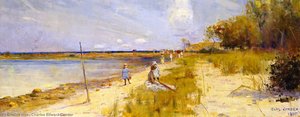
Charles Edward Conder’s “Dieppe,” painted in 1895, isn't merely a depiction of a coastal scene; it’s an immersion into a fleeting moment of tranquility and observation. The canvas breathes with the muted palette of a late afternoon – a symphony of blues deepening towards the horizon, punctuated by the warm ochres and yellows of the sand and distant buildings. The composition immediately draws the eye along a gentle diagonal path created by the sandy track leading toward the figures strolling along the beach. This isn’t a dramatic seascape; rather, it's an invitation to pause, to contemplate the quiet rhythm of daily life unfolding against the vastness of the sea.
The subject matter itself is deceptively simple: a group of people enjoying a seaside walk. Yet Conder elevates this commonplace activity through his masterful use of Impressionistic techniques. He’s less concerned with precise representation and more interested in capturing the *feeling* of the scene – the diffused light, the sense of warmth, the subtle interplay of color and texture. The figures are rendered with loose brushstrokes, their forms dissolving into the atmosphere, suggesting a momentary impression rather than a detailed portrait.
Impressionistic Techniques: A Dance of Light and Color
Conder’s approach is deeply rooted in Impressionism, a movement that sought to capture the subjective experience of light and color. Notice how he employs broken brushstrokes – short, distinct marks applied side-by-side rather than blended smoothly. This creates a shimmering effect, mimicking the way sunlight dances on water and reflects off surfaces. The layering of paint is equally significant; visible texture adds depth and richness to the canvas, inviting the viewer to examine the surface closely.
The color choices are deliberately restrained, contributing to the overall mood of serenity. He avoids bright, saturated hues, opting instead for a harmonious blend of blues, yellows, and browns. This creates a sense of atmospheric perspective – distant elements appear paler and less distinct, reinforcing the feeling of depth and distance. The use of complementary colors—the blue sky contrasted with the warm sand—further enhances the visual interest and vibrancy of the scene.
Historical Context: The Heidelberg School and Australian Modernism
To understand “Dieppe,” it’s crucial to consider Conder's place within the broader context of Australian art. He was a key figure in the Heidelberg School, a group of artists who developed a distinctly Australian style influenced by Impressionism and Post-Impressionism. Based in Melbourne, the Heidelberg School sought to capture the unique landscapes and light conditions of Victoria’s rural areas.
Conder's move to Sydney in 1884 marked a pivotal moment in his career. He quickly established himself as a talented landscape painter, experimenting with new techniques and styles. “Dieppe” reflects this period of artistic exploration, showcasing Conder’s growing mastery of Impressionistic principles while retaining a distinctly Australian sensibility. The painting's subject matter – a seaside scene – resonated deeply with the Heidelberg School’s focus on capturing the beauty of the natural world.
Symbolism and Emotional Resonance: A Moment of Quiet Reflection
Beyond its technical merits, “Dieppe” possesses a subtle yet powerful symbolic resonance. The figures strolling along the beach represent leisure, connection, and the simple pleasures of life. The vast expanse of the sea symbolizes both opportunity and uncertainty – a reminder of the world beyond our immediate surroundings. The painting evokes a sense of quiet contemplation, inviting the viewer to slow down and appreciate the beauty of the present moment.
Ultimately, “Dieppe” is more than just a landscape; it’s a meditation on light, color, and human experience. It's a testament to Conder's artistic vision and his ability to capture the essence of a fleeting scene with remarkable sensitivity and skill. A reproduction of this work offers a beautiful addition to any collection, bringing a touch of Impressionistic serenity into your home.
Kysymykset ja vastaukset
Kuka on teoksen "Dieppe" tekijä ja mikä on sen valmistumisvuosi?
Charles Edward Conder on luonut teoksen "Dieppe" vuonna 1895.
Onko Charles Edward Conder:n "Dieppe" pysty-, vaaka- vai neliökompositio?
Teoksen "Dieppe" formaatti on Landscape. Tämä on hyödyllinen tieto, kun suunnittelet jäljennöksen sijoituspaikkaa.
Mitä Charles Edward Conder:n "Dieppe" esittää?
Teoksen Charles Edward Conder:n "Dieppe" teemoihin kuuluvat seaside, beach, landscape, impressionism, leisure, tranquility, figures, atmosphere. Yhdessä ne tiivistävät teoksen aiheen.
Taiteilijan elämäkerta
nuoruus ja taiteellinen matka
Charles Edward Conder, brittiläissyntyinen maalaaja, litografi ja suunnittelija, jätti peruuttamattoman jäljen taidemaailmaan. Tottenhamissa, Middlesexissä, 24. lokakuuta 1868 syntyneen Conderin varhaisvuosia varjosti äidin kuolema Intiassa, kun hän oli vasta neljävuotias.taiteellinen ura Australiassa
vuonna 1884, vain 16-vuotiaana, Conder muutti Sydneyyn, Australiaan, työskennellen setänsä alaisena maanmittaajana. Hän kuitenkin pian huomasi, että hänen todellinen intohimonsa ei ollutkaan maan mittaaminen, vaan maisemien maalaaminen. Vuoteen 1888 mennessä hänestä oli tullut Illustrated Sydney News -lehden taiteilija, työskennellen tunnettujen nimien, kuten Albert Henry Fullwoodin ja Frank Mahonyn, rinnalla.Heidelbergin koulu ja merkittävät teokset
Conderin mestariteos, Departure of the Orient – Circular Quay (1888), osoitti hänen uudenlaista hallintaansa muodon ja siveltimenkäytön suhteen. Tämä satamanäkymä, joka kuvaa vilkasta satamaa Sydney Covessa, ostettiin nopeasti New South Walesin taidegalleriaan, mikä teki siitä Conderin ensimmäisen julkiseen kokoelmaan päätyneen teoksen.- A Holiday at Mentone (1888), elämäniloista maalausta, joka esittää rannalla rentoutuvia miehiä ja naisia, on toinen merkittävä esimerkki Conderin työstä.
- Conderin suhde G. P. Nerliin, kiertävään italialaiseen maalaajaan, vaikutti merkittävästi hänen kehitykseensä taiteilijana.
- Hänen osallistumisensa Melbournen 9 by 5 Impression -näyttelyyn Tom Robertsin ja Arthur Streetonin rinnalla vahvisti hänen asemansa Heidelbergin koulukunnan liikkeessä.
perintö ja myöhemmät vuodet
Conderin myöhempiä vuosia vaivasi huono terveys, mukaan lukien halvaus ja delirium tremens -kohtaus. Tästä huolimatta hän jatkoi maalaamista jättäen jälkeensä perinnön Heidelbergin koulukunnan keskeisenä hahmona. Hänen taiteensa otettiin vastaan Englannissa paremmin kuin Pariisissa, ja vuonna 1892 Henri de Toulouse-Lautrec maalasi hänestä muotokuvan. Katso Conderin teoksia New South Walesin taidegalleriassa tai tutustu lisää Heidelbergin kouluun OriginalUniqueArtn Charles Edward Conder -sivulla.- Löydä lisää Conderin elämästä ja teoksista Wikipedian Charles Conder -sivulta.
- Tutustu OriginalUniqueArtn kokoelmaan Conderin maalauksia, mukaan lukien A Holiday at Mentone (188#8) ja Departure of the Orient – Circular Quay (1888), OriginalUniqueArtn verkkosivustolla.
johtopäätös
Charles Edward Conderin vaikutus australialaiseen impressionismiin on kiistaton. Hänen perintönsä, jota leimaavat lumoavat maalaukset ja yhteys Heidelbergin koulukuntaan, jatkaa inspiroimista taiteen ystävien keskuudessa ympäri maailmaa.
Charles Edward Conder
1868 - 1909 , Iso-Britannia
Pähkinänkuoressa
- Artistic Movement Or Style: Heidelberg School
- Artists Who Influenced This Artist:
- Alfred Daplyn
- Victor Mann
- Julian Ashton
- Date Of Birth: October 24, 1868
- Date Of Death: February 9, 1909
- Full Name: Charles Edward Conder
- Nationality: British
- Notable Artworks:
- Departure of the Orient – Circular Quay
- A holiday at Mentone
- Under The Southern Sun
- Place Of Birth: Tottenham, United Kingdom
Aiheeseen liittyvät artikkelit
Capturing the Soul: The Most Emotionally Moving Impressionist and Post-Impressionist Masterpieces
Discover the profound emotional depth of Impressionist and Post-Impressionist masterpieces. Explore how legends like Monet, Van Gogh, and Gauguin captured light and soul through evocative landscapes and vibrant brushwork for a timeless connection to art history.

Beyond the Horizon: A Curated Guide to Integrating Post-Impressionist Landscapes into Modern Interiors
Transform your home with the emotive power of Post-Impressionist landscapes. Discover expert tips on selecting hand-painted oil reproductions to create a soulful, vibrant interior that reflects your unique style and connection to nature.

Impressionismin mestariteokset: Maisemamaalauksen lumo OriginalUniqueArtissa
Tutustu impressionismin lumoavaan maailmaan! Koe Claude Monet'n, Renoir'n ja muiden mestareiden ikonisten maisemamaalausten tarinat. Löydä inspiraatiota sisustukseen OriginalUniqueArtista – taidetta museolaadulla. Explore the full collection online!
Golden Fields & Sun-Drenched Meadows: Capturing the Soul of Impressionist Landscapes
Immerse yourself in the luminous world of Impressionist landscapes. Discover how masters like Monet and Gauguin captured ephemeral light through plein air painting, and learn to bring the soul of sun-drenched meadows into your home with exquisite, hand-painted oil reproductions.

Top 10 Impressionistimaisemaa: Taideteokset jotka muuttivat taiteen – OriginalUniqueArt.fi
Tutustu 10 ikoniseen impressionistimaisemaan! Claude Monet’n ja muiden mestareiden teokset heräävät eloon. Taiteen historiaa, tekniikoita ja inspiraatiota kotiisi – OriginalUniqueArt.com:sta löydät museolaatuiset taideprintit ja sisustusehdotukset. Tutki kokoelma verkossa!