

 Esikatselu
 Jaa teos
 Jaa
Jaa
 Tiedot
 Opas
Opas

 Lataa kuva
 Samanlaisia kohteita
 Röntgenkuvaus
 Diaesitys
 Tilastot
Man Reading in a Park


 Lue lisää
Giclée- ja taideprintit
Museolaatuisia giclée- tai kankaitaulun tulosteita nopealla tuotannolla ja joustavilla viimeistelyvaihtoehdoilla. ( Osta käsinmaalattu taideteos Siirry digitaaliseen kuvaan)




P118B €10

P118H €10

P118W €10

P438Z €10

P508JH €12

P508YH €12

P805H €10

P805Z €10

P919BZ €10

P919G €10

P919XJ €10

P959ZH €10

P968JZ €12

W106C €8

W218G €10

W218JH €8

W218Y €10

W307PJ €10

W316G €10

W316PJ €8

W316Y €10

W398PJ €8

W4111J €10

W500HY €15

W500JH €15

W692G €12

W849H €8

W940BG €15

W953PJ €8




Valitse valmiista mitoistamme sellaiset, jotka vastaavat teoksen alkuperäisiä mittasuhteita.

Syötä tarvitsemasi leveys ja korkeus, jotta tuloste sopii kehyksiisi tai seinällesi. Tulostetta voidaan vain leikata, sitä ei voida koskaan suurentaa alkuperäistä kuvaa suuremmaksi, joten eri muotoinen koko aiheuttaa osan kuvasta katoamisen. Lähetämme sinulle digitaalisen mallikuvan hyväksyttäväksi ennen kuin aloitamme tulostuksen. Tällä sivulla näkyvä kuva ei näytä lopullista rajausta — vain mallikuva näyttää sen.
Maailmanlaajuinen toimitus () 2 viikossa tavallisen 4–5 viikon sijaan. (28 lokakuu)

Ilmainen pikatoimitus ympäri maailman

Korkealaatuinen pellavakangas

Kattava kuljetusvakuutus

Tulliveron palautustakuu

Takuu täydellisestä värien vastaavuudesta

100 päivän palautusoikeus (vain valmistusvirheet)

100% rahat takaisin -takuu

Määräalennus tarjolla
 Lasivaihtoehto on saatavilla vain alle 110 cm kokoisille teoksille

Man Reading in a Park
Giclée- ja taideprintit
Replikaatin koko
-


Kokonaishinta
€ 70
A Moment Suspended in Time: The Leisure of August Macke
To gaze upon Man Reading in a Park is to step through a veil into a perfect afternoon—a moment so richly imbued with quiet contemplation that it feels almost suspended outside the rush of modern life. This painting by August Macke captures more than just a man on a bench; it encapsulates the very essence of leisure, the profound luxury of simply being present amidst the vibrant chaos of nature and society. The composition draws the eye immediately to the central figure, absorbed in the narrative held within his newspaper, yet the surrounding park life—the distant figures, the delicate perch of a bird against the foliage—reminds us that solitude is often found within community.
The Luminous Brushwork of German Expressionism
Macke’s technique here is a masterful blend of Impressionistic light play and the emotional depth characteristic of early German Expressionism. While his style hints at the bright, almost joyous palette associated with the movement, there is an underlying sense of poignant introspection. Observe the handling of the paint; it possesses a palpable texture, suggesting Macke’s skilled use of impasto that allows the sunlight filtering through the leaves to become visible pigment itself. The background is not merely painted scenery; it breathes. It vibrates with color and suggestion, allowing the viewer's own imagination to fill in the details of conversation or activity happening just beyond our direct focus.
Context and the Fleeting Nature of Joy
Painted in 1914, this work carries the bittersweet resonance of its time. August Macke’s life was tragically cut short by the looming shadow of global conflict, making works like this an artifact imbued with a poignant nostalgia for peace and simple pleasures. The park setting becomes a sanctuary—a temporary haven before the storm. It speaks to a yearning for permanence in an era defined by rapid change, suggesting that true beauty resides in these small, unrepeatable pockets of calm.
Symbolism of Solitude Amidst Life
The symbolism within Man Reading in a Park is wonderfully layered. The newspaper itself acts as a barrier and a portal; it connects the man to the outside world's discourse while simultaneously isolating him in his personal bubble of thought. Meanwhile, the surrounding activity—the other figures enjoying their day—serves as a beautiful counterpoint, reminding us that even when we seek quietude, we are always part of a larger, interconnected human tapestry. The bird perched overhead is nature’s silent witness, observing the ritual of human repose.
Bringing Macke's Atmosphere Home
For collectors and designers alike, this piece offers more than mere decoration; it offers an emotional anchor. Reproducing the luminosity and evocative mood of Man Reading in a Park allows one to infuse a space with sophisticated tranquility. Imagine this scene rendered on a wall—a vibrant conversation starter that whispers tales of sun-drenched afternoons and thoughtful repose, transforming any room into a curated retreat.
Kysymykset ja vastaukset
Voinko nähdä teoksen August Macke:n "Man Reading in a Park" omalla seinälläni ennen ostopäätöstä?
Teoksella "Man Reading in a Park" on lisätyn todellisuuden esikatselu: teoksen Tarkastele teosta AR-tilassa -sivu näyttää sen omassa tilassasi yhteensopivalla laitteella.
Voinko nähdä teoksen August Macke:n "Man Reading in a Park" eri valaistuksissa?
August Macke:n "Man Reading in a Park"-teoksen röntgennäkymä löytyy teoksen Röntgentutkimus-sivulta: interaktiivinen tutkimusmatka kuvaan yhdenentoista optisen kerroksen läpi.
Kuka on luonut teoksen "Man Reading in a Park" ja minä vuonna?
Teoksen "Man Reading in a Park" tekijä on August Macke ja se on vuodelta 1914.
Taiteilijan elämäkerta
A Life Cut Short: The Vibrant World of August Macke
August Robert Ludwig Macke, a name forever intertwined with the brief but brilliant flowering of German Expressionism, lived a life tragically curtailed by the horrors of the First World War. Born in 1887 in Meschede, a small town nestled within the Westphalian countryside, his artistic journey was one of rapid evolution and profound exploration – a relentless pursuit to capture not just what he *saw*, but how he *felt* about it. Macke’s early years were marked by a shift from his family’s building business to the captivating world of art, nurtured initially through informal studies and later formalized at the Düsseldorf Art Academy under Adolf Maennchen. However, it was through independent study, travel, and encounters with groundbreaking artistic movements that his unique voice truly began to emerge. These formative years were characterized by an absorption of Impressionist and Post-Impressionist techniques – a foundation upon which he would build a strikingly original style. He supplemented his income with stage design work, honing his compositional skills and developing a keen eye for color and light, essential tools in his future artistic endeavors.Influences and Artistic Development: A Synthesis of Styles
Macke’s artistic trajectory was profoundly shaped by a series of pivotal encounters that ignited his creative spirit. The most significant of these occurred in 1912 when he met Robert Delaunay in Paris – an encounter that introduced him to the revolutionary concepts of Orphism, a branch of Cubism focused on pure abstraction and vibrant color harmonies. This meeting proved transformative, fundamentally altering Macke’s approach to composition and prompting him to experiment with broken planes of color and abstracted forms, seeking to convey not just visual representation but also emotional resonance. Simultaneously, his close friendship with Franz Marc, a fellow artist and a key figure in the influential group Der Blaue Reiter (The Blue Rider), drew him into the orbit of Wassily Kandinsky and other avant-garde thinkers. While Macke’s style remained distinct from Kandinsky's more purely abstract explorations, he embraced the group’s spirit of artistic freedom and spiritual inquiry – a shared desire to push beyond traditional boundaries. He also deeply admired Henri Matisse’s bold use of color and simplified forms, incorporating elements of Fauvism into his own work. The influence of Italian Futurism, with its emphasis on dynamism and movement, is also evident in some of his later compositions. Macke's artistic development wasn't a simple imitation of these movements; rather, he skillfully synthesized their diverse influences into a uniquely personal style – a vibrant tapestry woven from multiple threads.Der Blaue Reiter and the Pursuit of Harmony
As an integral member of Der Blaue Reiter, Macke played a crucial role in shaping the group’s artistic direction and contributing significantly to its exhibitions and publications. However, he wasn't merely a passive participant; he actively pushed the boundaries of Expressionism, striving for a balance between emotional intensity and visual harmony. Unlike some of his colleagues who leaned towards darker, more angst-ridden themes, Macke consistently sought to portray beauty and tranquility in the world around him. His paintings – such as *Bathing Girls with Town in the Background* – exemplify this approach: vibrant colors, simplified forms, and a sense of idyllic serenity characterize his work. He masterfully blended elements of Fauvism, Cubism, and Futurism into a distinctly personal style, creating compositions that are both visually striking and emotionally resonant. *Woman in a Green Jacket*, painted in 1913, is another prime example – a portrait radiating warmth and vitality through its bold color palette and confident brushwork. The group’s focus on spirituality and the interconnectedness of all things profoundly influenced Macke's artistic vision, leading him to explore themes of nature, humanity, and the search for meaning in a rapidly changing world.A Tragic End and Lasting Legacy
The outbreak of World War I brought a sudden and devastating end to Macke’s promising career. Driven by patriotic fervor – a complex and ultimately tragic motivation – he volunteered for military service in 1914. Tragically, he was killed in action just weeks later, on September 26th, at the front near Champagne, France, at the young age of 27. His final painting, *Farewell*, poignantly captures the somber mood that descended upon Europe as war engulfed the continent – a haunting testament to his untimely demise. Despite his tragically short life, August Macke left behind a body of work that continues to captivate and inspire. He remains a significant figure in the history of Expressionism, celebrated for his vibrant colors, dynamic compositions, and optimistic vision. His paintings offer a glimpse into a world on the cusp of change – a world grappling with modernity, spirituality, and the complexities of human existence – imbued with a sense of beauty and hope amidst growing uncertainty.Exploring Macke’s World Today
Today, August Macke's works are held in prominent collections across Europe and beyond, including the Staatsgalerie Moderner Kunst in Munich, the Museum Ludwig in Cologne, and the Kunsthaus Zürich. Several museums dedicated to Expressionism feature his paintings prominently, offering visitors a chance to experience the power of his art firsthand. The Westfälisches Landesmuseum Münster and the Kunstmuseum Bonn are particularly noteworthy for their holdings of Macke’s work. His influence can be seen in the continued exploration of color and emotion by contemporary artists. For those seeking to delve deeper into his world, resources like Artnet and Wikipedia provide valuable biographical information and insights into his artistic development. Exploring his paintings through online databases such as OriginalUniqueArt allows for a closer examination of his technique and subject matter – revealing the enduring appeal of this remarkable artist whose life was tragically cut short but whose legacy continues to shine brightly.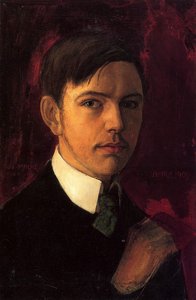
August Macke
1887 - 1914 , Saksa
Pähkinänkuoressa
- Artistic Movement Or Style: Expressionismi
- Artists Or Movements Influenced By This Artist: ['Der Blaue Reiter']
- Artists Who Influenced This Artist:
- Robert Delaunay
- Franz Marc
- Date Of Birth: 3 tammikuuta 1887
- Date Of Death: 26 syyskuuta 1914
- Full Name: August Robert Ludwig Macke
- Nationality: Saksalainen
- Notable Artworks:
- Nainen hattujen kanssa
- Gartentor
- Türkisches Café
- Place Of Birth: Meschede, Saksa
Aiheeseen liittyvät artikkelit

Unmasking Emotion: A Journey Through the Raw Power and Visceral Beauty of German Expressionism
Explore the raw emotional power of German Expressionism. From Kirchner to Die Brücke, discover how artists used distortion and vibrant color to unmask the human psyche. A deep dive into art history for the discerning collector and enthusiast.

Saksan ekspressionismin 10 mestariteosta: Taidetta ja tunnetta kotiisi
Uppoudu Saksan ekspressionismin maailmaan! Tutustu 10 mestariteokseen – Kirchnerin voimakkaista väreistä Munchin tunteisiin. Löydä taidemaalauksien tarinat ja inspiroi sisustusta OriginalUniqueArt.com:ssa. Explore the full collection online!
August Macke: Expressionist Visions of Harmony & Modern Life
Explore the vibrant Expressionist paintings of August Macke (1887-1914). Discover his key role in Der Blaue Reiter, Fauvist influences, and captivating depictions of modern life. A comprehensive guide for art enthusiasts & collectors.

Impressionismin mestariteokset: Maisemamaalauksen lumo OriginalUniqueArtissa
Tutustu impressionismin lumoavaan maailmaan! Koe Claude Monet'n, Renoir'n ja muiden mestareiden ikonisten maisemamaalausten tarinat. Löydä inspiraatiota sisustukseen OriginalUniqueArtista – taidetta museolaadulla. Explore the full collection online!
The Visceral Cry of a Nation: Exploring Emotion & Distortion in German Expressionism
Explore the powerful world of German Expressionism with OriginalUniqueArt. Discover Kirchner, Nolde & Die Brücke's emotive masterpieces. Learn about this pivotal art movement and its lasting impact on modern art.


