

 Katso seinällä
 Lähetä
 Jaa
Jaa
 Tarkemmat tiedot
 Opas
Opas

 Lataa kuva
 Samanlaisia kohteita
 Röntgenkuvaus
 Diaesitys
 Tilastot
Misty Moonlight
 Oil On Canvas
- WallArt
- Tonalism & Symbolism
 1885
1885- 19th Century
 28.0 x 29.0 cm
 Crystal Bridges Museum of American Art
 Lue lisää
Giclée- ja taideprintit
Museolaatuisia giclée- tai kankaitaulun tulosteita nopealla tuotannolla ja joustavilla viimeistelyvaihtoehdoilla. ( Tilaa käsinmaalattu jäljennös Siirry digitaaliseen kuvaan)




P118B €10

P118H €10

P118W €10

P438Z €10

P508JH €12

P508YH €12

P805H €10

P805Z €10

P919BZ €10

P919G €10

P919XJ €10

P959ZH €10

P968JZ €12

W106C €8

W218G €10

W218JH €8

W218Y €10

W307PJ €10

W316G €10

W316PJ €8

W316Y €10

W398PJ €8

W4111J €10

W500HY €15

W500JH €15

W692G €12

W849H €8

W940BG €15

W953PJ €8




Valitse valmiista mitoistamme sellaiset, jotka vastaavat teoksen alkuperäisiä mittasuhteita.

Kirjoita tarvitsemasi leveys ja korkeus, jotta tuloste sopii kehyskokoon tai seinällesi. Tulostetta voidaan vain leikata, sitä ei voi koskaan tehdä suuremmaksi kuin alkuperäinen kuva, joten eri muotoinen koko aiheuttaa osan kuvasta katoamisen. Lähetämme sinulle digitaalisen mallikuvan hyväksyttäväksi ennen kuin aloitamme tulostuksen. Tällä sivulla näkyvä kuva ei näytä lopullista leikkausta — vain mallikuva näyttää sen.
Maailmanlaajuinen toimitus () 2 viikossa tavallisen 4–5 viikon sijaan. (25 lokakuu)

Ilmainen pikatoimitus ympäri maailman

Korkealaatuinen pellavakangas

Kattava kuljetusvakuutus

Tulliveron palautustakuu

Takuu täydellisestä värien vastaavuudesta

100 päivän palautusoikeus valmistusvirhetapauksissa

100% rahat takaisin -takuu

Määräalennus saatavilla
 Lasivaihtoehto on saatavilla vain alle 110 cm kokoisille teoksille

Misty Moonlight
Giclée- ja taideprintit
Replikaatin koko
-


Kokonaishinta
€ 70
A Nocturne of Shadows and Light
In the quietude of the late nineteenth century, few artists captured the ephemeral essence of the American night as profoundly as Albert Pinkham Ryder. His masterpiece, Misty Moonlight (1885), serves as a hauntingly beautiful window into the soul of Tonalism, offering much more than a mere depiction of a seascape. The painting presents a serene yet melancholic vision of a nocturnal world, where a solitary sailing ship drifts through a sea of deep blacks and greenish grays. A luminous crescent moon hangs suspended in the hazy atmosphere, casting a soft, ethereal glow that seems to dissolve the boundaries between the water and the sky. This is not a scene of action, but one of profound stillness, inviting the viewer into a state of meditative contemplation.
The emotional resonance of this work lies in its ability to evoke a sense of mystery and longing. The sparse composition—a delicate dance of geometric forms including the rectangular expanse of the sea, the triangular silhouette of the vessel, and the circular moon—prevents any specific narrative from taking hold. Instead, the viewer is left to wander through the artist's dreamscape, feeling the weight of the heavy, damp air and the rhythmic, silent pulse of the tide. For the collector or interior designer, this piece offers a sophisticated anchor for a room, providing a focal point that commands attention through subtlety rather than spectacle.
The Alchemy of Unconventional Technique
To understand the mesmerizing texture of Misty Moonlight, one must look closely at Ryder’s radical approach to the medium. Eschewing the polished, academic precision favored by his contemporaries, Ryder embraced a method of deliberate instability. He was known for applying successive layers of oil paint while the underlying coats were still wet, a technique that allowed colors to bleed and merge in unpredictable ways. This process created the "gauzy" and atmospheric quality that defines his most celebrated works.
This layering does more than just create visual depth; it imbues the canvas with a physical materiality that feels alive. The resulting surface is often thick and textured, capturing light in a way that mimics the shifting mists of a coastal night. This mastery of atmosphere—achieved through what some might call "controlled chaos"—is precisely what makes a high-quality reproduction of this work so captivating. When rendered with care, the interplay of dark tones and soft highlights can transform a modern living space into a sanctuary of historical depth and artistic intrigue.
A Legacy of Symbolism and Inspiration
Ryder’s inspiration was deeply rooted in his formative years in New Bedford, Massachusetts, a bustling whaling port where the sea was an ever-present character in daily life. The maritime motifs found in Misty Moonlight are not merely decorative; they are echoes of a childhood spent amidst salt spray and moonlight. This connection to the American coast lends the painting an authentic, grounded spirit, even as it drifts into the realms of Symbolism.
As a pioneer of American Symbolism, Ryder used the landscape to represent internal emotional states. The ship, often a recurring motif in his oeuvre, can be seen as a symbol of the human journey through the unknown, navigating the murky waters of existence under the watchful eye of a distant, celestial light. For those seeking to decorate with purpose, incorporating such a piece allows for the introduction of profound storytelling into an environment. It is an invitation to look beyond the surface and find beauty in the shadows, making it an enduring choice for any curated collection of fine art.
Kysymykset ja vastaukset
Millaista väriharmoniaa Albert Pinkham Ryder:n "Misty Moonlight" edustaa?
Albert Pinkham Ryder:n "Misty Moonlight" esittää Unified Palette väriharmoniaa.
Mikä väri hallitsee teosta Albert Pinkham Ryder:n "Misty Moonlight"?
Teoksen Albert Pinkham Ryder:n "Misty Moonlight" hallitseva väri on Phthalo Green (#2d2c27).
Onko teoksessa Albert Pinkham Ryder:n "Misty Moonlight" värit kylläisiä vai hillittyjä?
Teoksen Albert Pinkham Ryder:n "Misty Moonlight" värikylläisyys on Subtle Color.
Taiteilijan elämäkerta
Early Life and Artistic Beginnings
Albert Pinkham Ryder, born March 19, 1847, in New Bedford, Massachusetts, remains a somewhat enigmatic figure in American art history. Details of his childhood are scarce, shrouded in the mists that would later become so characteristic of his paintings. However, it is known that he began to explore his artistic inclinations early on, capturing the landscapes of his native New Bedford with nascent skill. This coastal upbringing, steeped in the atmosphere of a bustling whaling port, undoubtedly left an indelible mark on his imagination and would resurface throughout his career as a recurring source of inspiration.Information about Ryder’s formative years is limited; he grew up in a family that adhered to strict Methodist beliefs, where women dressed Quaker fashion. In 1840 the family moved to New Bedford, then the greatest whaling port in America, shaping his worldview from an early age.
Ryder's artistic talent blossomed during his adolescence, fueled by observations of the rugged coastline and the dramatic skies above New Bedford Bay. He possessed a remarkable ability to translate visual impressions into expressive brushstrokes—a skill that would define his distinctive style.
Formal Training and European Influences
Ryder’s formal art education commenced with studies under William Edgar Marshall in New York City, providing him with foundational knowledge of traditional painting techniques. Subsequently, he enrolled at the National Academy of Design between 1870 and 1875, where he exhibited his debut work in 1873 and forged a lifelong friendship with Julian Alden Weir.
These formative years instilled in him a disciplined approach to artmaking and exposed him to the prevailing artistic sensibilities of the time. However, Ryder’s artistic vision transcended academic conventions; he actively sought inspiration from European masters—particularly those practicing the Barbizon School and the Hague School.
European Journeys and Artistic Transformation
Between 1877 and 1903, Ryder undertook four expeditions to Europe, immersing himself in the artistic landscape of the Old World. He was captivated by the Barbizon School’s commitment to naturalism and plein air painting—a method that prioritized direct observation of nature over studio reproductions.
Furthermore, he found profound resonance in the Hague School's muted color palettes and atmospheric landscapes, which emphasized mood and emotion rather than precise representation. These influences profoundly shaped Ryder’s artistic sensibilities, informing his compositional choices and contributing to the development of his signature style—characterized by ethereal light and evocative symbolism.
A Distinctive Artistic Style: Tonalism and Symbolism
Ryder's artistic approach was fundamentally rooted in Tonalism and Symbolism. Unlike Impressionists who aimed to capture fleeting moments of visual sensation, Ryder sought to convey deeper psychological states through subtle gradations of color and tonal values.
His paintings are imbued with a sense of mystery and contemplation—often depicting landscapes bathed in twilight or illuminated by moonlight. Ryder skillfully manipulated light and shadow to create dramatic effects, emphasizing the emotional resonance of his scenes.
He frequently employed symbolic imagery drawn from mythology and folklore—reflecting his belief that art could transcend mere visual representation and communicate spiritual truths. Ryder’s distinctive brushwork—characterized by broad, expressive strokes—further enhanced the textural quality of his canvases and contributed to their overall atmosphere.
Notable Works and Legacy
Ryder's oeuvre comprises numerous paintings that exemplify his artistic vision. Among his most celebrated works are Misty Moonlight, capturing the haunting beauty of a coastal nightscape; The Race Track, depicting a desolate landscape imbued with symbolic significance; and Siegfried & Rhine Maidens, illustrating a mythological narrative rendered in luminous color.
Ryder’s influence extended beyond his immediate contemporaries. He is considered a pioneer of American Tonalism—a movement that championed tonal harmonies and atmospheric effects—and a pivotal figure in the Symbolist tradition. His enduring legacy resides in his ability to transform personal experience into universal expressions of emotion and imagination.

Albert Pinkham Ryder
1847 - 1917 , Yhdysvallat
Tietoa taiteilijasta
- Artistic Movement Or Style: Tonalismi & Symbolismi
- Artists Who Influenced This Artist:
- Barbizon Koulu
- Hague Koulu
- Date Of Birth: 1847-03-19
- Date Of Death: 1917-03-28
- Full Name: Albert Pinkham Ryder
- Nationality: Amerikkalainen
- Notable Artworks:
- Misty Moonlight
- Siegfried & Rhine Maidens
- Place Of Birth: New Bedford, USA
Aiheeseen liittyvät artikkelit

Amerikkalaisen realismin mestariteokset: Taidetta ja tarinoita kotiisi
Tutustu amerikkalaisen realismin 10 mestariteokseen! Andrew Wyethistä Edward Hopperiin – taidetta, tarinoita ja inspiraatiota kotiisi. Laadukkaat taideprintit OriginalUniqueArt.comissa. Tutustu kokoelmaan verkossa!

Grant Wood & American Regionalism: Identity, Myth & the Rural Landscape
Explore the world of Grant Wood & American Regionalism with OriginalUniqueArt. Discover the symbolism behind 'American Gothic', recurring themes, and the movement's lasting impact on art history. High-quality reproductions available.
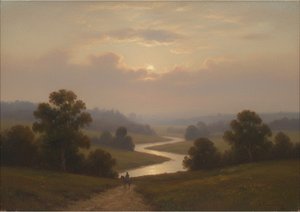
Atmospheric Visions: Exploring Tonalism in American Painting
Explore the captivating world of American Tonalism! Discover its history, key artists like Whistler & Inness, techniques, and lasting influence on art. Expert insights for collectors & enthusiasts.

Albert Bierstadt: Luminosity, Landscape & the American Ideal
Explore the breathtaking landscapes of Albert Bierstadt, master of the American West & a leading figure in the Hudson River School. Discover his luminous style and iconic paintings – a timeless investment for art lovers.

American Regionalism: A Crucible of Identity – Exploring Themes of Place, Labor & Social Commentary
Explore American Regionalism's powerful depiction of the American heartland during the Great Depression. Discover Grant Wood, Thomas Hart Benton & more. Expert analysis & high-quality art reproductions at OriginalUniqueArt.
