Vaihda tulosteeseen
 Lue lisää







































 Teoksille tai reproduktioille, joiden mikä tahansa sivu on suurempi kuin 105 cm (noin 41 tuumaa), kehys toimitetaan osina purettuna sarjana. Tämä menetelmä varmistaa turvallisen toimituksen ja ehkäisee vaurioita kuljetuksen aikana.


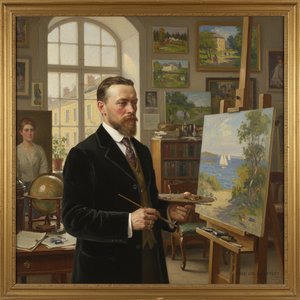
The Canvas as a Window: Albert Edelfelt’s Portrait of René Vallery-Radot
Albert Edelfelt's 1888 painting, “Portrait of René Vallery-Radot,” isn’t merely a likeness; it’s a carefully constructed tableau that speaks volumes about the man himself and the era in which he lived. Within the confines of a modestly sized canvas—measuring just over 45 by 31 centimeters—Edelfelt has captured not simply a face, but an entire life subtly interwoven with intellectual curiosity and familial devotion. The painting immediately draws the eye to René Vallery-Radot himself, seated at his desk, bathed in the soft glow of diffused light. His posture is relaxed yet attentive, suggesting a man deeply absorbed in thought – perhaps reviewing research notes or contemplating the implications of his scientific work alongside his role as husband and father.
Edelfelt’s masterful technique reveals a deliberate balance between realism and impressionistic sensitivity. He employs a meticulous attention to detail, evident in the rendering of René's features—the thoughtful furrow of his brow, the subtle lines around his eyes, and the precise brushstrokes defining his mustache. Yet, he avoids a photographic likeness, instead opting for a looser, more atmospheric approach to color and light. The background is deliberately muted, allowing the focus to remain firmly on the subject, while still hinting at the domestic setting—a testament to Edelfelt’s ability to capture not just what is seen but also the essence of a scene.
A Life in Science and Family: Contextualizing the Portrait
To fully appreciate “Portrait of René Vallery-Radot,” it's crucial to understand the context surrounding his life. René Vallery-Radot was a prominent figure in the scientific community, renowned for his work alongside Louis Pasteur in establishing pasteurization—a process that revolutionized food preservation and public health. He wasn’t simply an assistant; he played a vital role in developing and refining this groundbreaking technique. Simultaneously, he was a devoted husband to Marie-Louise Pasteur (Louis Pasteur's daughter) and a loving father to three children. Edelfelt skillfully portrays these dual roles—the scientist and the family man—without resorting to simplistic stereotypes.
The painting’s composition subtly reinforces this duality. The desk, laden with books, immediately establishes René’s intellectual pursuits. However, the inclusion of a small child's toy – a simple wooden horse – nestled amongst the scholarly volumes hints at his familial responsibilities and the joys of family life. This juxtaposition speaks to the harmonious balance he sought between his scientific endeavors and his personal relationships.
Symbolism and Emotional Resonance
Beyond its straightforward depiction, “Portrait of René Vallery-Radot” is rich in symbolic detail. The books on the desk represent knowledge, learning, and intellectual legacy—a direct reflection of René’s contributions to science. The muted colors and soft lighting evoke a sense of quiet contemplation and domestic tranquility. There's an underlying feeling of warmth and stability, suggesting a man grounded in his family and deeply committed to his work. The careful arrangement of the objects on the desk – from the inkwell to the writing implements—creates a visual rhythm that draws the eye inward, inviting the viewer to share in René’s focused attention.
Furthermore, the painting can be interpreted as a celebration of the Victorian ideal of domesticity. While acknowledging the scientific advancements of the era, Edelfelt subtly emphasizes the importance of family and intellectual pursuits within a stable home environment. It's a portrait that speaks to the values of hard work, dedication, and familial love—qualities highly esteemed in 19th-century society.
A Timeless Masterpiece: Reproductions and Artistic Legacy
Albert Edelfelt’s “Portrait of René Vallery-Radot” remains a captivating work of art, offering a glimpse into the life of a remarkable scientist and devoted family man. Reproductions of this painting are available in various sizes and formats, allowing art enthusiasts to bring this evocative image into their homes or offices. Whether displayed as a statement piece in a study or a thoughtful addition to a living room, this portrait continues to resonate with its quiet dignity, intellectual depth, and subtle emotional power—a testament to Edelfelt’s enduring artistic legacy.
Kysymykset ja vastaukset
Kuinka kylläisiä Albert Edelfelt:n "René Vallery-Radot" -teoksen värit ovat?
Teoksen Albert Edelfelt:n "René Vallery-Radot" värikylläisyys on Muted.
Mistä voin löytää teoksia, jotka muistuttavat teosta Albert Edelfelt:n "René Vallery-Radot"?
Teoksen Albert Edelfelt:n "René Vallery-Radot" Samankaltaisia teoksia -sivu esittelee samankaltaisia teoksia.
Onko teoksesta "René Vallery-Radot" saatavilla korkearesoluutioinen lataus?
Teoksen Albert Edelfelt:n "René Vallery-Radot" digitaalisen kuvan voi ostaa sen Digitaalinen teos -sivulta: korkearesoluutioinen digitaalinen kuvalataus.
 Esikatselu
 Jaa teos
 Jaa
Jaa
 Tiedot
 Opas
Opas

 Lataa kuva
 Samanlaisia kohteita
 Röntgenkuvaus
 Diaesitys
 Q&A
Q&A Tilastot