Thomas Cole portree

Thomas Cole maalid: 100 kuulsumat teost galeriin läbi

Uuendatud oktoober 2026 · järjestatud meie populaarsusindeksi järgi (otsingud, külastused ja tellimused igale teosele) · 596 teost Thomas Cole meie kataloogis

Lühidalt

Galleriile on Thomas Cole kõige kuulsam teos The Oxbow. The dream of the architect (1840) ja Väljutamine. Kuu ja tulipunkt (1828) täidavad kolmikut, mille iga silm tunnistab. Kunstnii Thomas Cole 596 teose põhjal esitleb galeriis allpool 100 kõige kuulsumat, kus iga originaal on märgitud aastaga, muuseumiga ja kirjeldatud, mis teeb selle unikaalseks.

1801 – 1848, Bolton Hudson river school Enamama teoseid: New York Historical Society

Galeria 10 parimat Thomas Cole maali

1
The Oxbow autor Thomas Cole

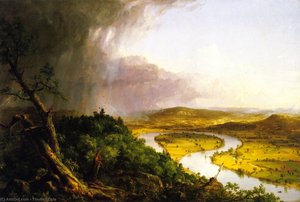
The Oxbow

Õlimaal kangaruumil

Ameerika romantismi meistriteos Thomas Cole'i teos "The Oxbow" on murdiliseline kunstiteos, mis tabab Ameerika metsikuse olemust ning looduse ja tsivilisatsiooni vahelist pinget. See ikooniline maastikupilt, mis on maalatud aastal 1836, on Hudsoni jõgi kooli nurgakivi – kunstiliikumuse, mis pühendas oma pühendumuse USA looduslikule ilule. Maal pakub panoramilist vaadet Connecticut'i jõelaadle kohe pärast äkklust, pakkudes draamatilist kontrasti vasakul asuva metsiku looduse ja paremal ulatuvate kultiveeritud põllumaade vahel. Kompositsioon ja tehnika Cole'i…

2
The dream of the architect (1840) autor Thomas Cole

The dream of the architect

1840 · Oil On Canvas · Toledo kunstimuuseum, Toledo

The work known as The dream of the architect, or The Architect's Dream, is an oil on canvas painting by the artist Thomas Cole. Created in 1840, this large-scale composition was commissioned by Ithiel Town in 1839. The image presents a complex arrangement of architectural forms that do not exist in a single physical location, instead forming an improbable landscape of various historical styles.

3
Väljutamine. Kuu ja tulipunkt (1828) autor Thomas Cole

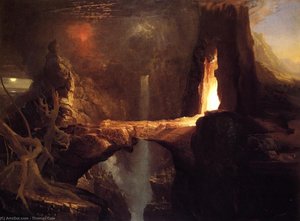
Väljutamine. Kuu ja tulipunkt

1828 · Õlimaal kangaruumil · Thyssen-Bornemisza Museum, Madrid

Thomas Cole'i maal "Ekstaas. Kuu ja tulivalgus", valminud 1828. aastal, on rohkem kui pelgalt maastikukunst; see on kutse sukelduda varase Ameerika esimese põlve vaimu – jõuetuse, saladuslikkuse ja süngasse imetlust tekitava sublime tunnetusse. Hudson River Schooli koolkonna pioneerina ei piirdu Cole'i töö loodusega, vaid annab sellele elukoha, võimu ja müsteeriumi. Vaataja on viidud tohutu kohti, kus teravad kaljud rebistavad pimedust, muistsed puujurid vänduvad nagu uinakad loomad ning kosilane kukkub nähtamatusse…

4
Vaade Firentsale San Miniaatost (1837) autor Thomas Cole

Vaade Firentsale San Miniaatost

1837 · Õlimaal kangaruumil · Cleveland Museum of Art, Cleveland

Thomas Cole’i “Vaade Firentsele San Miniatolt”, valminud aastal 1837, on hingustavalt ilus panoraam, mis jäädvustab Firenze igikestva ilu Itaalias. See maalitud maastikukunstiteos pakub laia vaateid linna ikoonilisele arhitektuurile, mis asetseb rullivate mägede ja kaugema mäeketi tausta ees. Stseen on sukeldatud sooja, pehme päikeseloojumise valgusesse, luues rahulikku ja maalähedast atmosfääri, mis kutsub vaatajat kaotsi minema selle vaikses kauniduses.

5
Uuring "Arcadia unistusest" jaoks (1838) autor Thomas Cole

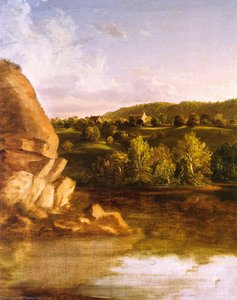
Uuring "Arcadia unistusest" jaoks

1838 · Õli paneelil · New York Historical Society, New York City

Thomas Cole'i "Study for Dream of Arcadia" (1838) on rohkem kui pelgupilt; see on aken teise maailma, kus looduse rahu ja lihtsus valitsevad. See maal, mis on esitatud õlilõuendil, kehastab Hudson’i jõe koolkonna idealismi – veendumust, et Ameerika maastikud võivad pakkuda vaimulikku tõestust ja põgenemist tööstusajastu kasvavast segadusest. Vaataja on koondatud maalitud stseeni südamesse, kus puude rühm ja väike hoone on asetatud idüllilisse keskkonda, mis on valgustatud kas varase hommikuse…

6
Elu reis: Lapseduse aeg (1842) autor Thomas Cole

Elu reis: Lapseduse aeg

1842 · Akrüül võimlusel · National Gallery of Art, Washington

Thomas Cole’i teos „The Voyage of Life: Childhood”, mille lõpetati 1842. aastal, paistab kui embleem Hudson River Schooli kunstlikust eetost – romantiliste ideaalide palavikust ombrust, mis on ilusasti sihvitud looduse täpsusega kavastamisega. See monumentaalne kangas on rohkem kui lihtsalt maastikupild; see embodies sügav allegoria inimliku oleiku endagi kohta, eriti elu reisil käivitatud algse etapi osas.

7
The Voyage of Life: Youth (1842) autor Thomas Cole

The Voyage of Life: Youth

1842 · Acrylic On Canvas · National Gallery of Art, Washington

Thomas Cole's "The Voyage of Life," specifically the depiction of Childhood, stands as a cornerstone of the Hudson River School movement and embodies its core tenets—a profound engagement with nature imbued with spiritual significance. Completed in 1842, this monumental canvas transcends mere landscape painting; it’s an elaborate allegory designed to illuminate the formative stages of human existence.

8
View on the Catskill, Early Autunm (1837) autor Thomas Cole

View on the Catskill, Early Autunm

1837 · Oil On Canvas · Metropolitan Museum of Art, New York

Thomas Cole’s “View on the Catskill, Early Autumn,” painted in 1837, isn't merely a landscape; it’s an invitation. An invitation to step into a world where the grandeur of nature intertwines with a profound sense of peace and contemplation. This iconic work, currently residing within the Metropolitan Museum of Art, stands as a cornerstone of the Hudson River School movement – a period that redefined American art by championing the…

9
Evening in Arcadia (1843) autor Thomas Cole

Evening in Arcadia

1843 · Oil On Canvas

Thomas Cole’s “Evening in Arcadia,” painted in 1843, is more than just a landscape; it’s a profound meditation on the relationship between humanity and nature. This masterpiece, born from the heart of the Hudson River School, captures a moment of serene beauty – a sunset casting long shadows across a pristine valley, a waterfall cascading into a tranquil pool, and figures thoughtfully observing this spectacle. Cole's work represents a pivotal…

10
Niagara Falls (1830) autor Thomas Cole

Niagara Falls

1830 · Oil On Canvas · Centennial One Object Exhibit, Unknown

To gaze upon Thomas Cole's Niagara Falls is to be swept away by the sheer, untamed power of creation itself. Painted in 1830, this masterpiece captures more than just a geographical spectacle; it arrests a moment where human contemplation meets an overwhelming natural force. As the founder of the Hudson River School, Cole possessed a singular ability to interpret the landscape not merely as scenery, but as a profound dialogue…

Thomas Cole maalid, järjestus 11 kuni 100

11River in the Catskills (1843) autor Thomas ColeRiver in the Catskills1843 · Museum of Fine Arts 12The Mountain Ford (1846) autor Thomas ColeThe Mountain Ford1846 · Metropolitan Museum of Art 13The Garden of Eden (1828) autor Thomas ColeThe Garden of Eden1828 · Amon Carter Museum of American Art 14View on the Schoharie (1826) autor Thomas ColeView on the Schoharie1826 15The Voyage of Life: Manhood (1842) autor Thomas ColeThe Voyage of Life: Manhood1842 · National Gallery of Art 16From the Top of Kaaterskill Falls (1826) autor Thomas ColeFrom the Top of Kaaterskill Falls1826 · Detroit Institute of Arts 17Sunny Morning on the Hudson River (1827) autor Thomas ColeSunny Morning on the Hudson River1827 · Fine Arts Museums of San Francisco 18View of the Arno (1838) autor Thomas ColeView of the Arno1838 · Thyssen-Bornemisza Museum 19Falls of the Kaaterskill (1826) autor Thomas ColeFalls of the Kaaterskill1826 20Falls at Catskill (1829) autor Thomas ColeFalls at Catskill1829 · Smithsonian American Art Museum 21Distant View of Niagara Falls (1830) autor Thomas ColeDistant View of Niagara Falls1830 · Art Institute of Chicago 22Daniel Boone Sitting at the Door of His Cabin on the Great Osage Lake, Kentucky (1826) autor Thomas ColeDaniel Boone Sitting at the Door of His Cabin on the Great Osage Lake, Kentucky1826 23Sunrise in the Catskill Mountains (1826) autor Thomas ColeSunrise in the Catskill Mountains1826 · National Gallery of Art 24The Consummation of the Empire (1836) autor Thomas ColeThe Consummation of the Empire1836 · New York Historical Society 25The Hunter (1845) autor Thomas ColeThe Hunter1845 · Amon Carter Museum of American Art 26The Voyage of Life, Youth autor Thomas ColeThe Voyage of Life, Youth 27The Architect (1840) autor Thomas ColeThe Architect1840 · Toledo kunstimuuseum 28Tree in the Catskills (1844) autor Thomas ColeTree in the Catskills1844 29Genesee Scenery (1847) autor Thomas ColeGenesee Scenery1847 30The Voyage of Life, Childhood autor Thomas ColeThe Voyage of Life, Childhood 31Peace at Sunset (also known as Evening in the White Mountains) (1827) autor Thomas ColePeace at Sunset (also known as Evening in the White Mountains)1827 · Fine Arts Museums of San Francisco 32Study for The Voyage of Life Youth (1839) autor Thomas ColeStudy for The Voyage of Life Youth1839 · Albany Institute of History - Art 33The Voyage of Life, Old Age autor Thomas ColeThe Voyage of Life, Old Age 34The Titan's Goblet (1833) autor Thomas ColeThe Titan's Goblet1833 · Metropolitan Museum of Art 35Valley of the Vaucluse (1841) autor Thomas ColeValley of the Vaucluse1841 · Metropolitan Museum of Art 36The Angel Appearing to the Shepherds autor Thomas ColeThe Angel Appearing to the ShepherdsChrysler Museum of Art 37In the Simmental, Switzerland (1843) autor Thomas ColeIn the Simmental, Switzerland1843 38The Voyage of Life: Old Age (1842) autor Thomas ColeThe Voyage of Life: Old Age1842 · National Gallery of Art 39Landscape with Figures: A Scene from 'The Last of the Mohicans' (1826) autor Thomas ColeLandscape with Figures: A Scene from 'The Last of the Mohicans'1826 40Frenchman's Bay, Mt. Desert Island (1844) autor Thomas ColeFrenchman's Bay, Mt. Desert Island1844 41The Voyage of Life: Youth (1840) autor Thomas ColeThe Voyage of Life: Youth1840 42Landscape Scene from 'The Last of the Mohicans' (1827) autor Thomas ColeLandscape Scene from 'The Last of the Mohicans'1827 43Winnipesaukee (1827) autor Thomas ColeWinnipesaukee1827 44The Cross and the World: Study for 'The Pilgrim of the World on His Journey' (1846) autor Thomas ColeThe Cross and the World: Study for 'The Pilgrim of the World on His Journey'1846 · Albany Institute of History - Art 45The Course of Empire: The Consummation of the Empire (1836) autor Thomas ColeThe Course of Empire: The Consummation of the Empire1836 · New York Historical Society 46Schroon Mountain, Adirondacks (1838) autor Thomas ColeSchroon Mountain, Adirondacks1838 47Catskill Landscape (1846) autor Thomas ColeCatskill Landscape1846 48Autumn Landscape (Mount Chocorua) (1828) autor Thomas ColeAutumn Landscape (Mount Chocorua)1828 49Italian Scene Composition (1833) autor Thomas ColeItalian Scene Composition1833 · New York Historical Society 50Niagara Falls (1830) autor Thomas ColeNiagara Falls1830 51The Voyage of Life: Manhood (detail) autor Thomas ColeThe Voyage of Life: Manhood (detail) 52A View of the Two Lakes and Mountain House, Catskill Mountains, Morning (1844) autor Thomas ColeA View of the Two Lakes and Mountain House, Catskill Mountains, Morning1844 · Brooklyn Museum 53View of Mt. Etna (1842) autor Thomas ColeView of Mt. Etna1842 · Virginia Kunstimuuseum 54View from Mount Holyoke, Northamptom, Massachusetts, after a Thunderstorm (detail) (1836) autor Thomas ColeView from Mount Holyoke, Northamptom, Massachusetts, after a Thunderstorm (detail)1836 · Metropolitan Museum of Art 55The Oxbow (also known as The Connecticut River near Northampton) (1836) autor Thomas ColeThe Oxbow (also known as The Connecticut River near Northampton)1836 56Expulsion from the Garden of Eden (1828) autor Thomas ColeExpulsion from the Garden of Eden1828 · Museum of Fine Arts 57Landscape (1845) autor Thomas ColeLandscape1845 · Minneapolis Institute of Art 58The Architect's Dream (1840) autor Thomas ColeThe Architect's Dream1840 · Toledo kunstimuuseum 59View from Mount Holyoke, Northamptom, Massachusetts, after a Thunderstorm (The Oxbow) (1836) autor Thomas ColeView from Mount Holyoke, Northamptom, Massachusetts, after a Thunderstorm (The Oxbow)1836 · Metropolitan Museum of Art 60Sketch for View from Mount Holyoke, Northampton, Massachusetts, after a Thunderstorm (The Oxbow) (1836) autor Thomas ColeSketch for View from Mount Holyoke, Northampton, Massachusetts, after a Thunderstorm (The Oxbow)1836 · Metropolitan Museum of Art 61The Architect's Dream (detail) (1840) autor Thomas ColeThe Architect's Dream (detail)1840 · Toledo kunstimuuseum 62The Hunter s Return (1845) autor Thomas ColeThe Hunter s Return1845 · Amon Carter Museum of American Art 63L'Allegro (also known as Italian Sunset) (1845) autor Thomas ColeL'Allegro (also known as Italian Sunset)1845 · Los Angeles County Museum of Art 64The Course of Empire: Destruction (1836) autor Thomas ColeThe Course of Empire: Destruction1836 · New York Historical Society 65Summer Twilight (1827) autor Thomas ColeSummer Twilight1827 66Study for Standing Shepherd (1831) autor Thomas ColeStudy for Standing Shepherd1831 · Detroit Institute of Arts 67A Wild Scene (1832) autor Thomas ColeA Wild Scene1832 · Baltimore Museum of Art 68The Four Times of Day in Italy (1836) autor Thomas ColeThe Four Times of Day in Italy1836 · Albany Institute of History - Art 69Indian Pass Tahawus (1847) autor Thomas ColeIndian Pass Tahawus1847 70View of Florence from San Miniato (1837) autor Thomas ColeView of Florence from San Miniato1837 71The Voyage of Life: Old Age (1840) autor Thomas ColeThe Voyage of Life: Old Age1840 72Mount Aetna from Taormina (1843) autor Thomas ColeMount Aetna from Taormina1843 73The Fountain of Vaucluse (1841) autor Thomas ColeThe Fountain of Vaucluse1841 74Moonlight - Piazza Vecchia autor Thomas ColeMoonlight - Piazza Vecchia 75The Course of Empire The Arcadian or Pastoral State - Thomas Cole (2026) autor Thomas ColeThe Course of Empire The Arcadian or Pastoral State - Thomas Cole2026 76On Catskill Creek (unfinished.) (1836) autor Thomas ColeOn Catskill Creek (unfinished.)1836 77Prometheus Bound (1847) autor Thomas ColePrometheus Bound1847 · Fine Arts Museums of San Francisco 78Schroon Mountain, Adirondacks, Essex County, New York, after a Storm (1838) autor Thomas ColeSchroon Mountain, Adirondacks, Essex County, New York, after a Storm1838 79View of Monte Video Seat of Daniel Wadsworth (1828) autor Thomas ColeView of Monte Video Seat of Daniel Wadsworth1828 80John Gallier (1799-1881) (1835) autor Thomas ColeJohn Gallier (1799-1881)1835 · New York Historical Society 81Landscape Composition Italian Scenery (1832) autor Thomas ColeLandscape Composition Italian Scenery1832 · Memorial Art Gallery 82The Cross and the World: Study for 'Two Youths Enter Upon a Pilgrimage - One to Cross the Other to the World (1846) autor Thomas ColeThe Cross and the World: Study for 'Two Youths Enter Upon a Pilgrimage - One to Cross the Other to the World1846 83Dead Rising from Tombs (1848) autor Thomas ColeDead Rising from Tombs1848 84Indian at Sunset (1847) autor Thomas ColeIndian at Sunset1847 85LA CROIX DANS LA SOLITUDE autor Thomas ColeLA CROIX DANS LA SOLITUDELouvre'i muuseum 86Saint John in the Wilderness autor Thomas ColeSaint John in the Wilderness 87Campagna di Roma (study for Aqueduct near Rome) (1832) autor Thomas ColeCampagna di Roma (study for Aqueduct near Rome)1832 88Falls of Kaaterskill (1826) autor Thomas ColeFalls of Kaaterskill1826 89View near the Village of Catskill (1827) autor Thomas ColeView near the Village of Catskill1827 · Fine Arts Museums of San Francisco 90The Past (1838) autor Thomas ColeThe Past1838 · Mead Art Museum 91The Departure (1838) autor Thomas ColeThe Departure1838 · National Gallery of Art 92The Voyage of Life: Childhood (1839) autor Thomas ColeThe Voyage of Life: Childhood1839 93Arch of Nero, Tivoli (1832) autor Thomas ColeArch of Nero, Tivoli1832 · Detroit Institute of Arts 94Study for a Wild Scene autor Thomas ColeStudy for a Wild Scene 95Catskill Creek, New York autor Thomas ColeCatskill Creek, New YorkNew York Historical Society 96Nude Male with Bow and Arrow autor Thomas ColeNude Male with Bow and Arrow 97The Vesper Hymn autor Thomas ColeThe Vesper HymnYale University Art Gallery 98Study for a Scene from Lord Byron’s “Manfred” (1833) autor Thomas ColeStudy for a Scene from Lord Byron’s “Manfred”1833 · Yale University Art Gallery 99Study for The Angel Appearing to the Shepherds (1831) autor Thomas ColeStudy for The Angel Appearing to the Shepherds1831 · Chrysler Museum of Art 100Self-Portrait (1836) autor Thomas ColeSelf-Portrait1836

Thomas Cole kuulsaimad maalid ajastult ajastule

Teemad, mis püüdisid Thomas Cole pilma

Neli teemat, mis esinevad neis originaalkindel kõige sagedamini, ning iga teema parim näide.

Muuseumid, kus on säilitatud Thomas Cole originaalteosed

Kümne 8 muuseumi kollektsioonid, mis sisaldavad kõige rohkem sellel lehel esitatud teoseid.

Muuseumid Linn Thomas Cole teosid Selle nimekirja maalid
New York Historical Society, New York CityNew York Historical Society New York City 13 Uuring "Arcadia unistusest" jaoks, The Consummation of the Empire, The Course of Empire: The Consummation of the Empire
Metropolitan Museum of Art, New YorkMetropolitan Museum of Art New York 11 View on the Catskill, Early Autunm, The Mountain Ford, The Titan's Goblet
National Gallery of Art, WashingtonNational Gallery of Art Washington 14 Elu reis: Lapseduse aeg, The Voyage of Life: Youth, The Voyage of Life: Manhood
Toledo kunstimuuseum, ToledoToledo kunstimuuseum Toledo 5 The dream of the architect, The Architect, The Architect's Dream
Fine Arts Museums of San Francisco, San FranciscoFine Arts Museums of San Francisco San Francisco 4 Sunny Morning on the Hudson River, Peace at Sunset (also known as Evening in the White Mountains), Prometheus Bound
Detroit Institute of Arts, DetroitDetroit Institute of Arts Detroit 15 From the Top of Kaaterskill Falls, Study for Standing Shepherd, Arch of Nero, Tivoli
Albany Institute of History - Art, AlbanyAlbany Institute of History - Art Albany 9 Study for The Voyage of Life Youth, The Cross and the World: Study for 'The Pilgrim of the World on His Journey', The Four Times of Day in Italy
Amon Carter Museum of American Art, Fort WorthAmon Carter Museum of American Art Fort Worth 4 The Garden of Eden, The Hunter, The Hunter s Return

Thomas Cole, iga kümnendiga üks signatuurpilt

Teosed aastakate kaupa

Vali vuosakülg, et näha selle ajastu definieerivat originaalteost.

Thomas Cole maalid: galerii vastused

Milline Thomas Cole maal on kõige kuulsam?Paljasta vastus

The Oxbow. Järgnevad The dream of the architect (1840) ja Väljutamine. Kuu ja tulipunkt (1828).

Millised on Thomas Cole top 10 maali?Paljasta vastus

The Oxbow, The dream of the architect, Väljutamine. Kuu ja tulipunkt, Vaade Firentsale San Miniaatost, Uuring "Arcadia unistusest" jaoks, Elu reis: Lapseduse aeg, The Voyage of Life: Youth, View on the Catskill, Early Autunm, Evening in Arcadia ja Niagara Falls. Ülemine reiting näitab iga teose puhul aastat ja muuseumi.

Kui palju teoseid Thomas Cole lõi?Paljasta vastus

Meie kataloogist leiate 596 teost kunstnikult Thomas Cole, mis on pärinevad ajastust 1826 kuni 1848.

Kust leiad Thomas Cole kõige kuulsamad originaalteosed?Paljasta vastus

Peamiselt New York Historical Society (New York City), Metropolitan Museum of Art (New York) ja National Gallery of Art (Washington) muuseumites. Ülalpool olevate muuseumite tabelis on nendest kõik loetletud.

Millal lõi Thomas Cole oma kuulsamad maalid?Paljasta vastus

Ajal 1830s: 34 100 sellel lehel olevat teost on sellel perioodil loodud, მათart közül Vaade Firentsale San Miniaatost.

Millised on Thomas Cole varased ja hilised kuulsad teosed?Paljasta vastus

Sellel lehel on kõige vanem teos View on the Schoharie (1826) ja kõige värskeim Dead Rising from Tombs (1848).

Millist teemat Thomas Cole kõige rohkem käsitledas?Paljasta vastus

Landscape (44), Mountains (21) ja Landscape painting (18), kogu selle lehekülje 100 teose kohta.

Millises tehnikas töötas Thomas Cole kõige rohkem?Paljasta vastus

Oil On Canvas, 57 teoseks 100 töödelt sellel lehel.

Millise suunaga on Thomas Cole seotud?Paljasta vastus

Hudson river school, seda lähtudes selle lehe originaalteostest.

Milliseid Thomas Cole originaalte New York Historical Society kogumuses on?Paljasta vastus

Uuring "Arcadia unistusest" jaoks, The Consummation of the Empire ja The Course of Empire: The Consummation of the Empire: New York Historical Society, New York City säilitab 7 selle lehel olevat teost.

Kas ma saan Thomas Cole maali käsitsi reprodutseerida?Paljasta vastus

Jah, reproduktsioonina: originaal jääb oma museumi, kuid mis tahes selle lehe maal võib olla teie jaoks käsitsi maaldav, tellustööna valmistatud üksik teos, mida saab tellida maali oma lehel.

Thomas Cole: kunstnik

The Life and Art of Thomas Cole

Born on February 1, 1801, in Bolton le Moors, Lancashire, England, Thomas Cole began his life far from the landscapes that would eventually define his name. His family emigrated to the United States in 1818, seeking a new beginning in a land of vast, unmapped territories. In those early years, he was a man of many trades, working as an engraver and later finding steady work as a portrait painter starting in 1822. He was largely self-taught, developing his eye through observation and the study of books rather than formal academic training. This independence of spirit allowed him to look at the American wilderness through a lens that was entirely his own.

His focus eventually shifted from the faces of individuals to the grand scale of the natural world. By founding the Hudson River School, he provided a visual language for a nation still defining itself. His work often sought to find a spiritual resonance within the untamed forests and mountains, moving away from the structured traditions of Europe. He lived a life of constant observation, finding profound meaning in the interplay of light and shadow across the valleys of the New World. This dedication to the landscape continued until his death on February 11, 1848, in Catskill, New York.

Residency in Catskill and New York

After a period of living in Philadelphia, Cole moved to Catskill, New York, in 1825. This relocation proved to be the defining setting of his life and creative output. By 1827, he had established a permanent studio at Cedar Grove, a farm in Catskill that provided both a residence and a workspace. It was within this landscape that he transitioned from his early work as a portrait painter to the focused study of the American wilderness.

His domestic life in the Catskills was marked by a significant union in 1836, when he married Maria Bartow. This period of stability coincided with his most productive years, as he worked from his studio to translate the surrounding topography into his large-scale canvases. The environment of the Hudson River Valley was not merely a backdrop for his subjects but a constant presence in his daily existence.

The end of his life came as abruptly as the seasonal shifts he so often painted. Cole died in Catskill on February 11, 1848, following a struggle with pleurisy. He left behind a body of work that was deeply rooted in the soil and light of the region where he had spent his most formative decades.

Technique and Artistic Style

Cole worked primarily with oil on canvas, a medium that allowed him to develop a reputation for both romantic landscape and history paintings. His approach often involved placing small figures or solitary structures against moody, expansive natural landscapes. These compositions were rarely mere scenery; they were frequently allegorical, using the physical world to suggest deeper moral or spiritual meanings. He possessed a keen ability to render the textures of the American wilderness, often using the interplay of light and shadow to create a sense of atmosphere and depth.

His aesthetic was often viewed as conservative, reflecting a certain resistance to the rapid changes of his era. Through his brushwork, he offered a quiet critique of the contemporary trends of industrialism, urbanism, and the relentless push of westward expansion. He preferred to frame the New World as a pristine, natural eden, a sharp contrast to the smog-filled cityscapes of the Industrial Revolution-era Britain in which he grew up. This preference for the untamed over the built environment gave his work a distinct, often escapist, character.

Key Works and Major Series

Cole’s early output revealed a growing fascination with the raw power of the American landscape. In 1826, he produced Kaaterskill Falls, a work that captured the vertical energy of the wilderness. As his ambitions expanded, he moved toward more complex compositions. Around 1833, he painted The Titan's Goblet, and by 1836, he had completed The Oxbow, a painting that juxtaposed the untamed river valley against the encroaching presence of cultivated farmland. This tension between the wild and the settled became a recurring theme in his visual language.

His most ambitious undertaking was the five-part series The Course of Empire, completed in 1836. Through these canvases, he traced the cyclical rise and fall of civilizations, from a pristine state to inevitable destruction. This interest in the passage of time and the human condition continued into his later years. In 1842, he painted The Voyage of Life, an allegorical series depicting the stages of an individual's existence. His final years saw a shift toward even more profound, often religious or mythological, subject matter. This is evident in The Architect's Dream, painted about 1840, and Prometheus Bound in 1847, a large-scale work based on the Greek tragedy. Even his 1845 work, The Hunter, reflected this ability to place human figures within a vast, sun-drenched valley.

Circle, Rivals and Pupils

Cole’s life was anchored by a network of intimate connections that extended from his immediate family to the most promising talents of his era. His sister, Sarah Cole, shared his inclination toward the landscape, establishing herself as a painter in her own right. Within his own household, the artistic impulse was a shared language; his daughter, Emily Cole, pursued a different but related path, working as a botanical artist with watercolors and applying her skill to the delicate medium of porcelain.

His professional influence was felt most directly through the mentorship of Frederic Edwin Church. By guiding Church, Cole ensured that the principles of the Hudson River School would find a powerful successor. This lineage was not merely a matter of technique but a passing of a specific way of seeing the American wilderness. Beyond his formal pupils, Cole maintained a deep and enduring friendship with Daniel Wadsworth, a connection that provided a steady presence amidst his prolific output.

Legacy and Enduring Influence

The departure of Thomas Cole in 1848 left a void in the American landscape that many spent decades attempting to fill. As the founder of the Hudson River School, he provided the first significant vocabulary for a nation seeking to define itself through its own soil and sky. His work moved beyond the mere recording of scenery, establishing a visual language that allowed subsequent generations of painters to explore the spiritual and moral dimensions of the wilderness. This shift helped transform American art from a provincial imitation of European traditions into a distinct and powerful force.

His influence reached far beyond the immediate circle of his contemporaries. By teaching the importance of direct observation paired with deep philosophical inquiry, he shaped the trajectory of American landscape painting for much of the nineteenth century. His ability to weave allegory into the natural world ensured that his impact was felt not only in the aesthetics of the brushstroke but in the very way the American wilderness was perceived by the public. He remains a cornerstone of American artistic achievement, a figure whose presence is felt in the continued study of the relationship between humanity and the untamed environment.

Where to See the Works Today

To encounter the physical traces of his vision, one must travel to the major repositories of American art. The Metropolitan Museum of Art in New York holds significant pieces of his output, including his study for the "Dream of Arcadia." In Washington D.C., the National Gallery of Art preserves several of his important canvases, such as "The Voyage of Life: Childhood," "The Voyage of Life: Manhood," and "The Voyage of Life: Old Age." These works allow for a direct study of his approach to the human experience through the lens of the natural landscape.

The Museum of Fine Arts in Boston also maintains a collection of his paintings, offering further insight into his development. For those seeking a connection to his personal environment, the Thomas Cole National Historic Site in Catskill, New York, preserves the actual home and studio where he lived and worked. This site, known as Cedar Grove, provides a rare glimpse into the domestic and creative spaces that shaped his life and his observations of the Hudson River Valley.

Kõik 596 teost Thomas Cole →