Kawanabe Kyōsai portree

72 kulubumatamatumat Kawanabe Kyōsai maalist, millist on vaid üks

Uuendatud november 2026 · järjestatud meie populaarsusindeksi järgi (otsingud, külastused ja tellimused igale teosele) · 72 teost Kawanabe Kyōsai meie kataloogis

Lühidalt

Three Kyōgen Dancers (801) on Kawanabe Kyōsai maalide kõige silmapaistvam teos; originaal kuulub museumi Metropolitan Museum of Art, New York. Pärast seda suunatakse pilk Sketches of East Asian Legendary Figures (801) ja Yang Guifei Adjusting her Hair (1850) suunas. Meie kataloogis olevatest Kawanabe Kyōsai 72 teosest on need 72 kõige kuulsumat, millist igaüks on esitatud koos aasta, muuseumi ja põhjusega, miks teos on püsiv.

1831 – 1889, Koga Ukiyo-e Enamama teoseid: Metropolitan Museum of Art

Kawanabe Kyōsai top 10 maalist galeriist vaatenurgast

1
Three Kyōgen Dancers (801) autor Kawanabe Kyōsai

Three Kyōgen Dancers

801 · Ink · Metropolitan Museum of Art, New York

A preliminary ink drawing captures three performers in the midst of a kyōgen dance. These figures, rendered with a fluid and spontaneous energy, embody the comedic essence of traditional Japanese theater. Each dancer is frozen in a distinct, expressive pose that suggests movement and rhythmic timing. One figure holds a drum, another a fan, and the third a bag, marking the specific roles and props essential to the performance. The…

2
Sketches of East Asian Legendary Figures (801) autor Kawanabe Kyōsai

Sketches of East Asian Legendary Figures

801 · Ink · Metropolitan Museum of Art, New York

The ink flows across the paper, capturing a moment of quietude and myth. In this black and white drawing, figures from the realm of legend emerge from the shadows of the everyday. We see Japanese figures like Daikoku and Urashima Tarō sharing space with Chinese immortals and the Twenty-Four Paragons of Filial Piety. There is a strange, casual intimacy to the scene, as if these divine and legendary beings have…

3
Yang Guifei Adjusting her Hair (1850) autor Kawanabe Kyōsai

Yang Guifei Adjusting her Hair

1850 · Ink On Paper · Los Angeles County Museum of Art, Los Angeles

In "Yang Guifei Adjusting her Hair" by Kawanabe Kyōsai, the brush captures a moment of quiet preparation. The subject is Yang Guifei, a woman known to history as Lady Yang. She was the beloved consort of Emperor Xuanzong of Tang and remains celebrated as one of the Four Beauties of ancient China. Here, she is a figure of grace, focused on the delicate task of arranging her hair.

4
Yamauba and Kintarō (1850) autor Kawanabe Kyōsai

Yamauba and Kintarō

1850 · Ink On Paper · Los Angeles County Museum of Art, Los Angeles

In this vertical composition, Kawanabe Kyōsai presents a dynamic encounter between two figures from Japanese folklore. The work, created about 1850, centers on the mountain hag Yamauba and the superhuman child Kintarō. A large, standing female figure dominates the space, her presence defined by the voluminous folds of her robes. Beside her, a smaller, crouching male figure provides a sense of scale and tension. The arrangement of these two bodies…

5
Hell Courtesan (1870) autor Kawanabe Kyōsai

Hell Courtesan

1870 · Cleveland Museum of Art, Cleveland

The scene unfolds within the delicate confines of a hanging scroll, where the figure of the Hell Courtesan, known in Japanese as Jigoku Tayū, emerges from the silk. This work, titled Hell Courtesan, captures a moment of profound stillness and spiritual weight. The artist, Kawanabe Kyōsai, brings this legendary character to life through a composition that balances the elegance of a high-ranking courtesan with the unsettling imagery of the afterlife.…

6
Frolicking Figures and Animals (1870) autor Kawanabe Kyōsai

Frolicking Figures and Animals

1870 · Ink On Paper · Metropolitan Museum of Art, New York

In this horizontal handscroll from 1870, we find a quiet, almost whispered dialogue between human presence and the natural world. The composition relies heavily on the use of negative space, a deliberate emptiness that allows the viewer to focus entirely on the gestural energy of the brushstrokes. It is a work of profound restraint, where the absence of color speaks more loudly than a full palette could. The monochromatic shades…

7
Calligraphy and Painting Party (1877) autor Kawanabe Kyōsai

Calligraphy and Painting Party

1877 · Ink On Paper

Calligraphy and Painting Party is a hanging scroll created by the Japanese painter and caricaturist Kawanabe Kyōsai. Born in 1831 in Koga, Japan, the artist navigated the shifting tides of the Edo and Meiji periods. This work dates to 1880, a moment when his brush captured the restless energy of a changing nation. His hand moved with the precision of a trained scholar and the wit of a satirist.

8
Wisteria Maiden and Demon Priest (1872) autor Kawanabe Kyōsai

Wisteria Maiden and Demon Priest

1872 · Ink · Minneapolis Institute of Art, Minneapolis

In this work, Wisteria Maiden and Demon Priest, Kawanabe Kyōsai presents a dramatic encounter between a maiden and a demon priest. The composition is centered on a woman dressed in an ornate, multi-colored kimono featuring red, blue, and white patterns. She appears to dance or float gracefully above a crouching, monstrous figure. This figure, the demon priest, is depicted with a weathered, muscular, and grotesque face, wearing dark, heavy robes…

9
Painting Party (1880) autor Kawanabe Kyōsai

Painting Party

1880 · Woodblock Print · Cleveland Museum of Art, Cleveland

Painting Party is a traditional Japanese ukiyo-e woodblock print by Kawanabe Kyōsai. The artist, born in 1831 in Koga, Japan, lived until 1889. This work emerged from a life defined by the shifting currents of the Meiji era. It captures a specific moment of social gathering through the precision of the woodblock medium.

10
Night Procession of One Hundred Demons (1880) autor Kawanabe Kyōsai

Night Procession of One Hundred Demons

1880 · Ink

Kawanabe Kyōsai painted Night Procession of One Hundred Demons about 1880. The work captures a Hyakki Yagyō, a traditional Japanese Night Parade of One Hundred Demons. This supernatural event brings a chaotic procession of various yokai into the light of the viewer's gaze. It is a rhythmic movement of spirits passing through the dark.

Kawanabe Kyōsai kuulsad maalid, numbrid 11 kuni 72

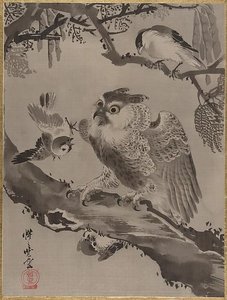
11Hell Courtesan (1880) autor Kawanabe KyōsaiHell Courtesan1880 12Jurōjin [center of a triptych] (1884) autor Kawanabe KyōsaiJurōjin [center of a triptych]1884 · Minneapolis Institute of Art 13Theatre Curtain of Shintomi-za, with an Impromputu Sketch Monster (1880) autor Kawanabe KyōsaiTheatre Curtain of Shintomi-za, with an Impromputu Sketch Monster1880 14Squirrels Eating Chestnuts (1886) autor Kawanabe KyōsaiSquirrels Eating Chestnuts1886 · Los Angeles County Museum of Art 15A Beauty in Front of King Enma's Mirror (1887) autor Kawanabe KyōsaiA Beauty in Front of King Enma's Mirror1887 16Urashima Tarō Riding on a Tortoise (1888) autor Kawanabe KyōsaiUrashima Tarō Riding on a Tortoise1888 · Metropolitan Museum of Art 17Two Children Playing with Goldfish (1887) autor Kawanabe KyōsaiTwo Children Playing with Goldfish1887 · Metropolitan Museum of Art 18Two Birds on a Branch (1887) autor Kawanabe KyōsaiTwo Birds on a Branch1887 · Metropolitan Museum of Art 19Singing Bird on a Branch (1887) autor Kawanabe KyōsaiSinging Bird on a Branch1887 · Metropolitan Museum of Art 20滝に燕図 Swallows by a Waterfall (1887) autor Kawanabe Kyōsai滝に燕図 Swallows by a Waterfall1887 · Metropolitan Museum of Art 21Tale of the Tongue-cut Sparrow (1800) autor Kawanabe KyōsaiTale of the Tongue-cut Sparrow1800 · Los Angeles County Museum of Art 22Sketches of Birds and Animals (1870) autor Kawanabe KyōsaiSketches of Birds and Animals1870 · Metropolitan Museum of Art 23Three Crossbills on a Leafless Tree (1878) autor Kawanabe KyōsaiThree Crossbills on a Leafless Tree1878 · Minneapolis Institute of Art 24Chinese-style Landscape with Man Fishing from a Boat by Moonlight [right of a triptych] (1884) autor Kawanabe KyōsaiChinese-style Landscape with Man Fishing from a Boat by Moonlight [right of a triptych]1884 · Minneapolis Institute of Art 25Landscape with River in Mountainous Country [left of a triptych] (1884) autor Kawanabe KyōsaiLandscape with River in Mountainous Country [left of a triptych]1884 · Minneapolis Institute of Art 26猿を襲う鷲図 Eagle Attacking a Monkey (1885) autor Kawanabe Kyōsai猿を襲う鷲図 Eagle Attacking a Monkey1885 · Metropolitan Museum of Art 27兎を追う鷲図 Eagle Pursuing Rabbit (1885) autor Kawanabe Kyōsai兎を追う鷲図 Eagle Pursuing Rabbit1885 · Metropolitan Museum of Art 28Eagle Attacking a Mountain Lion (1885) autor Kawanabe KyōsaiEagle Attacking a Mountain Lion1885 · Metropolitan Museum of Art 29White Eagle Eyeing a Mountain Lion (1885) autor Kawanabe KyōsaiWhite Eagle Eyeing a Mountain Lion1885 · Metropolitan Museum of Art 30Rocky Landscape (1887) autor Kawanabe KyōsaiRocky Landscape1887 · Metropolitan Museum of Art 31Crow on a Branch (1887) autor Kawanabe KyōsaiCrow on a Branch1887 · Metropolitan Museum of Art 32Untitled (D2X7KF) (1887) autor Kawanabe KyōsaiUntitled (D2X7KF)1887 · Metropolitan Museum of Art 33Fox Catching Bird (1887) autor Kawanabe KyōsaiFox Catching Bird1887 · Metropolitan Museum of Art 34Bird and Frog (1887) autor Kawanabe KyōsaiBird and Frog1887 · Metropolitan Museum of Art 35松に鴉図 Two Crows on a Pine Branch (1887) autor Kawanabe Kyōsai松に鴉図 Two Crows on a Pine Branch1887 · Metropolitan Museum of Art 36Cranes in Marsh (1887) autor Kawanabe KyōsaiCranes in Marsh1887 · Metropolitan Museum of Art 37Buffalo and Herdsman (1887) autor Kawanabe KyōsaiBuffalo and Herdsman1887 · Metropolitan Museum of Art 38柳に鴉図 Crow and Willow Tree (1887) autor Kawanabe Kyōsai柳に鴉図 Crow and Willow Tree1887 · Metropolitan Museum of Art 39岩に鴉図 Crow on a Rock (1887) autor Kawanabe Kyōsai岩に鴉図 Crow on a Rock1887 · Metropolitan Museum of Art 40Owl Mocked by Small Birds (1887) autor Kawanabe KyōsaiOwl Mocked by Small Birds1887 · Metropolitan Museum of Art 41木に鴉図 Crow on a Branch (1887) autor Kawanabe Kyōsai木に鴉図 Crow on a Branch1887 · Metropolitan Museum of Art 42竹に鴉図 Crow on a Bamboo Branch (1887) autor Kawanabe Kyōsai竹に鴉図 Crow on a Bamboo Branch1887 · Metropolitan Museum of Art 43旭に群鴉図 Flock of Crows at Dawn (1887) autor Kawanabe Kyōsai旭に群鴉図 Flock of Crows at Dawn1887 · Metropolitan Museum of Art 44ムクドリ図 Starlings on a Branch (1887) autor Kawanabe Kyōsaiムクドリ図 Starlings on a Branch1887 · Metropolitan Museum of Art 45Fish in a Whirlpool (1887) autor Kawanabe KyōsaiFish in a Whirlpool1887 · Metropolitan Museum of Art 46富士図 Mount Fuji (1887) autor Kawanabe Kyōsai富士図 Mount Fuji1887 · Metropolitan Museum of Art 47Rocky Landscape (1887) autor Kawanabe KyōsaiRocky Landscape1887 · Metropolitan Museum of Art 48瓜に鼠図 Mice in a Melon (1887) autor Kawanabe Kyōsai瓜に鼠図 Mice in a Melon1887 49Eagle Attacking Fish (1887) autor Kawanabe KyōsaiEagle Attacking Fish1887 · Metropolitan Museum of Art 50Squirrels Gathering Chestnuts (1887) autor Kawanabe KyōsaiSquirrels Gathering Chestnuts1887 · Metropolitan Museum of Art 51Monkey Hanging from Grapevines (1887) autor Kawanabe KyōsaiMonkey Hanging from Grapevines1887 · Metropolitan Museum of Art 52雪中鴉図 Crow Flying in the Snow (1887) autor Kawanabe Kyōsai雪中鴉図 Crow Flying in the Snow1887 · Metropolitan Museum of Art 53Waterfall, Eagle and Monkey (1887) autor Kawanabe KyōsaiWaterfall, Eagle and Monkey1887 · Metropolitan Museum of Art 54月に鴉図 Crow and the Moon (1887) autor Kawanabe Kyōsai月に鴉図 Crow and the Moon1887 · Metropolitan Museum of Art 55Pheasant Caught by a Snake (1887) autor Kawanabe KyōsaiPheasant Caught by a Snake1887 · Metropolitan Museum of Art 56Shakyamuni Conquering the Demons (Shaka Gōma zu) (1888) autor Kawanabe KyōsaiShakyamuni Conquering the Demons (Shaka Gōma zu)1888 · Metropolitan Museum of Art 57Eagle Holding Small Bird (1887) autor Kawanabe KyōsaiEagle Holding Small Bird1887 · Metropolitan Museum of Art 58Monkeys (1888) autor Kawanabe KyōsaiMonkeys1888 · Metropolitan Museum of Art 59Deer and Monkeys (1887) autor Kawanabe KyōsaiDeer and Monkeys1887 · Metropolitan Museum of Art 60Rabbits (1887) autor Kawanabe KyōsaiRabbits1887 · Metropolitan Museum of Art 61Cat Catching a Frog (1887) autor Kawanabe KyōsaiCat Catching a Frog1887 · Metropolitan Museum of Art 62水辺に鴉図 Crow and Reeds by a Stream (1887) autor Kawanabe Kyōsai水辺に鴉図 Crow and Reeds by a Stream1887 · Metropolitan Museum of Art 63白衣観音図 White Robed Kannon (1887) autor Kawanabe Kyōsai白衣観音図 White Robed Kannon1887 · Metropolitan Museum of Art 64Playful Demon autor Kawanabe KyōsaiPlayful DemonYale University Art Gallery 65Frolicking Animals, Nekomata and Tanuki Badger autor Kawanabe KyōsaiFrolicking Animals, Nekomata and Tanuki Badger 66Long Arms [right of a pair of Long Legs and Long Arms] autor Kawanabe KyōsaiLong Arms [right of a pair of Long Legs and Long Arms]Minneapolis Institute of Art 67Long Legs [left of a pair of Long Legs and Long Arms] autor Kawanabe KyōsaiLong Legs [left of a pair of Long Legs and Long Arms]Minneapolis Institute of Art 68Seven Otafukus autor Kawanabe KyōsaiSeven OtafukusMinneapolis Institute of Art 69Tanuki (Racoon Dog) Viewing Its Reflection in Water (801) autor Kawanabe KyōsaiTanuki (Racoon Dog) Viewing Its Reflection in Water801 · Metropolitan Museum of Art 70Boy’s Day Carp Streamer and Shōki Banner (1870) autor Kawanabe KyōsaiBoy’s Day Carp Streamer and Shōki Banner1870 · Metropolitan Museum of Art 71Figure Sketches autor Kawanabe KyōsaiFigure Sketches 72Frolicking Figures and Animals autor Kawanabe KyōsaiFrolicking Figures and Animals

Kawanabe Kyōsai kuulsaimad maalid ajastult ajastule

Teemad, mis püüdisid Kawanabe Kyōsai pilma

Neli teemat, mis esinevad neis originaalkindel kõige sagedamini, ning iga teema parim näide.

Muuseumid, kus on säilitatud Kawanabe Kyōsai originaalteosed

Kümne 5 muuseumi kollektsioonid, mis sisaldavad kõige rohkem sellel lehel esitatud teoseid.

Muuseumid Linn Kawanabe Kyōsai teosid Selle nimekirja maalid
Metropolitan Museum of Art, New YorkMetropolitan Museum of Art New York 48 Three Kyōgen Dancers, Sketches of East Asian Legendary Figures, Frolicking Figures and Animals
Minneapolis Institute of Art, MinneapolisMinneapolis Institute of Art Minneapolis 8 Wisteria Maiden and Demon Priest, Jurōjin [center of a triptych], Three Crossbills on a Leafless Tree
Los Angeles County Museum of Art, Los AngelesLos Angeles County Museum of Art Los Angeles 4 Yang Guifei Adjusting her Hair, Yamauba and Kintarō, Squirrels Eating Chestnuts
Cleveland Museum of Art, ClevelandCleveland Museum of Art Cleveland 2 Hell Courtesan, Painting Party
Yale University Art Gallery, New HavenYale University Art Gallery New Haven 1 Playful Demon

Kawanabe Kyōsai aastakatega: iga aastakannaga üks unikaalne originaal

Teosed aastakate kaupa

Vali vuosakülg, et näha selle ajastu definieerivat originaalteost.

Kawanabe Kyōsai maalid: küsimused galeriile

Mis on Kawanabe Kyōsai kõige kuulsam teos?Paljasta vastus

Three Kyōgen Dancers (801), Metropolitan Museum of Art, New York. Järgnevad Sketches of East Asian Legendary Figures (801) ja Yang Guifei Adjusting her Hair (1850).

Millised on Kawanabe Kyōsai kümneks kuulsumat maalatist?Paljasta vastus

Three Kyōgen Dancers, Sketches of East Asian Legendary Figures, Yang Guifei Adjusting her Hair, Yamauba and Kintarō, Hell Courtesan, Frolicking Figures and Animals, Calligraphy and Painting Party, Wisteria Maiden and Demon Priest, Painting Party ja Night Procession of One Hundred Demons. Ülemine reiting näitab iga teose puhul aastat ja muuseumi.

Kui palju teoseid kunstniku Kawanabe Kyōsai kohta on teada?Paljasta vastus

Meie kataloogist leiate 72 teost kunstnikult Kawanabe Kyōsai, mis on pärinevad ajastust 1850 kuni 1888.

Kust saab näha kõige kuulsamaid Kawanabe Kyōsai originaalteoseid?Paljasta vastus

Peamiselt Metropolitan Museum of Art (New York), Minneapolis Institute of Art (Minneapolis) ja Los Angeles County Museum of Art (Los Angeles) muuseumites. Ülalpool olevate muuseumite tabelis on nendest kõik loetletud.

Mille perioodi jooksul lõi Kawanabe Kyōsai oma tuntumad maalid?Paljasta vastus

Ajal 1880s: 52 72 sellel lehel olevat teost on sellel perioodil loodud, მათart közül Painting Party.

Milline kuuls Kawanabe Kyōsai maal on kõige varasem ja milline kõige hiljema?Paljasta vastus

Sellel lehel on kõige vanem teos Yang Guifei Adjusting her Hair (1850) ja kõige värskeim Urashima Tarō Riding on a Tortoise (1888).

Millist teemasid Kawanabe Kyōsai eelistas?Paljasta vastus

Animals (8), Woman (6) ja Black ink (6), kogu selle lehekülje 72 teose kohta.

Mida Kawanabe Kyōsai kõige rohkem kasutas oma maalide nimiseks?Paljasta vastus

Ink, 8 teoseks 72 töödelt sellel lehel.

Millisse toomangu kuulub Kawanabe Kyōsai teos?Paljasta vastus

Ukiyo-e, seda lähtudes selle lehe originaalteostest.

Mida Kawanabe Kyōsai originaalte ma näen Metropolitan Museum of Art muuseumis?Paljasta vastus

Three Kyōgen Dancers, Sketches of East Asian Legendary Figures ja Frolicking Figures and Animals: Metropolitan Museum of Art, New York säilitab 48 selle lehel olevat teost.

Kawanabe Kyōsai: kunstniku portree

Säri ja pember — elu muste ja ülesmurdus

Kawanabe Kyōsai sündis 1831. aastal Kogas samurai perekonnas. Tema varajased aastad olid tähistatud ägelise ja koonduva kohtumisega surmaga, kui üheksast aastast jäi ta Kanda jõest surnukorvaga lahkunud inimpea avastama. See varane šokk e else varem talle formaalset õpetamist Kanō kooli meistrite ja Utagawa Kuniyoshi juures. Kuigi ta valistas ära traditsioonile omased täpne børstlik töö, tõmbas tema vaim pigem popularsete koolide vabademaid stiile. Ta koli Edo'sse, kus tema isa liitus šogunaadi ametlikku tuletõrjeseigikonna, ja seal hakkas Kyōsai arendama persona, mis määrkas tema karjääri.

Tema tee ei olnud kunagi vaikne kohanemine. Poliitiliste muutuste ajal Edo perioodist Meiji ajastule, sai ta uksas nii lummava kui ka vastu käiva figuuriks. Šogunaadi ametivõimud arreti teda kolm korda, sageli tema satiirilise loomingu tõttu, mis pilkas valitsuse ametnikke ja kritiseeris kehtivaid poliitikaid. Need kokkupuuded seadusega ei jäenud tema loomingut takistavaks; vastupidi, need kinnitasid tema famaatust iseseisva mõtlemisviisiga. Tema kunst peegeldas rahva segadust, mis muutus feodaalset riiki modernseks vägiosaks.

Börsti demoni

Kyōsai tehniline oskus oli võrdne tema vaba ja disiplineerimata energiaga. Ta sai nime Shuchu gaki ehk "maali-demon", tiitli, mille ta omastas erinevate märgiste kasutamisega oma töödes. Tema teemad olid laiad ja sageli kummalised, ulatudes religioosest kuni groteski kuni. Ta täitis oma lamedad pinda demonide, luudega, kikburade ja loomadega, andes neile sageli inimlikud humoorikad omadused või poliitilise tähtsuse. Üks märkimistekelane pikk maalide rull, The battle of the farts, püksis oma ajastu poliitilist kargeid tundeid puhtalt karikatuuriga.

Tema loovprotsess oli sama legendaarne kui tema teemad. Öeldi, et ta suhkas pärast kogu ööd kella kella, jõudes olekku, kus børst liigus instinktiivse kiirusega. See spontaanne stiil, mida kutsusid vahel kyōga ehk "hullud pildid", võimaldas vaba ja elavast joonistust, mis tundisid olevat elav. Kuigi ta valdama Kanō kooli tehnilisi alustalasid, liikus tema kunst pigem kaosuse ja komöödia poole kui vaikse pühaduse poole. Ta oli oskuslik puustõendite trükkija, luues teoseid nagu Kyōsai hyakuzu ja erinevaid namazu-e trukeid, mis kogusid rahvas huvi.

Päevade pärand joonides

Lisaks tema üksikpiltidele aitas Kyōsai ka visuaalse lugulaadimise arendamisel. Aastal 1874 aitas ta koos Kanagaki Robuniga luua seda, mida peetakse esimeseks manga-ajakirjaks, Eshinbun Nipponchi. Kuigi väljaandmine kestis vaid kolm nummera, esitas see uue graafilise meedia vormi algatuse. Tema mõju ulatus kaugele Jaapani piiridest, kuna tema teosed jõudsid selliste kollektsioonidesse nagu Briti muuseum ja Pariisi Guimeti muuseum. Isegi Lääne külastajad, sealhulgas arhitektid nagu Josiah Conder, dokumenteerisid tema erakordseid oskusi.

Kunstnik suris 1889. aastal söögikanseri tõttu. Ta jäeti jätkasse loomingulisse pärandisse, mida hinnatakse üle 10 000 teoseks, mis hõlmavad trukeid, jooniseid ja albumeid. Tema elu oli peegeldus ajast, milles ta elas — turbulentne, üleminekuline ja sügavalt keeruline. Muste kaudu leidis üleminek keskaegast modernsesse tööstuslikku ühiskonda oma kõige ekspressiivse حنا.