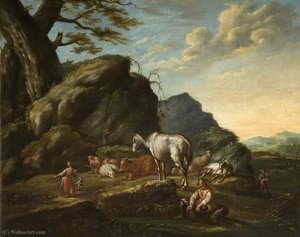
Goats and Flock of Sheep
Goats and Flock of Sheep is an oil painting by Philipp Peter Roos. The artist, who was also known by the moniker Rosa di Tivoli, produced this work about 1681. He was a German Baroque painter born in Sankt Goar, Germany.
Lühidalt
Kõigist Philipp Peter Roos jäetud originaalteostest on kõige kuulsam Goats and Flock of Sheep (1681), mis kuulub Bavaria riiklikud maalidema kogumikud kogele linnas München. Järgnevad sellest Piece of Livestock (1681) ja Landscape with Cattle and Shepherd (1681). Meie kataloogist löytyb 93 teost kunstnikult Philipp Peter Roos; galeriist on säilitatud 92 maailmas kõige imetlustunud teost, millest iga on esitatud koos kuupäeva, museumi ja oma luguga.
Goats and Flock of Sheep is an oil painting by Philipp Peter Roos. The artist, who was also known by the moniker Rosa di Tivoli, produced this work about 1681. He was a German Baroque painter born in Sankt Goar, Germany.
Piece of Livestock is an oil painting by Philipp Peter Roos, executed in 1681. The work originates from the Baroque period, a time when the artist was establishing his presence within the Italianate landscape tradition.
Landscape with Cattle and Shepherd is a work by the German Baroque painter Philipp Peter Roos. Created about 1681, the painting reflects the artist's specialized focus on pastoral scenes and animal subjects. Roos was a significant figure in the development of Italianate landscapes, often characterized by his intimate study of livestock and the natural environment.
In Piece of Livestock, Philipp Peter Roos organizes a pastoral scene through a close-up, ground-level perspective that establishes an immediate intimacy with the subjects. The composition is dominated by a large, seated cow positioned slightly to the right of the center. To the left, a smaller lamb or calf provides a sense of scale, while a woman interacts with a dog in the space behind the primary subject. This arrangement…
Resting Flock with Shepherds is an oil painting by the German Baroque artist Philipp Peter Roos. Created about 1681, this work captures a quiet moment within a rugged landscape. The composition focuses on a group of livestock and a shepherd, rendered with a sense of immediate presence that draws the viewer into the scene.
Resting Flock with Shepherds is an oil painting by Philipp Peter Roos. The canvas captures a heavy stillness among livestock and their guardian. This work was created about 1681. It presents a scene of animals and men gathered in a quiet, layered space under a turbulent sky.
In this Baroque-style oil painting, the mythological drama of the Liberation of Io unfolds with a sudden, heavy intensity. Created by Philipp Peter Roos about 1681, the scene captures a moment of profound tension between the divine and the mortal. A massive, powerful bull dominates the foreground, its muscular form rendered with a weight that feels almost tangible. This central figure looms over the landscape, its presence commanding the space…
This oil on canvas painting, dated 1681, presents a monochromatic scene rendered in various shades of gray. In the foreground, a young woman is positioned amidst a group of livestock, including sheep or goats. The composition is a medium shot, placing the human subject and the animals in the immediate front and middle ground. The terrain is undulating, forming rolling hills that recede into a background of hazy mountains and…
Returning Flock with Shepherds is an oil painting by Philipp Peter Roos. Created about 1681, the work captures a quiet moment of pastoral movement. The artist, a German Baroque painter, was born in Sankt Goar. He would later become known by the moniker Rosa di Tivoli.
The scene unfolds in Shepherd with Cow, Sheep and Goats in Italian Mountain Landscape, a work that captures a quiet moment of pastoral life. This painting, created about 1680, brings together a shepherd and his diverse herd amidst a rugged, mountainous setting. The figures and animals exist within a landscape that feels both immediate and deeply rooted in the natural world.
Neli teemat, mis esinevad neis originaalkindel kõige sagedamini, ning iga teema parim näide.
Kümne 8 muuseumi kollektsioonid, mis sisaldavad kõige rohkem sellel lehel esitatud teoseid.
| Muuseumid | Linn | Philipp Peter Roos teosid | Selle nimekirja maalid |
|---|---|---|---|
| München | 15 | Goats and Flock of Sheep, Piece of Livestock, Landscape with Cattle and Shepherd | |
| Kooberemaa | 5 | Cattle Piece, Landscape with a Bull, Sheep and Goats, A Shepherd with his Herd | |
| Buenos Aires | 4 | Landscape with shepherd and animals, Landscape with figures and animals, Shepherd and animals in a landscape | |
| Bratislava | 3 | Goat Herd with a Goatherd, Shepherd's Idyl in a Romantic Landscape with Ruins, Herd by an Ancient Well | |
| Praha | 3 | Ravine with a Stream, a Shepherd and His Herd, Horse and Goats Grazing, Shepherd with a Herd of Sheep and Goats | |
| Viin | 3 | Herd with Sleeping Shepherds, Rider Meeting, Landscape with Flock of Sheep | |
| Stiiitlinburg | 3 | Landscape with a Grotto, Landscape with a Waterfall, Landscape with a Herd | |
| Stockholm | 3 | Dead Hare, Landskap med hjord, A Goat Resting |
Vali vuosakülg, et näha selle ajastu definieerivat originaalteost.
This large-scale oil painting, dated 1669, presents a crowded, maximalist composition of diverse animal species. The arrangement is packed, with various animals overlapping to create a sense of density and movement. The color palette relies on deep, earthy tones, including rich browns, blacks, and dark ochres. These dark shades are interrupted by specific highlights of white and cream, alongside splashes of red from a rooster and parrots. The lighting follows…
Goats and Flock of Sheep is an oil painting by Philipp Peter Roos. The artist, who was also known by the moniker Rosa di Tivoli, produced this work about 1681. He was a German Baroque painter born in Sankt Goar, Germany.
A heavy, dark-colored cow anchors the center of this scene, its presence felt in the weight of its silhouette. To the left, two goats rest upon the ground, one a pale contrast of white and light tan against the shadows. A man sits nearby, leaning back in a moment of stillness, his gaze directed toward the animals or perhaps the viewer. The air in the enclosure feels thick and dim,…
In this work, titled Shepherd's Idyl in a Romantic Landscape with Ruins, the artist Philipp Peter Roos presents a quiet moment of rural existence. Created about 1700, the painting captures a shepherd tending to his flock amidst a landscape of rolling hills and weathered stone structures. There is a sense of stillness in the way the figures and animals occupy the space, suggesting a life governed by the rhythms of…
Goats and Flock of Sheep (1681), Bavaria riiklikud maalidema kogumikud, München. Järgnevad Piece of Livestock (1681) ja Landscape with Cattle and Shepherd (1681).
24 aastat vanus: teos Goats and Flock of Sheep on pärinev aastast 1681 ning Philipp Peter Roos sündis aastal 1657.
Goats and Flock of Sheep, Piece of Livestock, Landscape with Cattle and Shepherd, Piece of Livestock, Resting Flock with Shepherds, Resting Flock with Shepherds, Liberation of Io, Piece of Cattle, Returning Flock with Shepherds ja Shepherd with Cow, Sheep and Goats in Italian Mountain Landscape. Ülemine reiting näitab iga teose puhul aastat ja muuseumi.
Meie kataloogist leiate 93 teost kunstnikult Philipp Peter Roos, mis on pärinevad ajastust 1669 kuni 1700.
Peamiselt Bavaria riiklikud maalidema kogumikud (München), Statens Museum For Kunst (Kooberemaa) ja National Museum of Fine Arts (Buenos Aires) muuseumites. Ülalpool olevate muuseumite tabelis on nendest kõik loetletud.
Ajal 1680s: 21 92 sellel lehel olevat teost on sellel perioodil loodud, მათart közül Goats and Flock of Sheep.
Sellel lehel on kõige vanem teos Various animals gathered before Noah's Ark (1669) ja kõige värskeim Shepherd's Idyl in a Romantic Landscape with Ruins (1700).
Landscape (33), Animals (29) ja Goats (19), kogu selle lehekülje 92 teose kohta.
Oil On Canvas, 18 teoseks 92 töödelt sellel lehel.
Baroque, seda lähtudes selle lehe originaalteostest.
Goats and Flock of Sheep, Piece of Livestock ja Landscape with Cattle and Shepherd: Bavaria riiklikud maalidema kogumikud, München säilitab 15 selle lehel olevat teost.
Itaalia baroki kuldjases valuses on väheseid nimesid, mis suudaksid kutsuma esile maastiku pastoralist rahu nii otseotevasti kui Philipp Peter Roos. Ajaloo on teda tuntnud tema kütkavama monaakriga Rosa di Tivoli, ning see Saksa maastikumeister mueris maastikunäidete žanri sügava ja peaaegu viskeerse sidusega loodusmaailmaga. Sündinud 1655. aastal Reini piirkonnas — täpsemalt lähedal Sankt Goarile — oli Roos onneks mõeldud kunstnik juba oma varajastest aastadest peale. Ta oli Johann Heinrich Roosi, lugupidava maastikukunstniku, Poeg, kes andis talle alguse toonide harmoonia ja kompositsioonilise tasakaalu õppimisel, mis määrkas hiljem kunstniku täiskasvanuline stiili. See varajane õppeperiood ei olnud pelgalt tehnika omandamine; see oli süvenemine maailma nägemisele läbi valguse, varju ja maa vaikse väärikuse.
Roosi elu suund pöördis drastiliselt muutuks 1677. aastal, mida trükkis edasispöörile Hesse-Kasseli valdustepealaine Charles Ii่วม generosity. Tunnustades noore kunstniku kasvavat talent, pakkus valdustepealaine Roosile finantsvahendeid, et ta saaks alustada transformatiivset teekonda Rooma. Migratsioon germaansest traditsioonist Itaalia baroki südames võimaldas Roosil imelda Rooma kunsti vibratilist energiat. Just siin otsis ta mentorlust kuulsalt Giacinto Brandil, kelle mõju aitas täiendada Roosi võimet ühendada klassikaline struktuur spontaalsema ja atmosfäärilise realismiga. See Rooma periood oli ka sügavalt isiklik; just needel aastatel armastus Roosi ja tema mentori tütarlinna Isabella Brandi vahel algas. Nende liit viis ta lõpuks asuma Tivolis, liigutus, mis seostas tema identiteedi igavesti maastikuga, mida ta nii väga armastas.
Rosa di Tivoli teosel on eristav tema loomate teemade võõrustamatu autentikkus. Erinevalt paljudest tema kaasajastest, kes kasutasid loomi maastikus vaid dekoratiivsete lisandena, koheldis Roos iga olendit — massivsest härjast painuki nimble leiteni — portretisti väärikusega. Tema elukoht Tivolis oli kuulsalt loodud kontseptsioonil, mis sarnnes elavale studiouule; ta hoidis üles eksootiliste ja kodaste loomade laia kollektsiooni, muudades oma ümbrivkonna pidevaks liikumise, anatomia ja temperamentide uuringuks. See intiimne lähedus võimaldas tal jäädvustada kõrva peenimad liiged või looma lihaslikku pinge staatust, andes tema linatele hingavalt elavuse.
Tema tehniline meistriarvutus on nähtav måheliselt viisid, kuidas ta navigeeris baroki esteetika keerukuste seas. Kuigi tema kompositsioonid mängivad sageli Hollandi kuldajastu rahustavate ja atmosfääraliste kvaliteetidega, on need täidetud Itaalia kooli iseloomuliku dramaatilise intensiivsusega. Tema teosed peegeldavad sageli:
Philipp Peter Roosi ajalooline tähtsus peitub tema võimes ühendada Põhja-Euroopa struktureeritud maastiktraditsioonid ja Itaalia emotiivne, valgust täis dramaatika. Ta ilmus ajastul, mil selle ajastu teaduslik uurimine hakkas nõudma täpsemat loodusmaailma jälgamist, isegi kui religioosne ja mütooloogiline teema domineeris veel kunstilises teadvuses. Tema maalidest leiab nii naturalisti täpne detailika ja romantiku poeetilise täisvervluse. Dokumenteerides Rooma maastiku flora- ja faunat nii pühendumusega, lõi ta visuaalse rekordsi, mis räägib sama palju kui ajastu vaim, kui ka tema teemast.
Kuigi ta lahkus 1706. aastal, jättes endast Tivoli mullasse etNinatud pärandi, kestis tema mõju. Ta on oluline tegelane kõigile, kes uurib loomapildide (animalier) evolutsiooni ja itaali stiilis maastiku arengut. Tema silmad läbi ei näe meid lihtsalt karja kogumit; me ongi peen tõistund elus, mida ta tähistab kõige igasema ja puhtama vormis. Tema töö jätkub resoneerimas kui tunnistusk vaatlemise jõust ja pastoralistliku ideaali igavesti kestavast kauniduses.