The Dignified Legacy of Frank Robinson Daniell
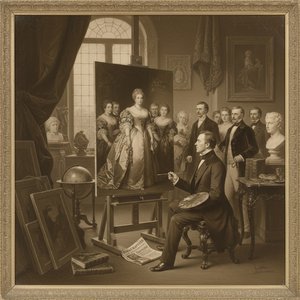
Frank Robinson Daniell, a name synonymous with the refined elegance of the Victorian era, remains a profound figure in the history of British portraiture. Born in 1866, Daniell emerged during a transformative period in the art world, a time when the traditionalist's devotion to realism stood in quiet, resolute contrast to the burgeoning Impressionist movement. His artistic identity was forged under the expert guidance of George Ronald Lane, a mentorship that instilled in him a deep reverence for meticulous detail and the subtle complexities of human character. This foundation allowed Daniell to transcend the mere recording of physical features, enabling him to capture the very essence of his subjects' souls through a masterful command of light, shadow, and tonal gradation.
Daniell’s technique was characterized by a deliberate and patient approach to the canvas. While many of his contemporaries sought to capture the fleeting, ephemeral effects of sunlight, Daniell favored a more enduring method: the careful layering of oil paint to build rich textures and profound depth. This commitment to traditional craftsmanship allowed him to render the heavy folds of judicial robes, the intricate lace of aristocratic collars, and the nuanced expressions of the human face with an almost tactile realism. His work does not merely present a likeness; it constructs a presence, imbuing his subjects with a sense of permanence and historical weight that reflects the societal values of his time.
A Master of Character and Status
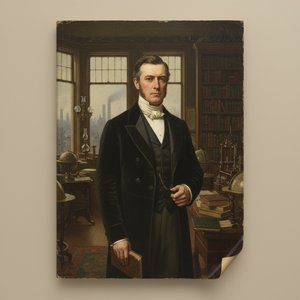
The breadth of Daniell’s oeuvre is most notably defined by his prestigious commissions, which served as a visual record of the British establishment. He became a preferred chronicler for those who held significant sway within the legal, political, and social hierarchies of London. His portraits were much more than vanity projects; they were studies in authority and grace. One of his most enduring achievements is the portrait of Judge Frederick Adolphus Philbrick, completed in 1913. In this work, Daniell captures not just the legal stature of the man, but a profound sense of wisdom and gravity, using every subtle crease and shadow to convey the weight of judicial responsibility.
Beyond the halls of justice, Daniell’s talent extended to the depiction of notable figures such as Henry Charles Wanklyn and the celebrated theatrical duo Fred Terry & Julia Neilson. His ability to navigate between the formal rigidity required for statesmen and the more expressive needs of performers demonstrates a remarkable versatility. Even when stepping away from the human form, his artistic eye remained sharp; his evocative landscapes, such as the captivating 'Entrance at Middleburg, Holland', reveal a different facet of his skill, showing an ability to translate his mastery of light and atmosphere into the natural world.
Historical Significance and Artistic Enduring Spirit
The significance of Frank Robinson Daniell lies in his role as a guardian of classical portraiture during an age of rapid artistic upheaval. By adhering to the principles of realism and formal composition, he provided a sense of continuity and stability in the British art scene. His works serve as vital historical documents, offering contemporary viewers a window into the dignity, fashion, and social structures of the late 19th and early 20th centuries.
Today, the legacy of Daniell continues to resonate through his surviving masterpieces, which are cherished for their psychological depth and technical brilliance. His life's work stands as a testament to the power of observation and the enduring beauty of the classical tradition:
- Technical Mastery: A profound dedication to the layering of oils and the pursuit of realistic texture.
- Psychological Insight: The ability to move beyond surface representation to capture the inner character of his subjects.
- Historical Documentation: Creating a lasting visual archive of the British aristocracy, judiciary, and cultural icons.
- Stylistic Integrity: Maintaining a steadfast commitment to traditional methods amidst the rise of modernism.
Küsimused ja vastused
Kas saan Frank Robinson Daniell teoseid värvispektri järgi uurida?
Lehekülg Värvitoonide indeks koondab Frank Robinson Daniell teosed värvide järgi.
Kui populaarsed on Frank Robinson Daniell teosed?
Frank Robinson Daniell lehekülg Statistika esitab statistika, mis on arvutatud see veebileht loetletud kunstniku teostest.
Kust saan vaadata Frank Robinson Daniell teoseid meeleolu järgi sorteerituna?
Frank Robinson Daniell teoseid saab sirvida meeleheaku järgi tema Tunnetunoodete tuba lehel, kus teosed on grupeeritud vastavalt nende loovitud tunnetele.