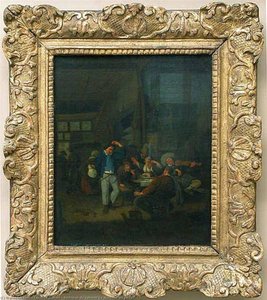
Cornelis Dusart portree

Cornelis Dusart maalid: 37 kuulsumat teost galeriin läbi

Uuendatud november 2026 · järjestatud meie populaarsusindeksi järgi (otsingud, külastused ja tellimused igale teosele) · 40 teost Cornelis Dusart meie kataloogis

Lühidalt

Galleriist vaadatuna on Cornelis Dusart kõige kuulsam teos Peasants in Front of an Inn (1681), mille originaal ripub Kunsthistorisches Museum-is, Viin. Village inn (1690) ja Country Inn with Hurdy-Gurdy Player (1681) täidavad kolmikut, mille iga silm tunnistab. Kunstnii Cornelis Dusart 40 teose põhjal esitleb galeriis allpool 37 kõige kuulsumat, kus iga originaal on märgitud aastaga, muuseumiga ja kirjeldatud, mis teeb selle unikaalseks.

1660 – 1704, Haarlem Dutch golden age Enamama teoseid: Rijksmuseum

Galeria 10 parimat Cornelis Dusart maali

1
Peasants in Front of an Inn (1681) (autor) Cornelis Dusart

Peasants in Front of an Inn

1681 · Oil On Panel · Kunsthistorisches Museum, Viin

The air outside the inn feels heavy with the scent of damp earth and woodsmoke. Under the shade of a leafy canopy, a group of peasants gathers, their bodies leaning into the ease of a midday rest. There is a palpable sense of movement held in suspension; a man sits perched on a bench, perhaps listening to the low murmur of conversation or the distant sound of a traveler approaching.…

2
Village inn (1690) (autor) Cornelis Dusart

Village inn

1690 · Oil On Panel · Rijksmuseum, Amsterdam

In this 1690 oil on panel, we find ourselves drawn into the quiet, unhurried rhythm of a Dutch village inn. The scene is one of communal leisure, where the boundaries between public social life and private intimacy blur under the soft, natural light of a rural afternoon. In the foreground, a man and a woman sit together, their presence grounding the composition with a sense of lived experience. He holds…

3
Country Inn with Hurdy-Gurdy Player (1681) (autor) Cornelis Dusart

Country Inn with Hurdy-Gurdy Player

1681 · Painting · Städel Museum, Frankfurt

A group of peasants gathers in the courtyard of a rustic, thatched-roof inn. The composition is crowded, with figures occupying the foreground and midground to create a sense of social activity. On the right, the heavy architecture of the building provides a structured frame, while foliage on the left balances the scene. The light originates from the upper left, casting soft shadows across the courtyard and highlighting the central figures.…

Cornelis Dusart maalid, järjestus 11 kuni 37

Teemad, mis püüdisid Cornelis Dusart pilma

Neli teemat, mis esinevad neis originaalkindel kõige sagedamini, ning iga teema parim näide.

Muuseumid, kus on säilitatud Cornelis Dusart originaalteosed

Kümne 8 muuseumi kollektsioonid, mis sisaldavad kõige rohkem sellel lehel esitatud teoseid.

Muuseum Linn Cornelis Dusart teosed Selle nimekirja maalid
Rijksmuseum, AmsterdamRijksmuseum Amsterdam 6 Village inn, A Mother with her Children, Village fair
Statens Museum For Kunst, KooberemaaStatens Museum For Kunst Kooberemaa 2 Bagpiper at an Inn, Peasants outside an Inn
Frans Halsi muuseum, HarenFrans Halsi muuseum Haren 2 Drinking party, The Notary
Kunsthistorisches Museum, ViinKunsthistorisches Museum Viin 1 Peasants in Front of an Inn
Städel Museum, FrankfurtStädel Museum Frankfurt 1 Country Inn with Hurdy-Gurdy Player
Fine Arts Museums of San Francisco, San FranciscoFine Arts Museums of San Francisco San Francisco 1 Village Scene
Varssavi Rahvusmuuseum, VarssaviVarssavi Rahvusmuuseum Varssavi 1 Fish scraping
National Gallery of Ireland, DublinNational Gallery of Ireland Dublin 1 A Merry-making

Cornelis Dusart, iga kümnendiga üks signatuurpilt

Teosed aastakate kaupa

Vali vuosakülg, et näha selle ajastu definieerivat originaalteost.

Cornelis Dusart maalid: galerii vastused

Milline Cornelis Dusart maal on kõige kuulsam?Paljasta vastus

Peasants in Front of an Inn (1681), Kunsthistorisches Museum, Viin. Järgnevad Village inn (1690) ja Country Inn with Hurdy-Gurdy Player (1681).

Kui vana Cornelis Dusart oli teose Peasants in Front of an Inn valmimisel?Paljasta vastus

21 aastat vanus: teos Peasants in Front of an Inn on pärinev aastast 1681 ning Cornelis Dusart sündis aastal 1660.

Millised on Cornelis Dusart top 10 maali?Paljasta vastus

Peasants in Front of an Inn, Village inn, Country Inn with Hurdy-Gurdy Player, Village Scene, teasing the cat, Fish scraping, A Merry-making, A kermess, Bagpiper at an Inn ja Peasants outside an Inn. Ülemine reiting näitab iga teose puhul aastat ja muuseumi.

Kui palju teoseid Cornelis Dusart lõi?Paljasta vastus

Meie kataloogist leiate 40 teost kunstnikult Cornelis Dusart, mis on pärinevad ajastust 1679 kuni 1702.

Kust leiad Cornelis Dusart kõige kuulsamad originaalteosed?Paljasta vastus

Peamiselt Rijksmuseum (Amsterdam), Statens Museum For Kunst (Kooberemaa) ja Frans Halsi muuseum (Haren) muuseumites. Ülalpool olevate muuseumite tabelis on nendest kõik loetletud.

Millal lõi Cornelis Dusart oma kuulsamad maalid?Paljasta vastus

Ajal 1680s: 11 37 sellel lehel olevat teost on sellel perioodil loodud, sellest Peasants in Front of an Inn.

Millised on Cornelis Dusart varased ja hilised kuulsad teosed?Paljasta vastus

Sellel lehel on kõige vanem teos The Milk Seller (1679) ja kõige värskeim Drinking party (1702).

Millist teemat Cornelis Dusart kõige rohkem käsitledas?Paljasta vastus

Inn (3), Woman (3) ja Men (3), kogu selle lehekülje 37 teose kohta.

Millises tehnikas töötas Cornelis Dusart kõige rohkem?Paljasta vastus

Oil On Panel, 4 teoseks 37 töödelt sellel lehel.

Millise suunaga on Cornelis Dusart seotud?Paljasta vastus

Dutch golden age ja Baroque, seda lähtudes selle lehe originaalteostest.

Milliseid Cornelis Dusart originaalte Rijksmuseum kogumuses on?Paljasta vastus

Village inn, A Mother with her Children ja Village fair: Rijksmuseum, Amsterdam säilitab 6 selle lehel olevat teost.

Cornelis Dusart: kunstnik

Cornelis Dusart: A Window into Dutch Everyday Life

Cornelis Dusart (1660-1704) stands as a fascinating figure within the Haarlem School of painting, offering viewers a glimpse into the vibrant tapestry of 17th-century Dutch society. Unlike many artists of his era focused on grand historical narratives or mythological subjects, Dusart dedicated himself to capturing the commonplace – itinerant peddlers haggling in bustling marketplaces and intimate scenes unfolding within taverns. This deliberate choice reveals a profound interest in portraying the realities of daily life, reflecting a humanist sensibility that was gaining momentum during the Golden Age. His artistic training began under the tutelage of Rembrandt Harmenszoon van Rijn, arguably the most influential painter of his time, cementing Dusart’s connection to the stylistic innovations emerging from Leiden and Amsterdam. Rembrandt's emphasis on dramatic lighting and psychological realism undoubtedly shaped Dusart’s approach, fostering a meticulous attention to detail that distinguishes his oeuvre. However, Dusart developed a unique style—characterized by soft brushstrokes and subtle tonal gradations—that subtly diverged from Rembrandt’s bolder palette. This distinctive technique allowed him to convey atmosphere and emotion with remarkable sensitivity. Dusart's prolific output spanned numerous commissions, primarily focusing on genre scenes. He skillfully rendered the textures of fabrics, the expressions of faces, and the nuances of light and shadow, creating images that feel remarkably authentic. Consider “The Street Seller,” a captivating depiction of a peddler engaging in trade—the artist’s meticulous observation captures not only the physical appearance of the scene but also the palpable energy of the marketplace. Similarly, "The Quack" portrays a physician examining a patient with quiet dignity and precision, highlighting Dusart's ability to convey psychological depth within seemingly simple compositions. Furthermore, Dusart’s work exemplifies the burgeoning fascination with realism that permeated Dutch art circles during his lifetime. He wasn’t merely documenting what he saw; he was striving to evoke feeling and understanding in the viewer. This ambition aligns perfectly with the broader cultural context of the period—a time marked by intellectual curiosity and a desire to represent human experience accurately. Dusart's contribution to Haarlem School painting is significant not only for its stylistic merits but also for its enduring portrayal of ordinary life, securing his place as an artist who captured the spirit of his era with remarkable artistry.
  • Notable Commissions: Dusart undertook numerous commissions for wealthy patrons and civic institutions, showcasing his versatility and artistic skill.
  • Influences: Rembrandt van Rijn’s masterful use of light and psychological realism profoundly impacted Dusart's artistic development.
  • Technique: Dusart employed soft brushstrokes and tonal gradations to create atmospheric paintings imbued with emotion and subtlety.

Major Achievements & Legacy

Dusart’s enduring legacy resides in his ability to distill the essence of everyday life into powerfully evocative images. His genre scenes continue to resonate with audiences today, offering insights into the social customs and psychological complexities of 17th-century Holland. While Dusart may not command the same level of fame as Rembrandt or Vermeer, his meticulous style and humanist vision solidify his position as a pivotal artist within the Haarlem School—a testament to the transformative power of observing and representing the human condition with unwavering dedication.