Eelvaade
 Saada
Saada Jaga
Jaga
 Teave teose kohta
 Juhend

 Laadi alla
 Sarnased teosed
 Röntgenuuring
 Slaidietendus
 Q&A
Q&A Statistika
Winter Landscape
 Acrylic On Canvas
- WallArt
- Post-Impressionism
 1909
1909 75.0 x 97.0 cm
 Loe lähemalt
Giclée / Kunstiprint
Muuseumikvaliteediga giclée- või kangasprint kiire tootmisega ja paindlikud viimistlusvõimalused. ( Osta käsitsi maalatud teos Lülita digitaalse pildi juurde)




P118B €10

P118H €10

P118W €10

P438Z €10

P508JH €12

P508YH €12

P805H €10

P805Z €10

P919BZ €10

P919G €10

P919XJ €10

P959ZH €10

P968JZ €12

W106C €8

W218G €10

W218JH €8

W218Y €10

W307PJ €10

W316G €10

W316PJ €8

W316Y €10

W398PJ €8

W4111J €10

W500HY €15

W500JH €15

W692G €12

W849H €8

W940BG €15

W953PJ €8




Vali meie eelmääratud suurused, mis vastavad teose algupärastele proportsioonidele.

Sisestage vajalik laius ja kõrgus, et see sobiks teie raamile või seinale. Trükki saab ainult lõigata, seda ei saa kunagi pildist suuremaks teha, seega ka erineva mustega suurus kaotab osa pildist. Enne trükkimist saadame teile kinnitamiseks digitaalse näidisprojektsiooni. Sellel lehel näidatud pilt ei kujuta reaalset lõiget — seda näitab ainult näidisprojektsioon.
Ülemaailmne tarne () 2 nädala jooksul, tavalise 4/5 nädala asemel. (30 oktoober)

Tasuta ekspresssaatmine üle maailma

Kõrgekvaliteediline lina-kangas

Täielik transpordikindlustus

Tollimaksude tagastamise garantii

Värvitoime täpsuse garantii

100 päeva tagastusõigus (ainult valmistusdefektide korral)

100% raha tagasi garantii

Hulgusoodustus
 Klaasivalik on saadaval ainult kuni 110 cm suuruses teostes

Winter Landscape
Giclée / Kunstiprint
Reproduktsiooni suurus
-


Koguhind
€ 71
Introduction to the Artist and Painting
Wassily Kandinsky, a Russian painter and art theorist, is renowned for his pivotal role in the development of abstract art. His painting Winter Landscape, created in 1909, exemplifies his unique blend of expressionism and abstraction. This captivating piece is a testament to Kandinsky's innovative approach to color and form.The Painting: A Winter Scene
Winter Landscape depicts a serene winter scene featuring a house in the middle of a snowy field, surrounded by trees. The painting measures 75 x 97 cm and is executed in oil on canvas. The dominant colors are shades of blue and green, with touches of yellow and orange, creating a vibrant yet peaceful atmosphere.Artistic Influences and Style
Kandinsky's work was influenced by various art movements, including Expressionism and Fauvism. His use of bold, expressive brushstrokes and vivid colors reflects the principles of these styles. The painting also showcases Kandinsky's interest in capturing the emotional essence of a scene rather than its literal representation.Historical Context
Winter Landscape was painted during Kandinsky's time in Munich, where he was part of the influential art group Der Blaue Reiter. This period marked a significant shift in his artistic style, as he began to explore abstract forms and colors more intensely.Significance and Legacy
Kandinsky's Winter Landscape is not only a beautiful piece of art but also an important milestone in the development of modern art. It demonstrates Kandinsky's pioneering spirit and his contribution to the evolution of abstract art. The painting is now housed at the Hermitage Museum in Saint Petersburg, Russia.Reproductions Available
For those who appreciate the beauty of Winter Landscape, OriginalUniqueArt offers high-quality, handmade oil painting reproductions. These reproductions capture the essence and vibrancy of Kandinsky's original work, allowing art enthusiasts to bring a piece of history into their homes.Conclusion
Winter Landscape by Wassily Kandinsky is a masterpiece that embodies the spirit of early 20th-century modernism. Its unique blend of expressionist and abstract elements makes it a captivating work that continues to inspire art lovers today. OriginalUniqueArt's reproductions provide an opportunity for everyone to experience this piece in their own space. Experience the beauty of Winter Landscape in your home with OriginalUniqueArt's handmade oil painting reproductions.Korduvad küsimused
Millises ruumis on soovituslik "Winter Landscape" näidata, arvestades selle värvilaudu?
Olles värvipalett Earthy, on teos „Winter Landscape“, autor Vasili Vassiljevich Kandinski soovitatav ruumideks Living Room. Just needistlikud toonid on üks põhjuseid selle soovituse taga.
Kas on õpilaste jaoks olemas infoleht teose „Winter Landscape“, autor Vasili Vassiljevich Kandinski kohta?
Juhend teose "Winter Landscape" kohta on selle Õppekasutusjuhend leht – trükkiv infoleht, mis esitab teose koos pealkirja, autori ja identifiekatsioonitabeliga (kunstnik, kuupäevad, tehnika, algne suurus, kollektsioon).
Mis on soovitatav trükimõõt teosele "Winter Landscape"?
Soovitatav trükimõõt teosele „Winter Landscape“, autor Vasili Vassiljevich Kandinski on Large.
Kunstniku elulugu
A Life Immersed in Color and Spirit
Wassily Wassilyevich Kandinsky, born in Moscow in 1866, was a revolutionary figure who irrevocably altered the course of modern art. His journey wasn’t one of immediate artistic calling; initially destined for a career in law and economics at the University of Moscow, it was a profound encounter with Impressionist painting – specifically Claude Monet's “Haystacks” – and a deeply moving experience witnessing Wagner’s opera "Lohengrin" that ignited within him an irrepressible desire to pursue art. This pivotal moment, occurring around age thirty, marked not merely a career change but a complete transformation of perspective, setting him on a path toward pioneering abstraction.
Early influences included Russian folk art, gleaned from an ethnographic expedition to the Vologda region in 1889, which instilled a fascination with vibrant color palettes and symbolic imagery. This foundation would prove crucial as he began to develop his unique artistic language. These early explorations weren’t simply about aesthetic preference; they were rooted in a deep cultural connection and a burgeoning understanding of how art could communicate beyond the literal.
The Dawn of Abstraction: From Expressionism to Inner Necessity
Kandinsky’s early works reveal a strong expressionistic bent, characterized by bold colors and emotional intensity – pieces like “Papeln (Poplars)” from 1902 exemplify this period. However, he wasn't content with merely representing the external world; he sought to express inner realities, spiritual truths that transcended mere visual depiction. This quest led him gradually away from representational art and toward a revolutionary exploration of color, form, and their emotional resonance.
He began to believe that colors possessed inherent psychological effects, capable of evoking specific feelings and sensations in the viewer. This conviction was deeply intertwined with his burgeoning interest in Theosophy, a spiritual movement emphasizing esoteric knowledge and universal brotherhood. As he delved deeper into these ideas, Kandinsky’s paintings became increasingly non-objective, shedding recognizable forms in favor of abstract compositions driven by an “inner necessity.” This wasn't simply about abandoning representation; it was about discovering a new visual language capable of expressing the intangible realms of emotion and spirituality.
Geometric Harmony and Spiritual Resonance
The period following his involvement with the influential artist group Der Blaue Reiter (The Blue Rider), which he co-founded in Munich in 1911, saw a further evolution in Kandinsky’s style. While earlier works often featured fluid, organic shapes, he began to explore geometric abstraction, focusing on the interplay of circles, triangles, and squares. “Several Circles” (140 x 140 cm) stands as a prime example of this phase – a dynamic composition where color and form interact in a harmonious yet energetic dance.
This wasn't cold or sterile geometry; rather, it was imbued with spiritual significance. Kandinsky believed that geometric shapes possessed inherent symbolic meaning, and their arrangement within the canvas could evoke specific emotional responses. His theoretical writings, most notably “Concerning the Spiritual in Art” (1911), articulated these beliefs, laying the groundwork for a new understanding of abstract art as a vehicle for expressing profound spiritual truths. He argued that art should not aim to imitate nature but rather to reveal the artist’s inner world and connect with the viewer on a deeper, more intuitive level.
Bauhaus Influence and Lasting Legacy
The outbreak of World War I forced Kandinsky's return to Russia in 1914, but following the Russian Revolution, he found himself increasingly at odds with the prevailing artistic climate. In 1920, he accepted a teaching position at the Bauhaus school in Germany, where he profoundly influenced generations of artists with his theories on color, form, and abstraction. The Bauhaus provided an ideal environment for Kandinsky to further develop his ideas and explore new creative avenues.
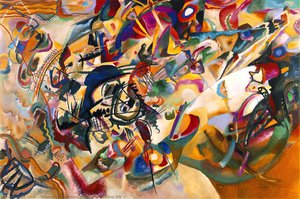
He continued to experiment with geometric forms and vibrant colors, often incorporating layered impasto techniques to create textured surfaces that added depth and complexity to his compositions – as seen in later works like “An Intimate Party” (1942). After the closure of the Bauhaus by the Nazi regime in 1933, Kandinsky moved to France, where he remained for the rest of his life. His impact on modern art is immeasurable; he is widely recognized as a pioneer of abstract expressionism and a key figure in the development of non-representational painting. His works are held in major museums worldwide, including the Tretyakov Gallery in Moscow, which houses his monumental “Composition VII,” a testament to his artistic vision and enduring legacy.
Kandinsky’s exploration of color, form, and spirituality continues to inspire artists today, solidifying his place as one of the most important figures in 20th-century art history. He didn't just paint pictures; he painted emotions, ideas, and the very essence of the human spirit.

Vasili Vassiljevich Kandinski
1866 - 1944 , Venemaa
Lühikest infot
- Artistic Movement Or Style: Abstract art, Expressionism
- Artists Or Movements Influenced By This Artist: ['Abstract Expressionism']
- Artists Who Influenced This Artist:
- Claude Monet
- Richard Wagner
- Date Of Birth: 1866
- Date Of Death: 1944
- Full Name: Wassily Wassilyevich Kandinsky
- Nationality: Russian, French
- Notable Artworks:
- Murnau with Rainbow
- Tempered Elan
- Several Circles
- Place Of Birth: Moscow, Russia
Sarnased artiklid

Geomeetrilise Abstraktsiooni 10 Meisterteost: Kunst ja Kodukaunistus OriginalUniqueArt.com-is
Avastage geomeetrilise abstraktsiooni 10 suurteost – Kandinsky, Mondrian ja teised. Lugege kunstiteoste lugusid ning leidke inspiratsiooni kodukaunistuseks OriginalUniqueArt.com-is! Kunstikollektsioon ja reprodutsioonid.
Beyond Representation: Exploring the Emotional Landscape of Abstract Expressionism
Explore the profound emotional world of Abstract Expressionism with OriginalUniqueArt. Discover key artists like Pollock & Rothko, learn about collecting, and find museum-quality reproductions to inspire your space.

Abstract Ekspressionismi 10 Meisterteost: Kunsti ja Sisustamise Klassikat
Sukeldu abstraktse ekspressionismi maailma! Avasta 10 legendaarset kunstiteost – Pollock, Rothko jt. – ja nende loo. Leia inspiratsiooni interjööriks ning kaunista kodu OriginalUniqueArt.com kvaliteetsete reproduktsioonidega. Uuri kollektsiooni!

Beyond Representation: Emotional Resonance & Formal Innovation in Abstract Painting
Explore the profound emotional depth & formal innovations of abstract painting. Discover key artists like Rothko & Kandinsky, understand art collecting insights, and elevate your space with timeless masterpieces. Expert analysis for discerning collectors.

Kandinsky's Masterpieces: 25 Paintings That Define Abstract Art | OriginalUniqueArt
Journey through Wassily Kandinsky's 25 most iconic abstract paintings. Explore his revolutionary use of color, form & spiritual expressionism. Find museum-quality Kandinsky reproductions and elevate your home decor with OriginalUniqueArt.com. Discover all masterpieces on OriginalUniqueArt.com!