Lülita trükkitoodetele
 Loe lähemalt







































 Kunstiteoste või reproduktsioonide puhul, mille üks külg on üle 105 cm (umbikmolt 41 tolli), saadetakse raam kirjal asendis, la Dismantlitud komplektina. See meetod tagab ohutuse kohaletoimetamisel ja väldib transpordil tekkivaid kahjustusi.


A Symphony of Geometric Resonance
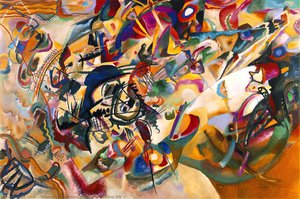
In the realm of modern abstraction, few works possess the rhythmic vitality and kaleidoscopic energy found in Wassily Kandinsky’s 1920 masterpiece, “Points.” To gaze upon this canvas is to enter a world where the boundaries between sound and sight dissolve, leaving only the pure, unadulterated essence of form. The painting serves as a breathtaking testament to Kandinsky's transition into a more structured, geometric language, yet it retains the soulful, spontaneous pulse that defined his earlier expressionist works. As colors dance across the surface—vibrant yellows, deep reds, and profound blues—the viewer is invited into a sensory experience that transcends mere visual observation, pulling the subconscious into a state of heightened awareness.
The composition is a masterful orchestration of shapes that seem to float in a cosmic, weightless void. At its heart, one might discern a startlingly human element: a central figure with an open mouth, suggesting a silent cry or perhaps a gasp of wonder, surrounded by a swirling constellation of circles and sharp-edged geometries. This interplay between the organic and the mathematical creates a tension that is both unsettling and deeply harmonious. Scattered throughout the piece, various circular motifs add layers of depth, acting as focal points that guide the eye through a labyrinth of color. Even the subtle inclusion of a clock-like element in the upper periphery hints at the fleeting nature of time, grounding this abstract universe within a sense of temporal movement.
The Spiritual Alchemy of Color and Form
Kandinsky’s approach to “Points” was far from accidental; it was an intentional pursuit of what he termed inner necessity. Having been profoundly moved by the dramatic crescendos of Wagnerian opera, Kandinsky sought to paint not what he saw in the physical world, but what he felt in his spiritual core. This piece represents a pivotal era in his career where the influence of the Bauhaus school began to manifest through more precise, geometric arrangements. Yet, beneath this structured exterior lies the vibrant spirit of Russian folk art—a legacy of bold hues and rhythmic patterns that prevents the work from ever feeling cold or clinical. Instead, the painting breathes with an emotional warmth, making it a piece that resonates deeply with the human spirit.
For the discerning collector or interior designer, “Points” offers more than just aesthetic beauty; it provides a transformative atmosphere. The dynamic composition acts as a centerpiece that can breathe life into a minimalist room or add a layer of intellectual complexity to a classic setting. Because the work avoids representational constraints, it functions as an open dialogue with its environment, reflecting the light and mood of the space it inhabits. A high-quality reproduction of this masterpiece allows one to bring a fragment of art history’s most revolutionary movement into the home, offering a daily encounter with the sublime power of pure abstraction.
Korduvad küsimused
Milline toon on teoses „Punktid“, autor Vasili Vassiljevich Kandinski domineeriv?
"Punktid" on kallutunud Okra ja sepia toonid toonile.
Kui suur on kontrasst teoses „Punktid“, autor Vasili Vassiljevich Kandinski?
Teose „Punktid“, autor Vasili Vassiljevich Kandinski kontrastivaimustus on Erilugus.
Mis vanuses loos Vasili Vassiljevich Kandinski teose "Punktid"?
Kui teos "Punktid" loodi aastal 1920, oli Vasili Vassiljevich Kandinski (sündinud aastal 1866) 54 aastane.
 Eelvaade
 Saada
Saada Jaga
Jaga
 Teave teose kohta
 Juhend

 Laadi alla
 Sarnased teosed
 Röntgenuuring
 Slaidietendus
 KÜSIMUSED JA VASTUSID
 Statistika