Lülita trükkitoodetele
 Loe lähemalt







































 Kunstiteoste või reproduktsioonide puhul, mille üks külg on üle 105 cm (umbikmolt 41 tolli), saadetakse raam kirjal asendis, la Dismantlitud komplektina. See meetod tagab ohutuse kohaletoimetamisel ja väldib transpordil tekkivaid kahjustusi.


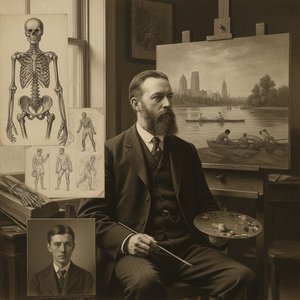
Thomas Eakins: A Pioneer of Anatomical Realism
Thomas Cowperthwait Eakins (1844–1916) stands as a monumental figure in American art—a painter of unflinching realism who dedicated his life to capturing the essence of human experience. He wasn’t merely interested in *representing* the world; he sought to dissect it, understand its anatomy, both physical and psychological, and then reconstruct it on canvas with an honesty that often bordered on provocation. Eakins's path was not one of immediate acclaim, but rather a slow burn of dedication, controversy, and ultimately, enduring recognition as perhaps the most profound realist in 19th and early 20th-century American art. His Philadelphia wasn’t a city of grand landscapes or romantic ideals; it was a world of doctors, rowers, hunters, and everyday individuals—and these were his subjects, rendered with an almost scientific precision. Early Influences and Artistic Formation Eakins's upbringing fostered both intellectual curiosity and a fascination with the human form. He studied anatomy diligently at Haverford College, meticulously dissecting cadavers to gain firsthand knowledge of musculature and skeletal structure – a practice considered unorthodox for its time but crucial to his artistic vision. This commitment to anatomical accuracy would become a hallmark of his oeuvre, informing his portraits and figure studies with an unprecedented level of detail. He absorbed the influence of Rembrandt and Michelangelo, artists who prioritized capturing the subtleties of human expression and form, shaping his approach to painting before he even began his formal training at the Pennsylvania Academy of Fine Arts.“The Concert Singer”: A Study in Observation and Precision
“The Concert Singer,” completed in 1892, exemplifies Eakins’s distinctive style—a portrait steeped in meticulous observation and technical mastery. The painting depicts Weda Cook (1867–1937), a celebrated soprano known for her vocal prowess, captured mid-performance on stage. Unlike traditional portraits that aimed to idealize the subject, Eakins sought to portray Cook with unflinching realism, capturing not just her physical appearance but also the palpable tension and concentration of her artistic endeavor. He achieved this remarkable feat through a painstaking process—spending hours sketching Cook’s movements and facial expressions, analyzing the mechanics of her singing voice, and meticulously rendering every nuance of her posture and musculature. Technique and Composition Eakins employed a technique characterized by layered glazing – applying thin washes of color over multiple layers to build up tonal depth and luminosity. This method allowed him to capture the subtle interplay of light and shadow on Cook’s skin, conveying an impression of palpable presence. The composition is deliberately understated, focusing solely on Cook herself against a simple backdrop of stage steps—a deliberate choice designed to heighten the viewer's attention to her form and expression. Notably, Eakins incorporated a small detail that speaks volumes about his artistic philosophy: he carved the opening bars of Felix Mendelssohn’s “O Mio Sussurro” into the frame of the painting, symbolizing his dedication to capturing not just the visual likeness but also the essence of Cook's performance—the very act of singing itself. Symbolism and Emotional Impact Beyond its technical brilliance, "The Concert Singer" resonates with profound symbolic significance. Eakins’s portrayal of Cook represents more than simply a depiction of a musician; it embodies the pursuit of artistic excellence and the unwavering focus required to achieve mastery. The artist's meticulous anatomical rendering underscores his belief that art should strive for an honest representation of human reality—a conviction rooted in his scientific training and fueled by a desire to transcend mere superficial beauty. Ultimately, the painting evokes a sense of quiet contemplation and admiration for Cook’s dedication, inviting viewers to consider the transformative power of artistic endeavor and the enduring legacy of Thomas Eakins as one of America's most influential realist painters.Korduvad küsimused
Millal ja millise kunstisuuna kuulub teos "The Concert Singer"?
Teos "The Concert Singer" loodi aastal 1890, kuuludes Contemporary Realism suunasse.
Kes on teose "The Concert Singer" autor ja millises stiilis see on kujutatud?
Teose "The Concert Singer" on loonud Thomas Eakins Contemporary Realism stiilis. Kunstnik ja suunamine määratlevad teose traditsiooni.
Kas teose „The Concert Singer“, autor Thomas Eakins pilt on vabalt reproduseeritav?
Teos „The Concert Singer“, autor Thomas Eakins on lubaõiguslikult avalikus õiguses – selle autoriõigud onหมดunud. See staatus reguleerib teose pildi reprodüseerimise võimalusi.
 Eelvaade
 Saada
Saada Jaga
Jaga
 Teave teose kohta
 Juhend

 Laadi alla
 Sarnased teosed
 Röntgenuuring
 Slaidietendus
 Q&A
Q&A Statistika