Saada
Saada Jaga
Jaga
 Teave teose kohta
 Juhend

 Laadi alla
 Sarnased teosed
 Slaidietendus
 KÜSIMUSED JA VASTUSID
 Statistika
Miraculous Mass (scene 7)

- 390.0 x 200.0 cm


 Loe lähemalt
Giclée / Kunstiprint
Muuseumikvaliteediga giclée- või kangasprint kiire tootmisega ja paindlikud viimistlusvõimalused. ( Osta käsitsi maalatud teos Lülita digitaalse pildi juurde)




































Vali meie eelmääratud suurused, mis vastavad teose algupärastele proportsioonidele.

Sisestage vajalik laius ja kõrgus, et see sobiks teie raamile või seinale. Trükki saab ainult lõigata, seda ei saa kunagi pildist suuremaks teha, seega ka erineva mustega suurus kaotab osa pildist. Enne trükkimist saadame teile kinnitamiseks digitaalse näidisprojektsiooni. Sellel lehel näidatud pilt ei kujuta reaalset lõiget — seda näitab ainult näidisprojektsioon.
Ülemaailmne tarne () 2 nädala jooksul, tavalise 4/5 nädala asemel. (7 november)

Tasuta ekspresssaatmine üle maailma

Kõrgekvaliteediline lina-kangas

Täielik transpordikindlustus

Tollimaksude tagastamise garantii

Värvitoime täpsuse garantii

100 päeva tagastusõigus (ainult valmistusdefektide korral)

100% raha tagasi garantii

Hulgusoodustus
 Klaasivalik on saadaval ainult kuni 110 cm suuruses teostes

Miraculous Mass (scene 7)
Giclée / Kunstiprint
Reproduktsiooni suurus
-


Koguhind
€ 72
The Composition of the Fresco
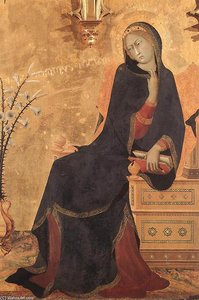
In the middle level of the San Martino Chapel within the Lower Church of San Francesco in Assisi, the fresco Miraculous Mass (scene 7) presents a religious narrative through a precise arrangement of figures and objects. Two men dressed in robes occupy the central space. One figure holds a cross while the other raises his hands toward the sky. The scene is set within an outdoor environment where a dining table and chairs are positioned near the subjects. Several birds are distributed across the composition, settled among the architectural and natural elements of the painting. The technique utilizes fresco, applying pigment directly onto the wet plaster of the wall to create a permanent bond with the structure.
The physical dimensions of this work measure approximately 390 x 200 cm. The artist employs a line-driven approach characteristic of the International Gothic style, utilizing flowing lines and decorative details. The color palette consists of various tones that define the folds in the robes and the textures of the surrounding setting. The arrangement of the altar cloth and candlesticks provides a structured, linear element that contrasts with the organic forms of the birds and the human figures.
Historical Context and Narrative Detail
Created around 1312, this work belongs to a larger cycle of frescoes depicting episodes from the life of Saint Martin. This specific scene depicts an event in Albenga where two angels appear during the elevation of the host to present Martin with a piece of fabric. The painting reflects the Sienese tradition of the early fourteenth century, a period marked by the influence of French manuscript illumination and ivory carving brought to Italy via the Via Francigena pilgrimage route.
The movement of the figures conveys a specific moment of transition. As the deacon reaches out toward his bishop, his gesture captures an expression of surprise. This interaction between the human subjects and the celestial elements—the appearing angels and the birds—integrates the spiritual event into a tangible, earthly setting. The work exists as part of a larger decorative program in the Cappella di San Martino, situated alongside other scenes such as the Miracle of the Resurrected Child and the Miracle of Fire.
Korduvad küsimused
Kuidas saan teoseid „Miraculous Mass (scene 7)“, autor Simone Martini vaadata diapositatsioonina?
Saadaval on diavorama: „Miraculous Mass (scene 7)“, autor Simone Martini teose Pildikava leht.
Mille kohta on teos "Miraculous Mass (scene 7)" ja milline on selle atmosfäär?
Teos „Miraculous Mass (scene 7)“, autor Simone Martini ühendab endas religious scene, fresco painting, simone martini, medieval art, cross symbolism, siena artists, courtly refinement ning loob Elegant atmosfääri.
Kas teose „Miraculous Mass (scene 7)“, autor Simone Martini värvid on kütkestatud või pehmed?
Teose „Miraculous Mass (scene 7)“, autor Simone Martini värvitoit on Subtle Color kütkusega.
Kunstniku elulugu
Simone Martini (c.1284–1344) – A Sienese Master of Elegance and Grace
Simone Martini, born around 1284 in Siena, Italy—though precise birthdates remain elusive—stands as a cornerstone figure in the transition from medieval to Renaissance art. He wasn’t merely a painter; he was an architect of elegance, a master of line and color who infused his works with a courtly refinement that distinguished him from contemporaries like Giotto di Bondone. Historical accounts regarding Martini’s formative years are fragmentary—scholarly debate centers on whether he apprenticed under Duccio di Buoninsegna, the dominant Sienese artist of his time, or if Florence and Giotto exerted a more profound influence—yet Martini undeniably forged an artistic path uniquely his own.
Origins and Education – The Seeds of Style
The exact circumstances surrounding Simone’s upbringing are shrouded in obscurity. Tradition suggests he was born in Siena’s Sant’Egidio district, possibly the son of Martino Senese, a craftsman specializing in preparing arriccio—the initial plaster layer applied to wall surfaces destined for fresco painting—though corroborating evidence remains scant. Regardless of his precise origins, Martini’s artistic training undoubtedly commenced within Duccio di Buoninsegna’s workshop, where he absorbed the stylistic precepts of Sienese Gothic.
The Siena Workshop – Collaboration and Patronage
Martini’s formative years were marked by close association with Memmo di Filippuccio, another artisan active in San Gimignano—a partnership that fostered not only professional growth but also exposure to the burgeoning artistic culture of Tuscany. Crucially, Martini secured his first major civic commission in 1311: the frescoing of the *Maestà* for Siena’s Palazzo Pubblico—a monumental undertaking that cemented Duccio’s legacy and established Martini as a rising talent.
The Maestà – A Synthesis of Tradition
The *Maestà*, completed in 1315, represents a pivotal moment in Martini’s artistic trajectory. It served as an homage to Duccio’s own masterpiece—a stylistic echo that underscored Martini’s commitment to established Sienese conventions. Yet, Martini transcended mere imitation; he innovated through meticulous attention to detail and the incorporation of groundbreaking techniques—particularly the use of metallic pigments and punching—resulting in a painting that embodies both grandeur and exquisite refinement.
International Gothic – Influence and Artistic Vision
Martini’s stylistic hallmark is undeniably International Gothic, a movement characterized by its delicate beauty, elongated figures, flowing drapery, and opulent ornamentation. This aesthetic was profoundly shaped by artistic currents originating from France—specifically the illuminated manuscripts and ivory carvings of Parisian ateliers—which Martini skillfully assimilated into his own distinctive vision.
Later Career – Avignon and Artistic Circles
Martini’s renown extended beyond Siena, attracting commissions from papal patrons in Avignon—a city at the epicenter of European power during the thirteenth century. His presence within Francesco Petrarca’s intellectual circle further enriched his artistic milieu—a connection underscored by Vasari’s account of Martini’s portrait of Laura de Noves—demonstrating Martini's ability to capture not only physical likeness but also the essence of beauty and inspiration.
Legacy – An Enduring Influence
Simone Martini’s contribution to European art history is undeniable. He championed International Gothic style, disseminating its aesthetic principles across the continent and shaping the artistic sensibilities of subsequent generations. His frescoes in San Francesco d’Assisi exemplify his mastery of large-scale decorative painting—a testament to Martini's unparalleled command of color, form, and compositional harmony. Martini died in Avignon in 1344, leaving behind a legacy that continues to inspire awe and admiration centuries later—a beacon of elegance and artistic innovation.

Simone Martini
1284 - 1344 , Itaalia
Lühikest infot
- Artistic Movement Or Style: International Gothic
- Artists Who Influenced This Artist:
- Duccio di Buoninsegna
- Francesco Petrarca
- Date Of Birth: c. 1284
- Date Of Death: 1344
- Full Name: Simone Martini
- Nationality: Italian
- Notable Artworks:
- Saint Louis Crowning Robert
- Annunciation (Uffizi)
- Consecration of Chapel
- Place Of Birth: Siena, Italy
Sarnased artiklid

Simone Martini: Innovation, Spirituality & Courtly Refinement in Sienese Painting
Explore the captivating world of Simone Martini, a pivotal figure in Sienese painting & the International Gothic style. Discover his innovative techniques, spiritual depth, and lasting influence on early Renaissance art.

The Enduring Legacy of Fresco: Technique, History & Artistic Expression Across Cultures
Explore the rich history & enduring legacy of fresco painting! Discover ancient techniques, Giotto's masterpieces, and modern applications. Expert insights for art lovers & professionals.
Sisekujunduse freskode emotsionaalne jõud: Ajalooline perspektiiv ja kaasaegne väljendus
Avastage freskode rikkalik ajalugu ja kaasaegseid võimalusi ekspertide käest. Kvaliteetsed seinamaalid interjööri, restaureerimine ja tellijatööd. Luksuslik sisekujundus teie kodule või ärile!

Perekonna pärandi säilitamine seinamaalingute kaudu: Freskode kunstiline ja kultuurilooline kontekst tänapäevas
Avastage freskode kunstiline ja ajalooline väärtus! Professionaalne konserveerimine ja restaureerimine perekonna pärandi säilimiseks. Kvaliteet, autentsus ja ekspertteadmised OriginalUniqueArt-is.
The Enduring Legacy of Fresco Painting: Techniques, History & Contemporary Relevance
Explore the rich history & enduring artistry of fresco painting – from Giotto to Michelangelo! Discover techniques, conservation efforts, & modern applications. Learn how OriginalUniqueArt brings this timeless art form to your home.