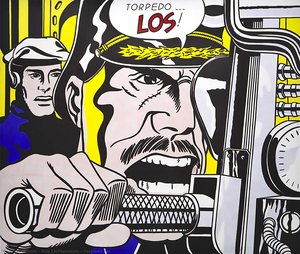
Vaata sisu
 Jaga teost
 Jaga
Jaga
 Detailid
 Õppekate juhend

 Laadi alla
 Sarnased teosed
 Röntgenuuring
 Slaidietendus
 Statistika
Untitled (1960)


 Loe lähemalt
Sellel lehel kuvatav kunstiteos on kaitstud autoriõigusega, mis tähendab, et meil ei ole seaduslikku õigust luua või müüa identset reproduktsiooni. Seda kaitset rakendatakse rahvusvaheliste kokkulepete alusel, nagu näiteks Berne konventsioon ning riiklike seadustega, sealhulgas nendega, mida on sätestatud USA autoriõiguse seadus – 17. peatükk.
See meetod järgib täielikult autoriõiguse reegleid, kuna see ei põhine kaitstud kunstiteose kopeerimisel või dupliteerimisel. Selle asemel on tegu loova reinterpreetatsiooniga – uue maaldisega, mis on algteosest inspireeritud, kuid ei ole sellest identiline.
Giclée / Kunstiprint
Muuseumikvaliteediga giclée- või kangasprint kiire tootmisega ja paindlikud viimistlusvõimalused. ( Telli käsitsi maalitud reproduktsioon Ülemineku digitaalse pildi müügi kanalisse)




P118B €10

P118H €10

P118W €10

P438Z €10

P508JH €12

P508YH €12

P805H €10

P805Z €10

P919BZ €10

P919G €10

P919XJ €10

P959ZH €10

P968JZ €12

W106C €8

W218G €10

W218JH €8

W218Y €10

W307PJ €10

W316G €10

W316PJ €8

W316Y €10

W398PJ €8

W4111J €10

W500HY €15

W500JH €15

W692G €12

W849H €8

W940BG €15

W953PJ €8




Vali meie eelmääratud suurused, mis vastavad teose algupärastele proportsioonidele.

Sisestage vajalik laius ja kõrgus, et see sobiks teie raamile või seinale. Trükki saab ainult lõigata, seda ei saa kunagi pildist suuremaks teha, seega ka differentse vormiga suurus kaotab osa pildist. Enne trükkimist saadame teile kinnitamiseks digitaalse näidisprojektsiooni. Sellel lehel näidatud pilt ei kujuta reaalset lõiget — seda näitab ainult näidisprojekttsioon.
Ülemaailmne tarne () 2 nädala jooksul, tavalise 4/5 nädala asemel. (23 oktoober)

Tasuta ekspresssaatmine üle maailma

Kõrgekvaliteediline lina-kangastest muld

Täielik transpordikindlustus

Tollimaksude tagastamise garantii

Värvitoime täpsuse garantii

100 päeva tagastusõigus (ainult defektide korral)

100% raha tagasi garantii

Hulgusoodustus
 Klaasivalik on saadaval ainult kuni 110 cm suuruses teostes

Untitled (1960)
Giclée / Kunstiprint
Reproduktsiooni mõõtmed
-


Lõppsumma
€ 70
A Prelude to Pop: The Raw Energy of Lichtenstein’s Abstract Genesis
Before the world came to know Roy Lichtenstein as the master of the Ben-Day dot and the architect of comic-strip chic, there existed a different, more visceral version of his creative soul. His 1960 work, Untitled, serves as a breathtaking window into a pivotal moment of transition, capturing an artist caught in the throes of Abstract Expressionism. In this piece, we encounter a creator unburdened by the irony and mechanical precision that would later define his career. Instead, we find a painter deeply engaged with the spontaneous, the tactile, and the profoundly emotional. It is a rare, intimate glimpse into the laboratory of a genius, where the heavy weight of post-war tension meets the liberating movement of the brush.
The canvas acts as a battlefield of color and motion, eschewing any recognizable subject in favor of pure, unadulterated feeling. There are no characters here, no narratives to decode—only the rhythmic dance of blues, reds, yellows, greens, and browns set against a muted, pale grey expanse. The composition lacks a traditional focal point, inviting the viewer’s eye to wander through a chaotic yet strangely harmonious arrangement of organic shapes and intersecting lines. This lack of structure is intentional; it mirrors the automatic process favored by the Abstract Expressionists, where the act of painting itself becomes the primary subject, capturing a fleeting moment of psychic energy before it can be codified into form.
Texture and Technique: The Tactile Language of Emotion
To stand before a high-quality reproduction of this work is to appreciate the incredible impasto technique that Lichtenstein employed during this era. Unlike his later, flatter works that mimicked the smoothness of print media, this 1960 masterpiece thrives on depth and physical presence. The paint is applied in thick, vigorous layers, creating a three-dimensional topography that catches the light and casts subtle shadows across the canvas. Each brushstroke feels urgent and decisive, suggesting a rapid, intuitive execution that prioritizes the artist's immediate impulse over meticulous planning.
This heavy texture does more than just add visual interest; it amplifies the painting's emotional resonance. The way the colors overlap and bleed into one another creates a sense of friction and tension, as if the pigments themselves are struggling to find equilibrium. For the collector or interior designer, this piece offers a sophisticated layer of complexity. It provides a focal point that is both intellectually stimulating and visually rich, making it an ideal centerpiece for spaces that demand a sense of movement, history, and raw, artistic authenticity.
A Historical Intersection: From Abstraction to Iconography
Understanding this painting requires situating it within the turbulent art landscape of 1960. This was a year of profound metamorphosis, where the dominance of Abstract Expressionism was beginning to face the rising tide of Pop Art. In this work, Lichtenstein stands at the crossroads. He is utilizing the vocabulary of the old guard—gestural abstraction and emotional intensity—while simultaneously experimenting with the very boundaries that he would soon shatter with his later, more commercialized imagery. It is a bridge between two worlds: the deeply personal, subjective experience of the mid-century painter and the objective, mass-produced reality of the coming decade.
For those seeking to adorn their homes or galleries with art that tells a story of evolution, Untitled (1960) is an incomparable choice. It offers more than mere decoration; it offers a piece of art history. It invites conversation about the nature of creativity and the courage required to abandon one's established style in search of something new. Whether placed in a contemporary minimalist setting or a classic, curated study, this painting brings with it an undeniable aura of prestige, energy, and the enduring spirit of artistic discovery.
Küsimused ja vastused
Milleks on „Untitled (1960)“, autor Roy Fox Lichtenstein mõeldud?
Prindi "Untitled (1960)" soovituslik kasutus on Statement.
Millise riigi kunstilihubast pärineb Abstract Expressionism teos "Untitled (1960)"?
Teose "Untitled (1960)" on loonud USA-s sündinud Roy Fox Lichtenstein, tuginedes Abstract Expressionism suunale. Kunstniku päritolu seob teose Abstract Expressionism stiiliga, mida praktiseerivad USA kunstnikud.
Millist atmosfääri teevad „Untitled (1960)“, autor Roy Fox Lichtenstein sisekujundusse?
Olles meeleoluult Dramatic, soovitatakse teost "Untitled (1960)" ruumiks Living Room.
Kunstniku elulugu
The Genesis of a Pop Visionary
Roy Fox Lichtenstein, born in the vibrant metropolis of New York City on October 27, 1923, indelibly altered the landscape of twentieth-century art. Emerging as a pivotal figure within the Pop Art movement, Lichtenstein didn’t simply reflect his era; he actively interrogated it, transforming commonplace imagery into compelling artistic statements. His upbringing in an upper-middle-class Jewish family fostered both a cultural awareness and an early artistic inclination. Childhood exposure to museums and concerts, coupled with a deep appreciation for jazz music, laid the groundwork for a creative spirit that would challenge conventional notions of fine art. Though initially drawn to realistic drawing and painting during his formative years, Lichtenstein’s formal training commenced at the Art Students League in 1939 under Reginald Marsh, followed by studies at Ohio State University – interrupted briefly by wartime service in the Army. These experiences provided a robust technical foundation that would later be brilliantly re-contextualized through the lens of mass culture and commercial aesthetics. The seeds of his signature style weren’t sown within the hallowed halls of artistic tradition but rather in the often-overlooked world of everyday imagery, particularly comic books and advertising.Early Influences and Artistic Exploration
Lichtenstein's formative years were marked by a fascination with Surrealism, mirroring the dominant aesthetic currents of his time. However, this initial engagement proved transitional, propelling him toward a radical stylistic shift. A crucial encounter transpired during his tenure at Rutgers University where he connected with Allan Kaprow, whose influence rekindled Lichtenstein’s interest in proto-pop iconography. This serendipitous meeting sparked a transformative reconsideration of artistic boundaries, prompting him to question the established dichotomy between “high” and “low” art. He began venturing beyond the subjective realm of Surrealism toward the objective language of popular culture – specifically, comic books and advertising. The year 1961 witnessed a decisive breakthrough with *Look Mickey*, a work that boldly appropriated characters from Disney comics, signaling the commencement of his distinctive style. This wasn’t mere imitation; it was an act of artistic re-evaluation, elevating commonplace imagery to the stature of fine art. He didn't simply replicate comic strip scenes; he meticulously recreated them utilizing techniques mirroring commercial printing processes – a deliberate blurring of distinctions between original artwork and mass production. This appropriation wasn’t about celebrating consumerism uncritically but rather scrutinizing its pervasive dominion over American society and contesting entrenched artistic hierarchies.The Birth of Ben-Day Dots and Bold Color Palettes
Lichtenstein's artistic vocabulary swiftly gained recognition: bold, primary hues, thick black outlines, and most notably, Ben-Day dots – a technique directly borrowed from the mechanical reproduction of comic books. These dots weren’t merely decorative; they constituted integral to his conceptual framework, representing the very process of mass production and challenging the traditional emphasis on the artist's hand. His paintings frequently magnified details from comic strips to monumental scale, compelling viewers to confront the aesthetic qualities of an art form typically dismissed as trivial. Works like *Whaam!*, *Drowning Girl*, and *Oh, Jeff…I Love You, Too…But…* became emblematic representations of Pop Art, encapsulating anxieties and desires inherent in a rapidly evolving consumer culture. These weren’t simply depictions of comic book narratives; they functioned as commentaries on themes of war, romance, and societal expectations – filtered through the visual language of mass media. He aimed to liberate art from subjective expression, presenting his work as impartial reflections of American society—a mirror held up to its own manufactured reality. The deliberate flatness and absence of painterly gesture further underscored this detachment, mirroring the impersonal nature of commercial printing.Major Achievements and Artistic Legacy
Lichtenstein’s influence extended far beyond the confines of painting. His innovative utilization of commercial techniques and appropriation paved the way for subsequent generations of artists investigating themes of consumerism, media saturation, and cultural identity. The sale of *Masterpiece* in 2017 solidified his position as one of the most commercially successful American artists of all time—but his legacy transcends monetary valuation. He challenged conventional notions of artistic authorship and originality, prompting a fundamental reassessment of what constitutes “art” itself. His oeuvre continues to inspire graphic designers, illustrators, and visual artists across diverse disciplines.- Significant Contributions: Spearheaded Pop Art style; achieved international acclaim through groundbreaking exhibitions.
- Iconic Works: *Whaam!*, *Drowning Girl*, *Oh, Jeff…I Love You, Too…But…*, *Masterpiece*.
- Teaching Influence: Shaped aspiring artists at SUNY Oswego and Rutgers University.

Roy Fox Lichtenstein
1923 - 1997 , USA
Lühikest infot
- Artistic Movement Or Style: Pop Art
- Artists Who Influenced This Artist:
- Reginald Marsh
- Allan Kaprow
- Date Of Birth: October 27, 1923
- Date Of Death: September 29, 1997
- Full Name: Roy Fox Lichtenstein
- Nationality: American
- Notable Artworks:
- Whaam!
- Drowning Girl
- Oh, Jeff…I Love You, Too…But…
- Place Of Birth: New York City, USA
Sarnased artiklid

The Psychology of the Palette: Decoding Roy Lichtenstein's Bold Color Theory
Explore the psychological depth of Roy Lichtenstein's color theory. An expert analysis for art students and collectors on Ben-Day dots, primary palettes, and the intersection of Pop Art with mass media history.
Roy Lichtensteini 25 parimat teost: popkunst ja koduseinte elegants
Avastage Roy Lichtensteini 25 parimat teost! Sukelduge popkunsti maailma, õppige maalidest ja tehnikatest. Kvaliteetsed reproduktsioonid ja interjööridisaini ideed OriginalUniqueArt.com-is. Vaadake kollektsiooni!
Pop Art meistriteosed: 10 ikoonilist teost, mis muutis kunsti maailma
Avastage 10 popkunstistiili ikoonilist teost Andy Warholist Roy Lichtensteini. Lugege kunstiteoste lugusid, tehnikat ja ajaloogu. Leidke oma seina jaoks täiuslik maali OriginalUniqueArt.com-is! Vaadake kollektsiooni.
The Psychology of the Palette: Decoding Roy Lichtenstein's Bold Color Theory
Explore the profound psychological depth of Roy Lichtenstein's color theory. Discover how his use of primary colors and Ben-Day dots revolutionized modern art, transforming mass media imagery into sophisticated fine art for the discerning collector.

Abstract Ekspressionismi 10 Meisterteost: Kunsti ja Sisustamise Klassikat
Sukeldu abstraktse ekspressionismi maailma! Avasta 10 legendaarset kunstiteost – Pollock, Rothko jt. – ja nende loo. Leia inspiratsiooni interjööriks ning kaunista kodu OriginalUniqueArt.com kvaliteetsete reproduktsioonidega. Uuri kollektsiooni!