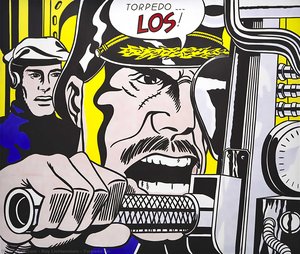
Õli-maalide versioon
 Kõik tegelda Mirror - 2 kohta







































 Kunstiteoste või reproduktsioonide puhul, mille üks külg on üle 105 cm (umbikmolt 41 tolli), saadetakse raam kirjal asendis, la Dismantlitud komplektina. See meetod tagab ohutuse kohaletoimetamisel ja väldib transpordil tekkivaid kahjustusi.


A Reflection on Modernity: Decoding Roy Lichtenstein’s “Mirror - 2”
Roy Lichtenstein's "Mirror – 2," created in 1970, is not merely an image *of* a mirror, but rather a profound exploration of perception, representation, and the very nature of looking. Emerging from the vibrant landscape of Pop Art, this screenprint transcends simple subject matter to become a compelling statement on modernity’s relationship with imagery and self-reflection. The artwork presents a stylized abstraction of a circular mirror against a stark white background, immediately drawing the viewer into a world defined by bold lines, geometric shapes, and the iconic Ben-Day dots that became synonymous with Lichtenstein's signature style. It is a work that doesn’t offer a literal reflection, but instead invites us to contemplate the constructed nature of reality itself.The Language of Pop: Technique and Style
Lichtenstein masterfully employs screenprinting techniques in “Mirror – 2,” a method deeply rooted in commercial art production. This choice is not accidental; it underscores his fascination with, and critique of, mass media and consumer culture. The crispness of the lines, the flat planes of color—primarily black, white, and strategic bursts of blue—and the deliberate application of Ben-Day dots all contribute to an aesthetic that mimics the look of comic book printing. These dots, rather than attempting to create tonal variation through traditional shading, function as a visual texture, simultaneously referencing mechanical reproduction and adding a layer of playful irony. The geometric forms within the ‘mirror’s’ surface—circles, rectangles, diagonal lines—are arranged in a dynamic yet fragmented manner, suggesting a shattered or distorted reflection. This isn't about capturing an image faithfully; it is about deconstructing and re-presenting visual information through the lens of popular culture.Beyond the Surface: Symbolism and Interpretation
The symbolism within “Mirror – 2” is open to interpretation, a hallmark of Lichtenstein’s more abstract works. The mirror itself, traditionally associated with self-reflection and truth, is here rendered as an object of artifice. It doesn't reveal *us* looking back; instead, it presents a constructed reality composed of graphic elements. This suggests a commentary on the mediated nature of experience in modern life—how our perceptions are shaped by images and representations rather than direct encounters with reality. The fragmented composition could also be interpreted as representing the fractured self, or the multiple identities we project to the world. The work subtly questions what it means to see, to be seen, and to construct an identity within a visually saturated environment.Lichtenstein’s Legacy: A Pioneer of Pop
Roy Lichtenstein (1923-1997) was a pivotal figure in the Pop Art movement, challenging conventional notions of fine art by embracing imagery from popular culture. Born in New York City, he initially explored Abstract Expressionism before finding his distinctive voice through the appropriation and reinterpretation of comic book aesthetics. His work, alongside that of Andy Warhol, helped to democratize art, bringing it closer to everyday life and questioning the boundaries between “high” and “low” culture. “Mirror – 2,” created during a period where Lichtenstein was experimenting with more abstract forms, demonstrates his continued exploration of visual language and his commitment to pushing the boundaries of artistic expression. His influence continues to resonate today, inspiring artists and designers alike with his bold aesthetic and thought-provoking concepts. The artwork stands as a testament to his enduring legacy—a vibrant reflection on the complexities of modern life.Korduvad küsimused
Kas teos Mirror - 2 on käsitsi maaldis või trükis?
Käsin maalitud: professionaalne kunstnik koopia teose Mirror - 2 õli-linast veebilehel.
Millise suuruse teose Mirror - 2 jaoks valida?
Suurused on vahemikus 31.7 x 31.5 cm (€178) kuni 240.3 x 239.0 cm (€1844); sellel lehel olev tabel on toodud peamised sammud ja nende hinnad.
Kui kaua kohalelymine aega võtab?
Tarneglus kestab 4–5 nädalat, pakkudes tasuta ekspresslaenitust üle maailma; kiiremat tootmist võimaldab seda lehte valitud valik. Teil on võimalik toote 100 päeva jooksul ilma tingimusteta täiesumma tagastamisega naasta, kui te ei ole sellest rahul.
Mida Roy Lichtenstein teoseks Mirror - 2 kasutas?
Acrylic On Canvas
 Eelvaade

 Saada
 Jaga
 Teave teose kohta
 Teave teose kohta


 Laadi alla
 Sarnased teosed
 Röntgenuuring
 Slaidietendus
 KÜSIMUSED JA VASTUSID

 Statistika