 Lülita trükkitoodetele
 Loe lähemalt







































 Kunstiteoste või reproduktsioonide puhul, mille üks külg on üle 105 cm (umbikmolt 41 tolli), saadetakse raam kirjal asendis, la Dismantlitud komplektina. See meetod tagab ohutuse kohaletoimetamisel ja väldib transpordil tekkivaid kahjustusi.


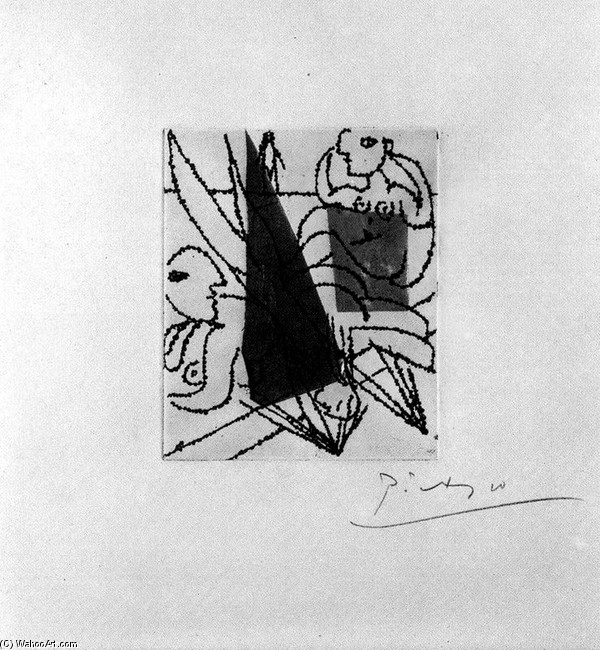
Pablo Picasso’s “The Diver”: Fragmented Reality Captured in Monochrome
Pablo Picasso's "The Diver," completed in 1932, stands as a cornerstone of Cubism—a movement that irrevocably altered the course of artistic expression. Executed in etching with colored paper additions, this artwork transcends mere visual representation; it delves into the complexities of perception and emotion through a masterful manipulation of geometric abstraction.
The photograph showcases Picasso’s meticulous attention to detail, capturing the subtle textures of the original paper surface alongside the stark beauty of monochrome. The composition itself is dominated by a rectangular space that serves as a canvas for fragmented figures—a deliberate rejection of traditional perspective—creating an unsettling yet captivating visual experience.
Stylistic Innovation: Embracing Cubist Principles
Picasso’s stylistic choices are profoundly rooted in the tenets of Cubism, pioneered alongside Georges Braque. Unlike Renaissance art's pursuit of illusionistic depth, Cubism dismantles conventional spatial conventions, presenting multiple viewpoints simultaneously on a single plane. “The Diver” exemplifies this approach perfectly; angular lines intersect and overlap, mirroring the fractured nature of observation and conveying a sense of dynamism that defies static representation.
The artist’s use of geometric shapes—primarily triangles and rectangles—is not merely decorative but fundamental to the artwork's conceptual framework. These forms represent abstracted figures and objects, emphasizing their structural essence rather than their realistic appearance. This deliberate simplification underscores Picasso’s desire to capture the underlying realities beneath surface impressions.
Historical Context & Symbolic Resonance
Created during a period of artistic experimentation and intellectual ferment—the early 1930s—"The Diver" reflects the broader anxieties surrounding the impending Second World War. Picasso's Cubist style, born from the influence of Cézanne and African sculpture, responded to the prevailing fascination with scientific advancements and challenged established aesthetic norms.
Beyond its formal innovations, “The Diver” possesses a palpable emotional resonance. The monochrome palette—a deliberate choice mirroring the tonal range found in charcoal sketches—amplifies the artwork’s contemplative mood. The fragmented figures evoke disorientation and uncertainty, prompting viewers to confront multiple perspectives on existence and conveying a profound sense of melancholy.
Technique & Material Considerations
The etching process itself contributes to the artwork's visual impact, allowing for precise tonal gradations and subtle textural nuances that would be unattainable with paint. Picasso skillfully utilized ink and charcoal on paper—a technique he honed throughout his prolific career—to achieve a remarkable level of detail while maintaining the stylistic integrity demanded by Cubism.
The photograph meticulously documents this artistic process, preserving the original medium's character despite its limitations in conveying color. However, it successfully communicates the artwork’s core aesthetic qualities: geometric abstraction, dynamic composition, and an unwavering commitment to exploring the psychological dimensions of visual experience.
Korduvad küsimused
Kas „The Diver“, autor Pablo Picasso kuulub nõutudud Cubist Style teostega?
Cubist Style suunnas on teos "The Diver" Iconic populaarsusega.
Mille kohta teos "The Diver" on?
„The Diver“, autor Pablo Picasso kujutab: cubism, abstraction, figure, geometric, monochrome, composition, perspective.
Kas teos „The Diver“, autor Pablo Picasso kuulub avalikku omandisse?
Tegijateõiguse osas on teos "The Diver" kuuluv klassifikatsiooni alla: on endiselt autoriõiguse all under kaitse.
 Eelvaade
 Saada
Saada Jaga
Jaga
 Teave teose kohta
 Juhend

 Laadi alla
 Sarnased teosed
 Röntgenuuring
 Slaidietendus
 Q&A
Q&A Statistika