Lülita trükkitoodetele
 Loe lähemalt







































 Kunstiteoste või reproduktsioonide puhul, mille üks külg on üle 105 cm (umbikmolt 41 tolli), saadetakse raam kirjal asendis, la Dismantlitud komplektina. See meetod tagab ohutuse kohaletoimetamisel ja väldib transpordil tekkivaid kahjustusi.


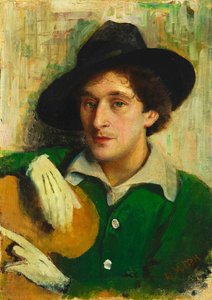
Marc Chagall's "David" – A Symphony of Memory and Flight
Marc Chagall’s “David,” painted in 1914, is not merely a depiction of a man with a guitar; it’s an immersion into the artist’s deeply personal world, a realm where reality dissolves into dream and memory. Born Moishe Shagal in 1887 in Liozna, Belarus – a town that would forever haunt his artistic imagination – Chagall established himself as one of the most distinctive voices of the early 20th century. This particular work exemplifies his signature style: a vibrant, almost hallucinatory blend of Cubist influences with deeply rooted Jewish folklore and a profound yearning for home. The painting immediately draws the eye to the central figure, a man seemingly lost in contemplation, cradling a guitar as if it were a precious relic. The bird perched upon the instrument adds another layer of symbolic richness, representing freedom, spirituality, and perhaps even the artist’s own restless spirit.
Cubist Echoes and Belarusian Roots
- Chagall's "David" is firmly rooted in the artistic currents of its time. While undeniably influenced by the burgeoning Cubist movement – evident in the fragmented forms and multiple perspectives – he transcends mere stylistic imitation.
- The painting’s genesis lies within Chagall’s formative years in Liozna, a town steeped in Orthodox religious tradition and Jewish cultural heritage. This duality—the juxtaposition of sacred and secular, ancient and modern—is a recurring theme throughout his oeuvre.
- The use of oil on canvas allows for the rich, saturated colors characteristic of Chagall’s work, creating an almost tactile quality that invites the viewer to step into the scene.
Symbolism: Flight, Faith, and Remembrance
Beyond its formal qualities, “David” is laden with potent symbolism. The guitar itself represents music, a universal language of emotion and memory, but also perhaps a longing for connection to the past. The bird, frequently appearing in Chagall’s work, symbolizes freedom, spiritual aspiration, and the ability to transcend earthly limitations. The posture of the figure – gazing downwards, lost in thought – suggests introspection and a desire to recapture vanished moments. It's a scene that evokes a sense of melancholy beauty, reminiscent of biblical narratives and folk tales.
A Window into Chagall’s Vision
Painted in 1914, just as Europe was teetering on the brink of war, “David” reflects a world grappling with uncertainty. Chagall's art offered an escape from the anxieties of the era, transporting viewers to a realm of heightened emotion and imaginative possibility. This reproduction captures not only the visual impact of the original but also the profound emotional resonance that continues to captivate audiences today. It’s a testament to Chagall’s ability to transform personal memory into universal symbols, inviting us to contemplate our own place in time and the enduring power of dreams.
Korduvad küsimused
Millist etap Mark Šagall loomingus teos "David" esindab?
Teos "David" esindab kunstniku Mark Šagall loovperioodi Early Cubist.
Mis aastal loodi teos „David“, autor Mark Šagall?
Teos "David" on pärit aastast 1914. See ajastu aitab mõista teost Mark Šagall karjääri ja selle ajastu kontekstis.
Mille kohta on teos "David" ja milline on selle atmosfäär?
Teos „David“, autor Mark Šagall ühendab endas guitar player, marc chagall, cubist style, bird motif, jewish folklore, dreamlike scene, oil on canvas ning loob Nostalgic atmosfääri.
 Eelvaade
 Saada
Saada Jaga
Jaga
 Teave teose kohta
 Juhend

 Laadi alla
 Sarnased teosed
 Röntgenuuring
 Slaidietendus
 Q&A
Q&A Statistika