Text size

() ·

A painting made for you, by hand

Violin and Guitar

Käsitsi valmistatud õlimaalireproduktsioon

Meie kunstnike poolt tellimusel valmistatud käsitsi maalitud õli-kainaste teos teie soovitud suuruses ja raamis. ( Lülita trükkitoodetele Lülita digitaalse pildi juurde)

Kogumisobjekti kirjeldus

Explore Juan Gris’s ‘Violin and Guitar’ (1913), a groundbreaking Cubist still life. Geometric forms, cool tones & layered glazes define this iconic piece – a must-see for art collectors.

Kunstniku elulugu

Avastage Juan Gris (1887-1927), hispaania kubismi meister! Tutvuge tema geomeetrilise stiili, süntheetilise kubismi ja püsiva mõjuga kaasaegsele kunstile. Vaadake teoseid nüüd.

from ·

Chapter 1

How large should it be?

Slide to change the size; the picture on the left shows the frame at its real width. The proportions of the original are kept.

Standardne suurus
kohandatud
CM
INCH

Vali meie eelmääratud suurused, mis vastavad teose algupärastele proportsioonidele.

laius
kõrgus

Sisestage vajalik laius ja kõrgus, et teos sobiks teie raamile või seinale. Kuna tegu on käsipainatud teosega, siis erineva kujuga suuruse korral võib kunstnik jätta pildi ümber veidi rohkem marginaali või lõigata osa ära — valik on teie. Enne maali alustamist saadame teile kinnitamiseks digitaalse näidisprojektsiooni. Sellel lehel näidatud pilt ei kajasta tegelikku tulemust — seda näitab ainult näidisprojektsioon.

Chapter 2

How should it arrive?

Choose the edges of the stretched canvas

Choose your frame

Corner sample of the WhiteWrap canvas edge finish, stretched on massivpuit bars
White €1
Corner sample of the BlurSideWrap canvas edge finish, stretched on massivpuit bars
Blurside €1
Corner sample of the ExtendedWrap canvas edge finish, stretched on massivpuit bars
Extended €1
Corner sample of the P118B picture frame: vormitud polüstüreen, 5 cm wide and 3 cm thick
P118B €10
Corner sample of the P118H picture frame: vormitud polüstüreen, 5 cm wide and 3 cm thick
P118H €10
Corner sample of the P118W picture frame: vormitud polüstüreen, 5 cm wide and 3 cm thick
P118W €10
Corner sample of the P438Z picture frame: vormitud polüstüreen, 5.5 cm wide and 3.5 cm thick
P438Z €10
Corner sample of the P508JH picture frame: vormitud polüstüreen, 7 cm wide and 3.5 cm thick
P508JH €12
Corner sample of the P508YH picture frame: vormitud polüstüreen, 7 cm wide and 3.5 cm thick
P508YH €12
Corner sample of the P805H picture frame: vormitud polüstüreen, 5 cm wide and 3.5 cm thick
P805H €10
Corner sample of the P805Z picture frame: vormitud polüstüreen, 5 cm wide and 3.5 cm thick
P805Z €10
Corner sample of the P919BZ picture frame: vormitud polüstüreen, 7 cm wide and 3.5 cm thick
P919BZ €10
Corner sample of the P919G picture frame: vormitud polüstüreen, 7 cm wide and 3.5 cm thick
P919G €10
Corner sample of the P919XJ picture frame: vormitud polüstüreen, 7 cm wide and 3.5 cm thick
P919XJ €10
Corner sample of the P959ZH picture frame: vormitud polüstüreen, 5 cm wide and 3 cm thick
P959ZH €10
Corner sample of the P968JZ picture frame: vormitud polüstüreen, 6 cm wide and 4 cm thick
P968JZ €12
Corner sample of the W106C picture frame: massivpuit, 5 cm wide and 3 cm thick
W106C €8
Corner sample of the W218G picture frame: massivpuit, 5 cm wide and 3 cm thick
W218G €10
Corner sample of the W218JH picture frame: massivpuit, 5 cm wide and 3 cm thick
W218JH €8
Corner sample of the W218Y picture frame: massivpuit, 5 cm wide and 3 cm thick
W218Y €10
Corner sample of the W307PJ picture frame: massivpuit, 6 cm wide and 3 cm thick
W307PJ €10
Corner sample of the W316G picture frame: massivpuit, 6 cm wide and 3 cm thick
W316G €10
Corner sample of the W316PJ picture frame: massivpuit, 6 cm wide and 3 cm thick
W316PJ €8
Corner sample of the W316Y picture frame: massivpuit, 6 cm wide and 3 cm thick
W316Y €10
Corner sample of the W398PJ picture frame: massivpuit, 5 cm wide and 3 cm thick
W398PJ €8
Corner sample of the W4111J picture frame: massivpuit, 6.5 cm wide and 3.5 cm thick
W4111J €10
Corner sample of the W500HY picture frame: massivpuit, 7 cm wide and 5 cm thick
W500HY €15
Corner sample of the W500JH picture frame: massivpuit, 7 cm wide and 5 cm thick
W500JH €15
Corner sample of the W692G picture frame: massivpuit, 8 cm wide and 4 cm thick
W692G €12
Corner sample of the W849H picture frame: massivpuit, 5 cm wide and 3 cm thick
W849H €8
Corner sample of the W940BG picture frame: massivpuit, 7.5 cm wide and 4.5 cm thick
W940BG €15
Corner sample of the W953PJ picture frame: massivpuit, 6 cm wide and 3.5 cm thick
W953PJ €8
Corner sample of the H24-GOLD picture frame: kareeritud puit ja gesso, 10 cm wide and 6 cm thick
H24-GOLD €30
Corner sample of the H24-SILVER picture frame: kareeritud puit ja gesso, 10 cm wide and 6 cm thick
H24-SILVER €30
Corner sample of the H36-GOLD picture frame: kareeritud puit ja gesso, 15 cm wide and 6.5 cm thick
H36-GOLD €45
Corner sample of the H36-SILVER picture frame: kareeritud puit ja gesso, 15 cm wide and 6.5 cm thick
H36-SILVER €45
Raami eelvaade
Raamitud

Moulding: . Overall size with the frame: .

Chapter 3

Who paints it, and should anything change?

Examples of what can be changed: Replace face with customer photo; Add pet (e.g., replace cat with dog); Include hidden message in background; Change background landscape or elements.
After order, OriginalUniqueArt.com team will email client for instructions and provide a mockup preview

Maailmline tarne 3–4 nädala jooksul tavalise 5 nädala asemel. (2 november). Kvaliteedis kompromisse ei tehta.

Chapter 4

The finishing touches

A nameplate, as in a museum?

Graveeritud pronksplaadi üksikasjad

This elegant plaque features the artist's name and the title of the artwork, finely engraved for a timeless presentation.

It is made from bronze with a refined, elegant finish. The text is precisely laser-engraved for a sharp and permanent result. Measuring 9x2 cm, the plaque is compact yet easy to read. It's built to be durable and scratch-resistant, offering a professional, museum-quality look. Mounting is simple thanks to the included adhesive backing.

Läbipaistva akrüülplaadi üksikasjad

The plaque includes essential engraved details such as the artist's name, the title of the artwork, the date it was created, the type of media used-like oil on canvas or watercolor-a brief description of the piece, and a QR code that links to the complete artwork information.

It is crafted from clear acrylic, offering a sleek, modern appearance. The text is UV-engraved in black to ensure strong visual contrast. With a size of 10x15 cm, it ensures optimal readability. It comes equipped with two metal hooks for secure wall mounting. The plaque is designed to be weather-resistant, making it suitable for various environments, and it includes interactive features that work seamlessly with smartphone scanning.

Musta akrüülplaadiรายละเอียด (Note: The user provided "Musta akrüülplaadi detailid" as the current translation and asked for an improved version. Since "Musta akrüülplaadi

This elegant plaque includes engraved information such as the artist's name, the title of the artwork, the date it was created, the type of media used (like oil on canvas or watercolor), a short description of the artwork, and a QR code for quick access to more information.

The plaque itself is made from refined black acrylic with a premium finish. The text is laser-engraved in white for high contrast and readability. Its size is 10x15 cm, designed to be easy to read. It comes with two metal hooks for professional mounting. The design is sleek and fits any interior style. It is also weather-resistant and durable, with built-in digital integration for mobile compatibility.

A protective varnish?

When do you need it?

Chapter 5

Your painting, as you ordered it

Violin and Guitar

Reproduktsiooni tehnika

Reproduktsiooni suurus

-

Eelistatud tippkunstnik

Rohkem detaile, peenust ja lisatootmisaega

-

Reproduktsiooni raamivalikud

-

-

Kunstiteoste või reproduktsioonide puhul, mille üks külg on üle 105 cm (umbikmolt 41 tolli), saadetakse raam kirjal asendis, la Dismantlitud komplektina. See meetod tagab ohutuse kohaletoimetamisel ja väldib transpordil tekkivaid kahjustusi.

Vajalik professionaalne kokkupanek – see ei ole isetegevusega valmistamiseks mõeldud toode.
Komplekt tuleb kokku panna ja lõvet pingutada kogemusega professionaalse raamija, kasutades puiduliim (ei kuulu komplekti), lõvetpingi ja klempe, et hoida raami kande mustad õigena liimi kuivamisaja jooksul. Vale kokkupanek või ebaühtlane lõvetping võib kunstiteost püsivalt kahjustada ning seda ei katta meie garantii.

  • Kaasatud on kõik tahked puidust liistud, täpselt lõigatud vastavaks suuruseks.

  • Kokku panemiseks kasutatakse lisatud kruvisid ning nurkade liimamiseks vajalikku puuliima, mida ei ole komplektis ja mida peab raamivalmistaja ise hankima.

  • Vajalik on kasutada professionaalseid tööriistu, mis ei kuulu komplekti: lõvetelapide pingist (pingutaja) ja klambreid, et hoida raami puidu nurgas õigena liimi kuivamisaja jooksul.

Oluline:
Nurgaliimamiseks on vaja puiduliim, liimimine peab toimuma klempide all kuni liim on täielikult kuivanud ning kokku monteeritud raami kanga pingutamiseks on vajalik kanga pingutustang. Kumbki neist ei kuulu komplekti. Palun veenduge enne selle suuruse tellimist, et teil on saadaval kogenud professionaalne raamistaja.

Nimesildikiri

-

-

Kaitsevärnitsus

Läikiv lakk (muudab värvid elavamaks ning kaitseb valgust ja niiskust eest)

-

Kohanda oma teost

Näiteid muudatuste kohta: Asenda nägu kliendi fotoga; Lisa lemmikloom (nt asenda kass koeraga); Lisa taustale peidetud sõnum; Muuda tausta maastikku või elemente.

-

Kiire tarne

Ülemaailmne tarne riiki 3–4 nädalaga tavalise 5 nädala asemel. (2 november). Kvaliteedis kompromisse ei tehta.

-

Kiirsaatmine

Ülemaailmne tarne () 5 nädala jooksul. (9 november).

Sisse kuuluv

Koguhind

€ 267

Kogu summa € 267

Klaasivalik on saadaval ainult kuni 110 cm suuruses teostes

Included with every order

  • Tasuta ekspresssaatmine üle maailma
  • Kõrgekvaliteediline lina-kangas
  • Täielik transpordikindlustus
  • Tollimaksude tagastamise garantii
  • Värvitoime täpsuse garantii
  • 100 päeva tagastusõigus (ainult valmistusdefektide korral)
  • 100% raha tagasi garantii
  • Hulgusoodustus

A Fragmented Harmony: Juan Gris’s “Violin and Guitar”

Juan Gris’s “Violin and Guitar,” painted in 1913, isn't merely a still life; it’s a meticulously constructed exploration of perception and the very nature of representation. Emerging from the fertile ground of early Cubism, this work embodies the movement’s revolutionary shift away from traditional perspective and towards a fractured, multi-faceted view of reality. More than just depicting musical instruments, Gris offers us a glimpse into his innovative approach to visual language – a deliberate dismantling and reassembling of form that speaks volumes about the artist's intellectual rigor and artistic vision.

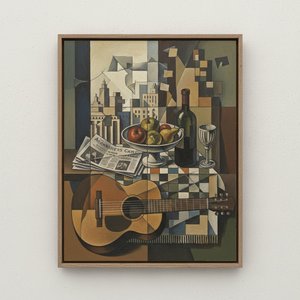
The canvas is dominated by the assertive presence of a guitar and violin, rendered with an almost startling degree of realism despite their fragmented composition. However, these recognizable objects are not presented in a straightforward manner. Instead, they’re broken down into geometric planes – sharp angles, interlocking rectangles, and subtly curved lines—that suggest multiple viewpoints simultaneously. This is the hallmark of Synthetic Cubism, where elements from various perspectives are layered upon one another to create an illusion of depth and volume within a flattened space. The background, hinted at through a suggestion of a window and curtain, further reinforces this sense of spatial ambiguity, inviting the viewer to actively participate in constructing the image.

The Language of Cubism: Deconstruction and Reconstruction

Gris’s approach is deeply rooted in the principles pioneered by Picasso and Braque. He embraced the analytical cubist method – a process of dissecting objects into their constituent parts, analyzing them from multiple angles, and then reconstructing them on the canvas. Yet, “Violin and Guitar” marks a significant departure from the purely analytical style. It’s a prime example of Synthetic Cubism, where pre-existing elements—fragments of color, texture, and form—are collaged together to create a new, unified image. The use of *papier collé*, or pasted paper, is subtly present in the background, adding another layer of complexity and visual interest.

Noticeably absent is the dense, monochromatic palette often associated with early Cubism. Instead, Gris employs a vibrant and carefully considered color scheme – cool blues and grays juxtaposed against warm reds and greens. These colors aren’t merely decorative; they contribute to the overall sense of dynamism and visual tension within the composition. The deliberate use of contrasting hues draws attention to specific areas of the painting, guiding the viewer's eye through the intricate network of lines and shapes.

Symbolism and Emotional Resonance

While “Violin and Guitar” is undeniably a formal masterpiece, it also carries a subtle layer of symbolic meaning. Music itself has long been associated with harmony, emotion, and creativity. The instruments depicted—the violin and guitar—represent these concepts in tangible form. The fragmentation of the objects can be interpreted as reflecting the complexities of human experience – the way we perceive reality through multiple lenses and the challenges of integrating disparate elements into a cohesive whole.

Furthermore, the painting’s overall mood is one of quiet contemplation. The muted colors, the fragmented forms, and the sense of spatial ambiguity create an atmosphere of detachment and introspection. It's not a celebratory or overtly emotional work; rather, it invites the viewer to engage in a process of careful observation and interpretation. The deliberate lack of strong shadows contributes to this feeling of flatness and abstraction, emphasizing the painting’s formal qualities over its representational ones.

A Legacy of Innovation

“Violin and Guitar” stands as a pivotal work in Juan Gris's artistic development and a cornerstone of Cubist innovation. It demonstrates his mastery of geometric form, his innovative use of color, and his ability to create complex visual narratives through seemingly simple compositions. Gris’s unique approach—combining rigorous analytical study with a poetic sensibility—established him as one of the most influential artists of the 20th century, leaving an indelible mark on the development of modern art.

Korduvad küsimused

Kes on teose "Violin and Guitar" autor ja millal see on loodud?

Juan Gris loob teose "Violin and Guitar" aastal 1913.

Mis on teose „Violin and Guitar“, autor Juan Gris domineeriv väritoon?

Teose „Violin and Guitar“, autor Juan Gris domineeriv toon on Green to Violet Spectrum. See toon on paleti alusvärv.

Millist suurust ja orientatsiooni soovitatakse teosele „Violin and Guitar“, autor Juan Gris trükkimisel?

Medium suurus, Portrait orientatsioon: see on teosele „Violin and Guitar“, autor Juan Gris soovitatud trükkimise seadistus.

More about this painting

Eelvaade AR-eelvaade Lülita trükkitoodetele Lülita digitaalse pildi juurde Saada
Teave teose kohta Juhend Lisa lemmikutesse Laadi alla Sarnased teosed Röntgenuuring Slaidietendus Q&A Statistika

In numbers

  • 1913the year it was painted
  • 29frames to choose from
  • standard sizes, in its own proportions
  • 5weeks to paint and deliver it
Juan Gris

Juan Gris

1887 - 1927, Hispaania

Quick facts about Juan Gris

  • Artistic Movement Or Style: Kubism, Sünthetiline kubism
  • Artists Or Movements Influenced By This Artist:
    • Purism
    • Amédée Ozenfant
    • Le Corbusier
  • Artists Who Influenced This Artist:
    • Pablo Picasso
    • Henri Matisse
    • Georges Braque
  • Date Of Birth: 23. märts 1887
  • Date Of Death: 11. mai 1927
  • Full Name: José Victoriano González-Pérez
  • Nationality: Hispaania
  • Notable Artworks:
    • Kitarr mere ees
    • Aukuning Pablo Picassole
    • Veski meister
    • Portree Madame Josette Grisist
  • Place Of Birth: Madrid, Hispaania

Kunstniku elulugu

Kubismi spani visjonär: Juan Grisi elu ja kunst

Sündinud Madridis 1887. aastal nimega José Victoriano González-Pérez, alustas kunstnik, kes saaks tuntud kui Juan Gris, teekonda, mis tõi ta 20. sajandi alguse kunstiajalukku kõige olulisemate nimede hulka. Tema algne tee ei viinud kohe pintsi ja lõvetrad siia; ta õppis insinööri silma Kunstide ja Teaduste koolis, näidates analüsti meelt, mis mõjutas hiljem sügavalt tema kunstilist lähenemist. Isegi need kujundavate aastate jooksul leendis loov säde – panused joonistustesse kohalike ajakirjadesse viitasid kasvavale visuaalsele talentile. Just 1905. aastal võttis ta pseudonüümi Juan Gris, nimi, mis sündis uuest identiteedist ja eesmärgist, kui ta alustas ametlikke maaliõppusi José Moreno Carbonero juures. See märkis murdelikku pöördet, suunates teda kunstilise innovatsiooni teele.

Pariisi äratus ja kubismi omaksimine

Aast 1906 tõi endaga kaasa rahustamatut muutust Pariisi siirega, linnaga, mis tol ajal pulsas kunstilisest energiast. Gris uputas end sellesse vibratsioonikusse, sõlmides sõprusi nagu Henri Matisse, Georges Braasi ja Fernand Léger. Alguses tegelemas satiilse illustratsiooniga väljaannetes nagu L'Assiette au Beurre, teritas oma tähelepanekuvõimet ja arendas teravat visuaalset naljakust. Kuid Pablo Picasso magnetiline tõmbe jõud oskus olla eriti mõjuva. Umbes 1910. aastal hakkas Gris pühenduma tõelisele maaliujule, liikudes karikatuurist kaugemale kubismi ujuva keele suunas. See ei olnud pelgalt imiteerimine; ta alustas otsingut, et tuvastada vormi ja ruumi olemus, otsides uut visuaalset korda. Tema varajased uurimused marksid teadlik eemaldumist traditsioonilisest esitlusviisist, omaksates abstraktsiooni kui vahendit reaalsuse alusestruktuuri tabamiseks.

Perseptsiooni geomeetria: stiil ja peateosed

Juan Grisi kunstiline looming on iseloomustatud erakordse selguse ja intellektuaalse rangusega. Ta ei dekonstruerinud objekte lihtsalt; ta rekonstrueeris neid hoolikalt täpselt, rõhutades geomeetrilisi vorme ja hoolikalt läbi kaalutud väripaletti. See lähenemine viis selle, mis sai tuntuks tema „kristallperioodina“, mida näitavad suurepärased teosed nagu Still Life Before an Open Window ja Place Ravignan (1915). Need teosed demonstreerivad planeede ja nurkadega märkimisväärset mängu, luues sügavuse ja tahujuse tunnet, samal ajal väljakutses konventsionaalsetest perspektiivi mõistest. Pärast 1913. aastat omaksis Gris täielikult sündteetilist kubismi, olles uuendaja tehnika papier collé ehk kollaaži kasutamisel – integreerides oma kompositsionides reaalsest maailmast leitud materjale nagu ajalehefragmentid ja tekstuuritud paberid. See tehnika lisas tema töödele veelgi rohkem keerukust ja taktiilsust, hämardades piire maali ja skulptuuri vahel. Silmapaistvad näited on Guitar in front of the sea (1925), mis on tunnistus tema lihtsustatud vormidele ja kubistilistele põhimõtetele järgimisele, ning Homage à Pablo Picasso (1912), mis märkas tema kasvavat tunnust avantgardses kunstimaailmas.

Pärand ja püsiv mõju

Juan Grisi panus kubismi vastu ulatub kaugemale kui pelg stiililine innovatsioon; ta tõi liikumisele kaasa unikaalse intellektuaalse sügavuse ja struktuurse selguse. Ta liikus analüütilisest faasist edasi organiseeritumate ja sündteelistemate lähenemiste poole, rõhutades korda ja täpsust. Tema töö mõjutas sügavalt puristlikku stiili, mida edaldasid Amédée Ozenfant ja Charles Edouard Jeanneret (Le Corbusier), proponenteerides naasmist klassikalistest vormi- ja kompositsioonipõhimõtetest. Grisi rõhuasetus geomeetrilistele vormidele, harmonilistele väripalettidele ja igapäevaste esemete integreerimisele kunstisse kinnitas teda kui võtmefigureks 20. sajandi kunstis. Tema pärand inspireerib kunstnereid ka täna, demonstreerides kubismi püsivat jõudu ja Juan Grisi visjonlikku geniaalust – spani lõiki meistrit, kes rešiteeris meie arusaamatust perseptsioonist ja esitlusest.

Teave teose kohta

  • Dimensions: 60 x 81 cm
  • Location: Museo Reina Sofia
  • Artist: Juan Gris
  • Year: 1913
  • Medium: Oil on canvas
  • Notable elements: Geometric shapes,

Kunstiteaduse kvartett

Iga küsimuse kohta on ainult üks õige vastus.

Küsimus 1:
What artistic movement is ‘Violin and Guitar’ primarily associated with?
Küsimus 2:
In ‘Violin and Guitar’, what is a key characteristic of the depiction of the objects?
Küsimus 3:
Which of the following best describes Juan Gris’s approach to Cubism as seen in this work?
Küsimus 4:
The use of ‘papier collé’ (collage) in ‘Violin and Guitar’ primarily serves to:
Küsimus 5:
What does the fragmented spatial representation in ‘Violin and Guitar’ suggest about Gris's artistic approach?