Menüü
Vaata sisu Vaata AR-eelvaadet Lülita trükkitoodetele Ülemineku digitaalse pildi müügi kanalisse Jaga teost
Detailid Õppekate juhend Lisa lemmikutesse Laadi alla Sarnased teosed Röntgenuuring Slaidietendus Statistika

Untitled

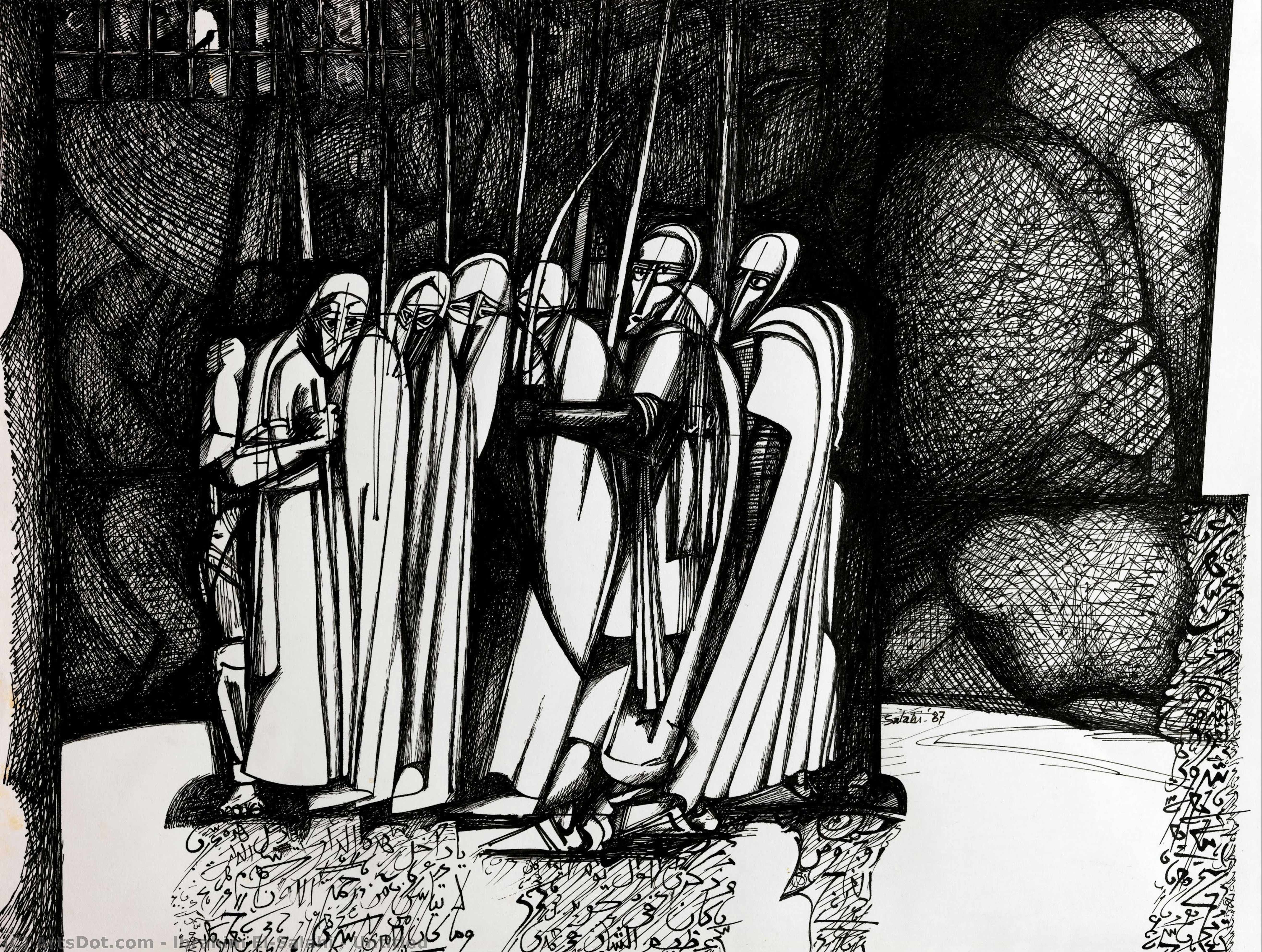
A hauntingly intricate black and white ink drawing by Sudanese master Ibrahim El-Salahi from 1987 captures a sense of confinement through layered figures and calligraphic textures, inviting you to explore this modern classic.

Explore the captivating art of Ibrahim El-Salahi, a Sudanese master of African Modernism & Hurufiyya. His paintings blend Islamic calligraphy, abstract forms, and cultural motifs. Discover his unique visual language!

Sellel lehel kuvatav kunstiteos on kaitstud autoriõigusega, mis tähendab, et meil ei ole seaduslikku õigust luua või müüa identset reproduktsiooni. Seda kaitset rakendatakse rahvusvaheliste kokkulepete alusel, nagu näiteks Berne konventsioon ning riiklike seadustega, sealhulgas nendega, mida on sätestatud USA autoriõiguse seadus – 17. peatükk.

Austasena ja seaduslikuna alternatiivina pakume originaalist inspireeritud, käsitsi maalitud isikupärastatud teoseid. Meie osutavad ja professionalsed kunstnikud uurivad hoolikalt originaali stiili, meelemoi ja kunstilist olemust, et luua uus, ainulaadne teos, mis tekitab sama tunnet – olles samal ajal omaette originaalne looming.

See meetod järgib täielikult autoriõiguse reegleid, kuna see ei põhine kaitstud kunstiteose kopeerimisel või dupliteerimisel. Selle asemel on tegu loova reinterpreetatsiooniga – uue maaldisega, mis on algteosest inspireeritud, kuid ei ole sellest identiline.

Käsitsi valmistatud õlimaalireproduktsioon

Meie kunstnike poolt tellimusel valmistatud käsitsi maalitud õli-kainaste teos teie soovitud suuruses ja raamis. ( Lülita trükkitoodetele Ülemineku digitaalse pildi müügi kanalisse)

Corner sample of the P118B picture frame: moulded polystyrene, 5 cm wide and 3 cm thick
P118B 10
Corner sample of the P118H picture frame: moulded polystyrene, 5 cm wide and 3 cm thick
P118H 10
Corner sample of the P118W picture frame: moulded polystyrene, 5 cm wide and 3 cm thick
P118W 10
Corner sample of the P438Z picture frame: moulded polystyrene, 5.5 cm wide and 3.5 cm thick
P438Z 10
Corner sample of the P508JH picture frame: moulded polystyrene, 7 cm wide and 3.5 cm thick
P508JH 12
Corner sample of the P508YH picture frame: moulded polystyrene, 7 cm wide and 3.5 cm thick
P508YH 12
Corner sample of the P805H picture frame: moulded polystyrene, 5 cm wide and 3.5 cm thick
P805H 10
Corner sample of the P805Z picture frame: moulded polystyrene, 5 cm wide and 3.5 cm thick
P805Z 10
Corner sample of the P919BZ picture frame: moulded polystyrene, 7 cm wide and 3.5 cm thick
P919BZ 10
Corner sample of the P919G picture frame: moulded polystyrene, 7 cm wide and 3.5 cm thick
P919G 10
Corner sample of the P919XJ picture frame: moulded polystyrene, 7 cm wide and 3.5 cm thick
P919XJ 10
Corner sample of the P959ZH picture frame: moulded polystyrene, 5 cm wide and 3 cm thick
P959ZH 10
Corner sample of the P968JZ picture frame: moulded polystyrene, 6 cm wide and 4 cm thick
P968JZ 12
Corner sample of the W106C picture frame: solid wood, 5 cm wide and 3 cm thick
W106C 8
Corner sample of the W218G picture frame: solid wood, 5 cm wide and 3 cm thick
W218G 10
Corner sample of the W218JH picture frame: solid wood, 5 cm wide and 3 cm thick
W218JH 8
Corner sample of the W218Y picture frame: solid wood, 5 cm wide and 3 cm thick
W218Y 10
Corner sample of the W307PJ picture frame: solid wood, 6 cm wide and 3 cm thick
W307PJ 10
Corner sample of the W316G picture frame: solid wood, 6 cm wide and 3 cm thick
W316G 10
Corner sample of the W316PJ picture frame: solid wood, 6 cm wide and 3 cm thick
W316PJ 8
Corner sample of the W316Y picture frame: solid wood, 6 cm wide and 3 cm thick
W316Y 10
Corner sample of the W398PJ picture frame: solid wood, 5 cm wide and 3 cm thick
W398PJ 8
Corner sample of the W4111J picture frame: solid wood, 6.5 cm wide and 3.5 cm thick
W4111J 10
Corner sample of the W500HY picture frame: solid wood, 7 cm wide and 5 cm thick
W500HY 15
Corner sample of the W500JH picture frame: solid wood, 7 cm wide and 5 cm thick
W500JH 15
Corner sample of the W692G picture frame: solid wood, 8 cm wide and 4 cm thick
W692G 12
Corner sample of the W849H picture frame: solid wood, 5 cm wide and 3 cm thick
W849H 8
Corner sample of the W940BG picture frame: solid wood, 7.5 cm wide and 4.5 cm thick
W940BG 15
Corner sample of the W953PJ picture frame: solid wood, 6 cm wide and 3.5 cm thick
W953PJ 8

Standardne suurus
kohandatud
CM
INCH

Vali meie eelmääratud suurused, mis vastavad teose algupärastele proportsioonidele.

laius
kõrgus

Sa võite sisestada oma mõõtmed konkreetse raami või ruumi sobivuse tagamiseks. Kui teie valitud suurus ei vasta originaalpildi proportsioonidele, siis kärvime kunstiteost või laiendame maali täiendavate käsitsi maalitud elementidega. Enne tootmise algust saadetakse teile heakskiitmiseks digitaalne eelvaade.
Palun pidage meeles, et ekraanil kuvatav eelvaade ei kajasta tegelikku kärpimist või laiendamist. Ainult eelvaade näitab täpselt lõplikku kompositsiooni.
Kuigi on saadaval kohandatud suurused, soovitame originaalproportsioonide säilimiseks valida mõõdud eelmääratletud nimekirjast.

Näited muudetavatest elementidest: asenda nägu kliendi fotoga; lisa lemmikloom (nt asenda kass koeraga); lisa taustale peidetud sõnum; muuda tausta maastikku või elemente.
Pärast tellimust saadab OriginalUniqueArt.com meeskond kliendile e-posti juhised ning esitab eelvaate kavandi

Maailmline tarne 3–4 nädala jooksul tavalise 5 nädala asemel. (10 oktoober). Kvaliteedis kompromisse ei tehta.

Tasuta ekspresssaatmine üle maailma
Kõrgekvaliteediline lina-kangastest muld
Täielik transpordikindlustus
Tollimaksude tagastamise garantii
Värvitoime täpsuse garantii
100 päeva tagastusõigus (ainult defektide korral)
100% raha tagasi garantii
Hulgusoodustus

Kogu summa

€ 430

Untitled

Reproduktsiooni materjal

Reproduktsiooni mõõtmed

-

Lõppsumma

€ 430

Teave teose kohta

  • Artistic style: Expressive and abstract
  • Location: Математи: Арабський музей сучасного мистецтва, Доха
  • Subject or theme: Human interaction within a confined space
  • Year: 1987
  • Dimensions: 45 x 34 cm
  • Medium: Ink on paper

Kunstiteaduse kvartett

Iga küsimuse kohta on ainult üks õige vastus.

Küsimus 1:
What is the primary color palette used in Ibrahim El-Salahi's 'Untitled' (1987)?
Küsimus 2:
Which technique does the artist use to create depth, texture, and shadows in this work?
Küsimus 3:
What is the central subject matter depicted in the artwork?
Küsimus 4:
Where can Arabic script be found within the composition?
Küsimus 5:
What is the approximate size of this artwork?

A Tapestry of Shadows and Silence

In the evocative monochrome of "Untitled" (1987), Ibrahim El-Salahi invites the viewer into a profound, dreamlike realm where the boundaries between reality and introspection dissolve. This striking work, rendered in the delicate yet powerful medium of ink on paper, presents a densely layered composition that feels both intimate and monumental. At its heart lies a central cluster of nine figures, draped in long, flowing robes that suggest a shared moment of quiet communion or perhaps a collective state of confinement. The artist utilizes an intricate web of cross-hatching and fine line work to breathe life into these forms, creating a tactile surface that invites the eye to wander through its labyrinthine textures.

The atmosphere of the piece is one of heavy, contemplative stillness. There is a palpable sense of enclosure, as if the figures are held within a space defined by implied walls or bars, evoking themes of imprisonment and the weight of existence. This feeling of containment is further deepened by a large profile portrait that emerges from the background on the right, its presence partially obscuring the central scene like a memory or a haunting specter of history. Through the masterful use of varying line densities rather than traditional light sources, El-Salahi creates an illusion of depth and shadow, lending the artwork a flattened, almost surrealist quality that lingers in the mind long after the first glance.

The Intersection of Tradition and Modernity

Beyond its visual complexity, "Untitled" serves as a profound vessel for cultural and symbolic meaning. The artist’s mastery of line is not merely a technical feat but a spiritual one; the rhythmic, organic shapes of the figures and the inclusion of Arabic script in the lower corner speak to El-Salahi's unique position within the Hurufiyya movement. Here, the ancient rhythms of Islamic calligraphy are woven into the fabric of modern abstraction, transforming the alphabet from a tool of literal communication into a fundamental element of visual poetry. The interplay between the geometric precision of certain structures and the fluid, gestural freedom of the robes creates a beautiful tension that is central to the experience of the work.

For the discerning collector or interior designer, this piece offers more than just aesthetic beauty; it provides a focal point of intellectual and emotional depth. The monochromatic palette allows it to integrate seamlessly into sophisticated, contemporary environments, while its intricate subject matter demands engagement and conversation. Whether viewed as an exploration of human interaction within a confined space or as a meditation on the layers of identity and history, "Untitled" remains a timeless testament to the power of expressive abstraction. It is a work that does not merely decorate a space but enriches it, bringing with it the visionary spirit of one of the most significant voices in African Modernism.

Küsimused ja vastused

Kui vana oli Ibrahim El-Salahi, kui ta loos 1987 aastal teose "Untitled"?

Ibrahim El-Salahi oli 57 aastane, kui ta lõi teose "Untitled" aastal 1987. Empiiriline vanus on arvutatud kunstniku sünnaaasta põhjal, 1930.

Kui intensiivsed on värvid teoses „Untitled“, autor Ibrahim El-Salahi?

Teose „Untitled“, autor Ibrahim El-Salahi värvid on Monochromatic intensiivsusega.

Millisele kunstnikule on teos "Untitled" atribuutseeritud?

Teose "Untitled" autoriks on mõeldud Ibrahim El-Salahi.

Mis on teose „Untitled“, autor Ibrahim El-Salahi loomisaeg?

Teos „Untitled“, autor Ibrahim El-Salahi loodi aastal 1987.

Milliseid ühiseid elemente jagab teos "Untitled" ümbri mõeldu "Ibrahim El-Salahi loominguga"?

Ibrahim El-Salahi loominguses kuulub teos "Untitled" African Modernism stiilile, kandes endas ka teemasid nagu islamic calligraphy influence, african modernism, hurufiyya art movement, sudanese cultural heritage, integration of diverse traditions.

Mis on teose „Untitled“, autor Ibrahim El-Salahi kunst ajalooline positsioon?

Teos „Untitled“, autor Ibrahim El-Salahi kuulub African Modernism suunale, mis on osa Modern ajastust. Koos annavad need teosele selle koha kunstiajas.

Milline on teose „Untitled“, autor Ibrahim El-Salahi värvitoit?

Teose „Untitled“, autor Ibrahim El-Salahi värvitoit on Muted kütkusega.


Kunstniku elulugu

The Visionary of the Khartoum School

Born in the historic city of Omdurman, Sudan, on September 5, 1930, Ibrahim El-Salahi stands as a monumental figure in the landscape of global modernism. His life and work represent a profound intersection of cultural heritage and avant-garde experimentation. As a central pillar of the Khartoum School, El-Salahi did not merely paint; he orchestrated a visual dialogue between the ancient rhythms of Islamic calligraphy and the radical abstractions of the twentieth century. His journey is one of deep intellectual synthesis, where the boundaries between the personal, the political, and the spiritual dissolve into a singular, flowing aesthetic.

El-Salahi’s early years were marked by an expansive curiosity that transcended borders. While his roots remained firmly planted in Sudanese soil, his artistic consciousness was shaped by a globalized perspective. During the 1950s, he began to absorb the transformative energies of various international movements, finding echoes of Pablo Picasso and Edgar Degas within his own developing language. This period of exploration was further enriched by his professional life as a public servant and diplomat. Traveling through diverse landscapes allowed him to witness the pulse of different cultures, an experience that would later manifest in his work as a sophisticated layering of motifs, textures, and symbols.

The Language of Hurufiyya and Abstraction

At the heart of El-Salahi’s contribution to art history is his mastery of the Hurufiyya movement. This revolutionary approach sought to reclaim the Arabic alphabet, not merely as a tool for literacy, but as a fundamental element of abstract composition. By deconstructing calligraphic forms, he moved beyond literal meaning to explore the raw, rhythmic power of the letterform itself. His canvases became battlegrounds of beautiful tension, where geometric precision met organic fluidity. This technique allowed him to participate in the broader African Modernism movement while maintaining a distinctively Pan-Arabic identity.

His stylistic evolution is characterized by a breathtaking use of bold colors and intricate, layered compositions. In his later works, one can observe a fascinating interplay of influences, where the structural lessons of Cubism meet a more meditative, almost spiritual abstraction. The artist possesses a unique ability to weave together disparate elements—traditional Sudanese motifs, cosmic symbols, and contemporary abstract shapes—into a cohesive visual tapestry. This synthesis creates a sense of "eternal time," where the past and the present exist simultaneously within the frame of a single painting.

Legacy and Global Recognition

The significance of Ibrahim El-Salahi’s oeuvre extends far beyond the borders of Sudan, reaching the most prestigious institutions in the world. His work has been celebrated in galleries and museums such as the Tate Modern and the Today Art Museum, cementing his status as one of the most important contemporary African artists of his generation. His ability to navigate the complexities of identity—balancing the local with the universal—has made him a vital voice in the discourse of post-colonial art.

Throughout his storied career, El-Salahi has achieved several milestones that define his enduring impact:

  • Pioneering African Modernism: He played a decisive role in establishing a modern visual identity for Sudan and the wider continent.
  • Mastery of Calligraphic Abstraction: His refinement of the Hurufiyya style provided a blueprint for integrating traditional script into contemporary fine art.
  • Cultural Diplomacy through Art: Through his unique aesthetic, he bridged the gap between Islamic traditions and Western modernist movements.
  • Global Artistic Influence: His works continue to inspire new generations of artists exploring the intersection of heritage and abstraction.

Today, the legacy of Ibrahim El-Salahi lives on through the profound emotional resonance of his paintings. Whether through the haunting beauty of "Deer in a Hat" or his more recent, complex abstractions, his work remains a testament to the power of art to transcend language, culture, and time.

Ibrahim El-Salahi

Ibrahim El-Salahi

1930 - , Sudan

Lühikest infot

  • Full Name: Ibrahim El-Salahi
  • Nationality: Sudanese
  • Date Of Birth: 1930
  • Place Of Birth: Omdurman, Sudan
  • Notable Artworks: ['Deer in a hat']
  • Artistic Movement Or Style: African Modernism, Hurufiyya movement
  • Artists Who Influenced This Artist:
    • Edgar Degas
    • Pablo Picasso





































