Lülita trükkitoodetele
 Loe lähemalt







































 Kunstiteoste või reproduktsioonide puhul, mille üks külg on üle 105 cm (umbikmolt 41 tolli), saadetakse raam kirjal asendis, la Dismantlitud komplektina. See meetod tagab ohutuse kohaletoimetamisel ja väldib transpordil tekkivaid kahjustusi.


A Symphony of Color: Unpacking the Essence of Matisse’s Still Life
Henri Matisse's "Still Life," a work often imbued with the quiet intensity of observation, invites us into a world where form and color coalesce to create an experience far richer than mere representation. This particular iteration, though its precise provenance remains elusive, embodies the core tenets of Matisse’s mature style – a deliberate rejection of academic realism in favor of a vibrant, emotionally charged exploration of shape and hue. Born in 1869 in Le Cateau-Cambrésis, France, Matisse's artistic journey was initially marked by legal studies before a pivotal illness redirected him toward the world he would ultimately dominate. This shift wasn’t simply a change of profession; it represented a profound embrace of intuition and a radical reimagining of painting as a vehicle for expressing joy and sensation.
The composition itself is deceptively simple, yet profoundly effective. A table serves as the stage for an arrangement of familiar objects: a vase, books, a bottle, an orange, and a bowl. However, these aren’t presented with photographic accuracy. Instead, Matisse employs a flattened perspective, characteristic of his “Fauvist” period (roughly 1905-1908), where the illusion of depth is sacrificed in favor of heightened color and simplified forms. The objects are not rendered as three-dimensional entities but rather as blocks of color – a bold red for the vase, a warm ochre for the books, a vibrant orange for the fruit. This deliberate abstraction allows Matisse to focus on the pure visual impact of each element, creating a dynamic interplay between them.
The Language of Color: Fauvism and Beyond
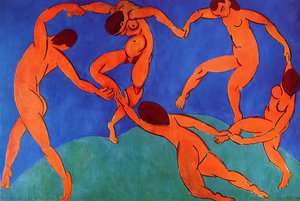
Matisse’s use of color is undeniably central to understanding this work. He wasn't simply applying pigments; he was wielding them as instruments of emotion. The palette is deliberately intense – saturated reds, yellows, blues, and greens dominate the scene. This chromatic boldness was a defining feature of Fauvism, a movement Matisse co-founded alongside André Derain and Maurice de Vlaminck. Fauvist paintings were initially met with shock and disapproval by critics who found their use of color jarring and unnatural. However, Matisse recognized that color could transcend mere representation and directly communicate feeling. He famously stated, “I want to paint what I see – not what I think I should see.”
The arrangement itself subtly echoes the principles of decorative art. The objects are carefully positioned to create a balanced composition, reminiscent of still life arrangements found in Renaissance paintings, but imbued with Matisse’s distinctly modern sensibility. Notice how the diagonal lines created by the table and the placement of the objects guide the viewer's eye across the canvas, drawing attention to each element individually before uniting them within the overall harmony.
Symbolism and Emotional Resonance
While seemingly straightforward, "Still Life" is rich in symbolic potential. The inclusion of books suggests a connection to intellect and knowledge, while the fruit – particularly the orange – can be interpreted as representing abundance, vitality, and perhaps even pleasure. The bowl, often associated with nourishment and hospitality, adds another layer of meaning. However, Matisse rarely offered explicit explanations for his symbolism; he preferred that viewers interpret the work through their own emotional lens.
Ultimately, "Still Life" is a testament to Matisse’s belief in the power of color to evoke emotion and create a sense of joy. It's a painting that invites us to slow down, to appreciate the beauty of everyday objects, and to experience the world through a vibrant, optimistic perspective. A reproduction captures this essence beautifully, allowing you to bring this captivating work into your own space – a source of visual delight and emotional resonance for years to come.
Technical Details & Reproduction Quality
OriginalUniqueArt offers meticulously crafted hand-painted reproductions of Henri Matisse’s “Still Life,” ensuring the preservation of the artist's original vision. Our skilled artisans utilize archival-quality pigments and techniques that faithfully replicate the nuances of Matisse’s brushstrokes, color palette, and textural qualities. We offer a range of sizes to suit your needs, from intimate tabletop pieces to large-scale statement artworks. Each reproduction is created with the utmost care and attention to detail, guaranteeing an authentic representation of this iconic masterpiece.
Korduvad küsimused
Kas saan teost "Still Life" lähemalt uurida?
Teose „Still Life“, autor Henri Matis röntgenvaade on saadaval selle Röntgenuuring lehel: see on interaktiivne pildi uurimine läbi üheksateist optilise kihti.
Kas teosele „Still Life“, autor Henri Matis on olemas juhend?
Teosele „Still Life“, autor Henri Matis on saadaval Õppekasutusjuhend leht: trüvitav infoleht teose kohta, mis on loodud õpilasteks ja klassiruumis kasutamiseks.
Kuidas leida teoseid, mis on stiilis sarnased teosele „Still Life“, autor Henri Matis?
Teose „Still Life“, autor Henri Matis lehel Sarnased teosed on esiletõstetud sarnased teosed.
 Eelvaade
 Saada
Saada Jaga
Jaga
 Teave teose kohta
 Juhend

 Laadi alla
 Sarnased teosed
 Röntgenuuring
 Slaidietendus
 KÜSIMUSED JA VASTUSID
 Statistika