Eelvaade
 Saada
Saada Jaga
Jaga
 Teave teose kohta
 Juhend

 Laadi alla
 Sarnased teosed
 Röntgenuuring
 Slaidietendus
 KÜSIMUSED JA VASTUSID
 Statistika
A Carnival Evening

- 117.0 x 90.0 cm


 Loe lähemalt
Giclée / Kunstiprint
Muuseumikvaliteediga giclée- või kangasprint kiire tootmisega ja paindlikud viimistlusvõimalused. ( Osta käsitsi maalatud teos Lülita digitaalse pildi juurde)




P118B €10

P118H €10

P118W €10

P438Z €10

P508JH €12

P508YH €12

P805H €10

P805Z €10

P919BZ €10

P919G €10

P919XJ €10

P959ZH €10

P968JZ €12

W106C €8

W218G €10

W218JH €8

W218Y €10

W307PJ €10

W316G €10

W316PJ €8

W316Y €10

W398PJ €8

W4111J €10

W500HY €15

W500JH €15

W692G €12

W849H €8

W940BG €15

W953PJ €8




Vali meie eelmääratud suurused, mis vastavad teose algupärastele proportsioonidele.

Sisestage vajalik laius ja kõrgus, et see sobiks teie raamile või seinale. Trükki saab ainult lõigata, seda ei saa kunagi pildist suuremaks teha, seega ka erineva mustega suurus kaotab osa pildist. Enne trükkimist saadame teile kinnitamiseks digitaalse näidisprojektsiooni. Sellel lehel näidatud pilt ei kujuta reaalset lõiget — seda näitab ainult näidisprojektsioon.
Ülemaailmne tarne () 2 nädala jooksul, tavalise 4/5 nädala asemel. (8 november)

Tasuta ekspresssaatmine üle maailma

Kõrgekvaliteediline lina-kangas

Täielik transpordikindlustus

Tollimaksude tagastamise garantii

Värvitoime täpsuse garantii

100 päeva tagastusõigus (ainult valmistusdefektide korral)

100% raha tagasi garantii

Hulgusoodustus
 Klaasivalik on saadaval ainult kuni 110 cm suuruses teostes

A Carnival Evening
Giclée / Kunstiprint
Reproduktsiooni suurus
-


Koguhind
€ 72
Henri Rousseau: A Vision of Untouched Paradise
Henri Emile Rousseau (1875 – 1933) stands apart from the Impressionists and Post-Impressionists who dominated Parisian art circles at the turn of the century. Instead, he forged his own distinctive artistic path—one rooted in a profound appreciation for primitive art and fueled by an uncompromising commitment to capturing the essence of untamed nature. His canvases depict fantastical landscapes populated by animals and humans rendered with childlike simplicity and vibrant color palettes, transporting viewers into dreamlike realms brimming with symbolic resonance. Rousseau’s upbringing in Lyon instilled in him a deep connection to folklore and observation of the natural world—influences that would irrevocably shape his artistic vision. Despite facing considerable skepticism from critics of his time—who dismissed his style as amateurish—Rousseau persevered, establishing himself as one of France's most recognizable painters and securing a place among the pioneers of Modern Art.The Enchanting Style of Naïve Art
Rousseau’s artistic approach defied convention by rejecting formal academic training. He developed a highly personal visual language characterized by meticulous detail—particularly in rendering foliage and fabric—combined with flattened perspective and an almost childlike simplicity. This deliberate departure from established artistic norms wasn't merely stylistic; it represented a conscious choice to perceive and represent the world through a lens untouched by rational analysis, prioritizing emotional impact over precise representation. Critics initially scorned Rousseau’s style as lacking sophistication, yet his unwavering dedication to capturing the primal beauty of the wilderness ultimately garnered him acclaim and cemented his legacy as a visionary artist. The resulting paintings possess an undeniable allure—a captivating tension between meticulous observation and dreamlike abstraction that continues to inspire artists and collectors today.“A Carnival Evening”: Decoding Symbolism in Rousseau’s Masterpiece
Rousseau's 1885 painting, “A Carnival Evening,” exemplifies this distinctive style of Naïve Art. Currently housed at the Philadelphia Museum of Art, the artwork depicts a surreal nighttime scene featuring two figures strolling along a path through a stark, leafless landscape illuminated by an enormous moon. A ghostly figure floats above them—adding an element of mystery and unease—while a dense forest dominates the background. The composition is dominated by vertical lines created by towering trees, contrasting sharply with the horizontal expanse of the sky. Rousseau’s masterful use of color—primarily muted blues and browns—creates a somber atmosphere that underscores the painting's profound emotional depth. The symbolism embedded within “A Carnival Evening” speaks to themes of desire, escape, and contemplation on the complexities of human experience. The prominent hot air balloon, populated by shadowy figures, serves as a potent symbol of aspiration—representing a yearning for transcendence beyond earthly constraints. Conversely, the dark forest embodies the unknown, the subconscious, and potentially, isolation—reflecting Rousseau’s fascination with the darker aspects of nature and the human psyche. Furthermore, the couple themselves are imbued with symbolic significance—their downcast gazes hinting at introspection amidst the festive backdrop. The painting's enduring power lies in its ability to evoke a sense of melancholy beauty—a reminder that even amidst celebration, there exists an underlying awareness of vulnerability and mortality.Technique and Impressionistic Influence
Rousseau’s technique—characterized by oil paint application—contributes significantly to the artwork’s textural richness and luminous quality. Despite rejecting academic conventions, Rousseau skillfully employed observational techniques reminiscent of Impressionism, capturing fleeting moments of light and color with remarkable accuracy. This blending of meticulous detail with Impressionistic sensibilities underscores Rousseau's artistic genius—demonstrating his ability to synthesize disparate influences into a singular vision that transcends stylistic boundaries. The resulting paintings possess an undeniable vibrancy—a testament to Rousseau’s unwavering commitment to conveying emotion through visual representation.Korduvad küsimused
Milline on teose "A Carnival Evening" atmosfäär?
Teose „A Carnival Evening“, autor Henri Emilien Rousseau meeleolu on kirjeldatud kui Müstiline. See klassifikatsioon võib aidata leida teosele sobiva sisekujunduse.
Millest teos "A Carnival Evening" on valmistatud ja millises stiilis?
„A Carnival Evening“, autor Henri Emilien Rousseau ühendab endas Õlimaal kangaruumil tehnikat ja Naive Surrealism stiili. Tehnika ja suundumus kirjeldavad teose valmistusviisi ja esteetikat.
Millisel tehnikal on teos "A Carnival Evening" valmistatud ja mis on selle mõõtmed?
Originaalteos „A Carnival Evening“, autor Henri Emilien Rousseau on Õlimaal kangaruumil teos mõõtmisel 117 x 90 cm. Tehnika ja suurus kirjeldavad originaalobjekti.
Kunstniku elulugu
Henri Emile Rousseau (1875 – 1933): The Enchanted Vision of Primitive Beauty
Henri Emile Rousseau, born in Lyon, France, in 1875, defied the conventions of Impressionism and Post-Impressionism to forge a singular artistic path—one characterized by an uncompromising embrace of Naïve Art. His canvases depict fantastical landscapes populated by animals and humans rendered with childlike simplicity and vibrant color palettes, transporting viewers into dreamlike realms brimming with symbolic resonance. Rousseau’s upbringing in a working-class family instilled in him a deep appreciation for the natural world and folklore, influences that would profoundly shape his artistic vision. Despite facing considerable skepticism from critics of his time—who dismissed his style as amateurish—Rousseau persevered, establishing himself as one of France's most distinctive painters and securing a place among the pioneers of Modern Art.- Early Life & Artistic Beginnings: Rousseau’s formal artistic training was minimal; he largely self-taught, honing his skills through sketching outdoors and studying prints. He initially pursued commercial illustration work to support himself, but his passion for painting remained unwavering.
- The Influence of Primitive Art: Rousseau's fascination with African masks and tribal art—particularly those collected by Alexandre Cabanel—served as a catalyst for his stylistic evolution. These artworks captivated him with their bold colors, stylized forms, and rejection of academic realism, inspiring him to abandon traditional techniques in favor of a more direct and expressive approach.
- Key Paintings & Artistic Style: Rousseau’s oeuvre is dominated by monumental landscapes infused with mythological elements and populated by animals imbued with spiritual significance. Notable works include “The Sleeping Venus” (1890), “The Promised Land” (1893), “The Concert” (1897), and “The Shepherdess,” which exemplifies his signature style—characterized by flattened perspectives, luminous colors, and a deliberate blurring of outlines.
- Recognition & Legacy: Despite initial rejection by the Parisian avant-garde, Rousseau gained recognition in 1905 thanks to the patronage of Ambroise Vollard, who championed his work and secured exhibitions at Galerie Bernheim-Jeune. His paintings gradually attracted admirers among artists like Picasso and Matisse, cementing his reputation as a visionary artist whose uncompromising vision anticipated Surrealism.
- Death & Enduring Influence: Rousseau died in Étampes in 1933, leaving behind a legacy of approximately 800 paintings—a remarkable achievement considering his unconventional methods. His distinctive Naïve Art style continues to inspire artists today, demonstrating the enduring power of imagination and the beauty found in unfiltered observation.
Exploring Rousseau’s Palette & Technique
Rousseau's artistic technique was remarkably simple yet profoundly effective. He eschewed meticulous detail, opting instead for bold brushstrokes and vibrant hues—often achieved through layering thin glazes of color onto a toned ground. This method allowed him to capture the essence of his subjects with remarkable immediacy and luminosity, conveying emotion and atmosphere as much as visual representation. His use of complementary colors—such as reds and greens—created striking contrasts that heightened the dramatic impact of his compositions. Furthermore, Rousseau’s deliberate flattening of perspective—a technique borrowed from African art—reinforced the dreamlike quality of his landscapes and contributed to their captivating allure.
Henri Emilien Rousseau
1875 - 1933
Lühikest infot
- Full Name: Henri Émile Rousseau
- Nationality: French
- Date Of Birth: 1875
- Date Of Death: 1933
- Place Of Birth: Nancy, France
- Notable Artworks:
- A Carnival Evening
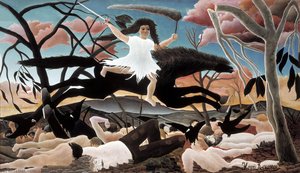
- War or The Ride of Discord
- Fantasia de mariage
- Artistic Movement Or Style: Naive Art
- Artists Who Influenced This Artist:
- Gustave Moreau
- Pierre Puvis de Chavannes
- Artists Or Movements Influenced By This Artist: ['Symbolism']
Sarnased artiklid

Naive Art Unveiled: The Charming Beauty of Simple Masterpieces
Discover the enchanting world of Naive Art. Explore the profound beauty of self-taught masters like Henri Rousseau through an art-history lens, uncovering how simple forms and vibrant colors create timeless, soulful masterpieces for the discerning collector.
Henri Rousseau: Primitivism, Paradox & Subversion of Academic Tradition
Explore the captivating world of Henri Rousseau, the celebrated Naïve artist who challenged academic traditions with his unique jungle scenes & dreamlike symbolism. Discover his lasting influence on modern art and collecting today.

The Untamed Vision: Exploring Naïve Art & Primitivism's Rejection of Convention
Explore the revolutionary world of Naïve Art & Primitivism! Discover how artists challenged academic traditions with raw emotion & unique styles. Learn about Picasso, Rousseau & more at OriginalUniqueArt.
Fauvism's Boldest Visions: 10 Masterpieces That Revolutionized Modern Art | OriginalUniqueArt
Explore 10 Fauvist masterpieces by Matisse, Derain & Vlaminck that ignited Modern Art! Discover bold colors, expressionist landscapes & the history of this revolutionary movement. Find museum-quality prints at OriginalUniqueArt.com.

Henri Matisse: 25 meistriteost värviküllase kunsti maailmast | OriginalUniqueArt
Avastage Henri Matisse 25 ikoonilist teost! Sukelduge värviküllase Fauvismi maailma, modernse kunsti ajaloosse ja inspireerige oma interjööri. Kvaliteetsed kunstireprodutsioonid OriginalUniqueArt.com-is. Avasta kogu kollektsioon online!