

 Eelvaade
 Saada
Saada Jaga
Jaga
 Teave teose kohta
 Juhend

 Laadi alla
 Sarnased teosed
 Röntgenuuring
 Slaidietendus
 Q&A
Q&A Statistika
Landscape Black and White


 Loe lähemalt
Hankige trükiivaldatav fail, mis on kvaliteedilt palju parem kui veebilehel näidatud eelvaade. Kõik meie müüdavad digitaalsed pildid pärinevad meie arhiivist kõrge resolutsiooniga originaalfailidest — tavaliselt 5000 kuni 15 000 pikslit laiust — nii et saate julgelt trükida suurematsat, lüüdist teha või detailset sisu reproduktsiooni teha.
Meie stuudiost ei lahtu ükski fail puutumatuna. Digiekpert võrdleb värve algsest maalistimusega ja vajadusel korrigeerib neid, seejärel parandab selgust ja detaile professionaalsete retušimisvahendite abil — püüdes alati jääda truudeks kunstniku pintoonile ja stiilile. Tulemuseks on pilt, mis näeb välja nagu maali, mitte nagu filtreeritud skann.
Teet kinnituse enne lõplikku valmimist: meie ekspert saadab pildi 72 tunni jooksul e-posti ülevaatamiseks. Ei ole rahul? Paluge parandusi või korrektsioone ning kui kvaliteet ei vasta ootustele, võite paluda tagastamist.
See on kvaliteet, millele tuguvad väljaandjad, disainistuudiod, galeriid ja trükikojad.
Digitaalne kunstiteos
Laadi alla kõrge resolutsiooniga fail isiklikuks vaatamiseks, trükkimiseks ja loomingulisteks projektideks. ( Lülita trükkitoodetele Osta käsitsi maalatud teos)
Sisse kuulub iga digitaalse pildi tellimusega
Eksperdi digitaalne kohaletoimetamine, garanteeritud
Valides OriginalUniqueArt.com, ei saa sa lihtsalt pilti – saad professionaalselt parandatud digitaalse teose, mida on valmistatud täpsusega ja mis on toetatud rahuldamatusgarantiiga. Siin on kõik, mis sinu tellimusega automaatselt kaasneb:

Kiire digitaalne edastus
Teie kõrge resolutsiooniga digitaalne pildifail saadetakse teile e-posti 72 tunni jooksul pärast tellimist – kohe kasutamiseks valmis.

Tehisintellektiga täiustatud digitaalne fail
Teie teos on professionaalselt optimeeritud arenenud tehisintellekti tööriistade ja käsitsi redigeerimise abil, tagades maksimaalse detailitaseme, selguse ja värvitäpsuse.

Tasuta eluaegne uuesti saatmine
Kas kustutasid faili kogukalu unustamisel või kustutamisel? Puudub mure – saad selle uuesti igal ajal ilma lisatasuta.

Puuduvad importimaksud – alati
Nautige oma teoseid koheselt ilma tolli-, maksude või tarnimaskuludeta – digiletchargused on alati maksuvabadud.

Värvitäpsuse garantii
Me tagame, et teie digitaalne pilt kajastaks originaali värve professionaalsete tööriistade ja värvihalduse abil võimalikult täpselt.

100 päeva rahuldamatuse garantii
Kui te ei ole oma digitaalse pildi eest rahul, siis me parandame seda või tagastame 100% summast 100 päeva jooksul – küsimusteta.

100% raha tagastamise garantii
Ei ole rahul? Saate täielise tagastaja 100 päeva jooksul pärast digitaalse faili kättesaamist – ilma küsimusteta.

Suurema tellimuse soodustused
Osta 3 pilti, säästa 10% - Osta 5, säästa 15% - Osta 10+, säästa 20%. Sobib suurepäraselt loomingulisteks projektideks, galeriideks ja agentuurideks.
A Geometric Dance of Light and Shadow
In the evocative realm of mid-century abstraction, Landscape Black and White stands as a profound testament to the transformative power of shape and contrast. Created in 1967 by the visionary artist Hale Aspacio Woodruff, this piece invites the viewer into a dreamlike dimension where the boundaries between reality and geometry dissolve. At first glance, the eye is immediately arrested by a striking, luminous yellow square that anchors the left side of the composition, acting as a singular beacon of warmth amidst a sea of monochromatic depth. This bold use of color serves not merely as a focal point but as a rhythmic heartbeat within the painting, disrupting the somber tones of gray and black to create a visual tension that is both unsettling and deeply captivating.
The composition breathes through a sophisticated interplay of forms, where smaller squares in varying shades of charcoal and slate are scattered like celestial fragments across an abstract landscape. This arrangement suggests a structured chaos, a carefully orchestrated movement that guides the viewer's gaze across the canvas. Amidst this geometric dance, the subtle presence of two human figures—one positioned near the center and another toward the periphery—adds a layer of poignant narrative. These figures, though integrated into the abstract architecture of the piece, ground the work in a sense of shared existence, suggesting that even within the most fragmented or abstract environments, the human spirit remains an observant and integral participant.
Technique and the Legacy of Modernism
The technique employed in this 1967 masterpiece reflects a masterful command over balance and spatial perception. Through the deliberate application of flat planes and sharp edges, Woodruff achieves a sense of depth that defies the two-dimensional surface. The interplay between the stark black voids and the soft, misty grays creates an atmospheric quality reminiscent of a fog-swept morning, yet the rigid geometry prevents the work from becoming purely ethereal. This duality—the tension between the organic feeling of a landscape and the mathematical precision of geometric abstraction—is what gives the painting its enduring intellectual weight.
For the discerning collector or interior designer, Landscape Black and White offers an unparalleled opportunity to introduce a piece of historical significance into a contemporary setting. Its monochromatic palette provides a sophisticated foundation for modern decor, allowing it to harmonize with minimalist, industrial, or even classical interiors. As a high-quality reproduction, this artwork preserves the soul of Woodruff’s original vision, offering a window into a pivotal era of American art history. It is more than a mere decoration; it is an emotional experience that evokes contemplation, inviting anyone who dwells in its presence to find beauty in the balance of light and shadow.
Korduvad küsimused
Kui intensiivsed on värvid teoses „Landscape Black and White“, autor Hale Aspacio Woodruff?
Teose „Landscape Black and White“, autor Hale Aspacio Woodruff värvid on Monochromatic intensiivsusega.
Kust saan näha originaalteost „Landscape Black and White“, autor Hale Aspacio Woodruff?
Originaalteost "Landscape Black and White" saab vaadata Spelman College Museum of Fine Art, Atlanta, United States of America-is.
Kui karge on teose "Landscape Black and White" väripalett?
Teose „Landscape Black and White“, autor Hale Aspacio Woodruff värvitoit on Muted kütkusega.
Kunstniku elulugu
A Legacy of Visionary Expression
Hale Aspacio Woodruff stands as a monumental figure in the tapestry of twentieth-century American art, a master whose hands moved between the delicate precision of printmaking and the sweeping grandeur of muralism. Born in Cairo, United States of America, his journey was one of profound movement and cultural synthesis. Growing up in Nashville, Tennessee, within a Black family, Woodruff’s early life was shaped by the segregated realities of the era, yet his artistic spirit sought horizons far beyond local boundaries. His education was as diverse as his palette, spanning prestigious institutions such as the Herron School of Art and Design in Indianapolis, the Art Institute of Chicago, and the Harvard Fogg Art Museum. These formative years provided him with a rigorous technical foundation, but it was his time abroad that truly ignited his creative metamorphosis.
The allure of Paris played a crucial role in his development, as a prize from the Harmon Foundation in 1926 allowed him to spend four transformative years studying in France. This period of immersion in European modernism provided a vital dialogue between classical training and avant-garde experimentation. Later, his artistic evolution was further enriched by a summer spent in Mexico, where he studied the art of mural painting under the legendary Diego Rivera. This encounter with the Mexican muralist movement deeply influenced his approach to public art, instilling in him a belief that art should serve as a powerful, communicative force within the social fabric.
The Soul of the Canvas
Woodruff’s body of work is characterized by an extraordinary ability to weave together history, myth, and identity. He was particularly renowned for his ability to capture the rhythmic pulse of heritage, most notably in his Art of the Negro series. In masterpieces such as Native Forms, Panel One, he invites viewers into a world where ancestral echoes breathe through bold, energetic brushstrokes and a saturated palette. His compositions often act as spiritual gateways, where the boundaries between the physical and the unseen dissolve into a dance of symbolic communication. Through the use of stylized figures and cultural motifs, he constructed narratives that celebrated resilience and the profound complexity of human existence.
As his career progressed, Woodruff’s style demonstrated a remarkable versatility, moving from the narrative depth of his murals to the evocative realms of abstraction. In works like Landscape Black and White, one observes a geometric dance of light and shadow, where the tension between monochromatic depth and sudden, luminous color creates a dreamlike dimension. Whether he was exploring the celestial dialogues of Sentinel Gate or the vibrant gatherings in his panel paintings, his work remained anchored by a commitment to high artistic development and a telling quality that reflected the human condition. His legacy is not merely found in the pigments on canvas, but in his enduring role as an educator and founder, having established the art department at Atlanta University, ensuring that the flame of creativity would continue to burn brightly for generations to come.
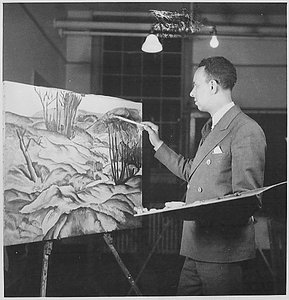
Hale Aspacio Woodruff
1900 - 1980