Lülita trükkitoodetele
 Loe lähemalt







































 Kunstiteoste või reproduktsioonide puhul, mille üks külg on üle 105 cm (umbikmolt 41 tolli), saadetakse raam kirjal asendis, la Dismantlitud komplektina. See meetod tagab ohutuse kohaletoimetamisel ja väldib transpordil tekkivaid kahjustusi.


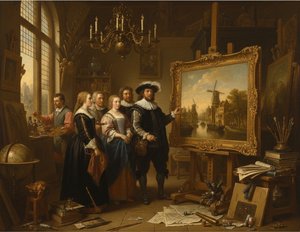
Gabriel Metsu’s “Tavern Scene”: A Window into Dutch Golden Age Life
Gabriel Metsu's "Tavern Scene," painted around 1655, isn’t merely a depiction of a room; it’s a meticulously crafted snapshot of 17th-century Dutch society – a microcosm brimming with subtle social commentary and artistic innovation. The painting, now housed in the National Gallery of Ireland, offers a rare glimpse into the daily lives of ordinary people within the opulent context of the Dutch Golden Age, a period renowned for its burgeoning wealth, artistic flourishing, and complex social dynamics. Metsu’s work stands apart from his contemporaries not through grand scale or dramatic gesture, but through an almost unnerving intimacy and a remarkable ability to capture the quiet moments of human interaction.
The scene itself unfolds within a modestly furnished tavern room, bathed in the warm glow of candlelight. Two figures dominate the composition: a man seated at a chair, engaged in conversation with a woman who stands beside him. Around them, a carefully arranged tableau vivant – a bowl and cup on a table, a book resting nearby, a clock hanging on the wall – suggests a comfortable, if slightly cluttered, domestic setting. Yet, it’s not simply a portrait of two individuals; Metsu masterfully employs light and shadow to create a sense of depth and atmosphere, drawing the viewer into this intimate space. The details are astonishingly precise: the texture of the fabrics, the gleam of the pewter cup, the subtle wrinkles on the faces of the figures – all rendered with an almost photographic realism that was characteristic of the Dutch Masters.
The Artist’s Eclectic Style and Early Influences
Gabriel Metsu's artistic identity remains somewhat enigmatic. He resisted categorization, earning the label “a highly eclectic artist,” a testament to his broad range of interests and techniques. While he produced history paintings, portraits, and genre scenes, it was in the realm of domestic interiors – particularly tavern scenes – that he truly excelled. His work reflects a deep engagement with the artistic currents of his time, drawing inspiration from masters like Rembrandt and Vermeer, yet forging his own distinct style. Early influences are believed to have come from his upbringing in Leiden, where he was exposed to diverse cultural traditions and artistic practices.
Metsu’s approach was marked by a meticulous attention to detail and an uncanny ability to capture the nuances of human emotion. He frequently employed small-scale panels, allowing him to focus on intimate scenes and individual characters. His use of light is particularly noteworthy – it's not merely functional but serves to illuminate the subjects and create a sense of drama within the confined space of the tavern. The composition itself is carefully balanced, with each element contributing to the overall harmony of the scene.
Symbolism and Social Commentary
Beyond its technical brilliance, “Tavern Scene” is rich in symbolic meaning. The arrangement of objects – the bowl, cup, book, and clock – speaks to the rhythms of daily life and the importance of leisure activities within Dutch society. The presence of a world map on the wall hints at the burgeoning global trade networks that fueled the nation’s prosperity. However, Metsu doesn't simply offer a straightforward depiction of tavern life; he subtly critiques the excesses and moral ambiguities of the era.
The inclusion of a gambling scene, with dice and playing cards scattered on the table, suggests the prevalence of gambling and its potential for ruin. The presence of a woman in a provocative pose, alongside a young man engaged in conversation, hints at the complexities of social relationships and the temptations of the flesh. Even seemingly innocuous details – such as the old shoes near the doorway – carry symbolic weight, reminding us of the passage of time and the inevitability of aging. The painting’s final detail, the letter addressed to the painter, is a clever device that invites the viewer to contemplate the artist's own role within this social tableau.
A Legacy of Intimacy and Observation
“Tavern Scene” stands as a testament to Gabriel Metsu’s extraordinary talent and his profound understanding of human nature. It’s a painting that rewards careful observation, inviting viewers to linger over its details and decipher its subtle symbolism. More than just a depiction of a tavern, it's a window into the social, cultural, and psychological landscape of 17th-century Holland – a period of remarkable artistic achievement and profound societal change. Reproductions of this captivating work offer a tangible connection to this fascinating era, allowing us to appreciate Metsu’s unique vision and his enduring legacy as one of the most accomplished artists of the Dutch Golden Age.
Korduvad küsimused
Millistes mõõtudes ja millises suunases on "Tavern Scene" trükkimist soovitatav teha?
Medium suurus, Portrait orientatsioon: see on teosele „Tavern Scene“, autor Gabriel Metsu soovitatud trükkimise seadistus.
Millised on teose "Tavern Scene" reprodutseerimissõjaõigused Metropolitani Kunstimuuseum kogumuses?
Teose „Tavern Scene“, autor Gabriel Metsu autoriõiguste staatus on selge: teos kuulub avalikule omandile (avalikus õiguses – selle autoriõigud onหมดunud). Selle paik Metropolitani Kunstimuuseum kollektsioonis ei muuda seda staatust.
Kas on olemas sarnaseid teoseid kui "Tavern Scene"?
Teose „Tavern Scene“, autor Gabriel Metsu lehel Sarnased teosed on esiletõstetud sarnased teosed.
 Eelvaade
 Saada
Saada Jaga
Jaga
 Teave teose kohta
 Juhend

 Laadi alla
 Sarnased teosed
 Röntgenuuring
 Slaidietendus
 Q&A
Q&A Statistika