Expressionism
Prophet (Emil Nolde)
Emil Nolde (1867–1956) on loonud teose Prophet. See kuulub Expressionism suuntrime. Teos on valmistatud materjalist Woodcut.
- Woodcut

 Eelvaade

 Käsitsi maalatud õlimaalatsioon
 Saada
 Jaga
 Juhend


 Laadi alla
 Sarnased teosed
 Röntgenuuring
 Slaidietendus
 KÜSIMUSED JA VASTUSID

 Statistika
Prophet: põhitooded
- Pealkiri
- Prophet
- Kunstnik
- Emil Nolde (1867–1956)
- Kunstnik on sündinud
- Nordel, Taani
- Tehnika
- Woodcut
- Suunad
- Expressionism
- Aeglkond
- Modern
- Teema
- man, face, beard, black and white, portrait, eyes
Mida Prophet kujutab?
The Portrait of Prophet by Emil Nolde
In Prophet, the German Expressionist painter Emil Nolde captures a man who exists between the physical and the divine. The subject is a portrait of a man likely intended to represent a prophet, a figure carved from shadow and light. His beard and hairstyle suggest a man from a distant past or a religious leader, a person shaped by the weight of revelation. The face is a landscape of heavy lines and stark contrasts.
The man’s intense gaze pierces through the grain of the medium. A furrowed brow carries the imprint of deep emotion, perhaps a mixture of sadness, concern, or a singular, driving determination. This is not a likeness of a person in repose, but a study of a soul under pressure. The features are simplified, stripped of unnecessary detail to reveal the raw essence of the subject's internal state.
Emil Nolde uses the starkness of the form to emphasize this spiritual tension. Every line serves the gravity of the man's expression. The eyes do not merely look; they witness. The stillness of the portrait holds a quiet, heavy ache.
Composition and Visual Elements
The man's face occupies the center, a heavy presence that fills most of the frame. His head tilts slightly, caught in a moment of quiet anguish or deep contemplation. Around him, the background remains largely empty, a void that forces the eye back to the subject's features. There is no horizon, only the weight of the gaze.
Bold, thick lines carve the anatomy of the man. They define the coarse texture of his beard, the sharp ridge of his nose, and the deep-set hollows of his eyes. These lines are not smooth; they are angular and sharp, cutting through the space to shape his hair and facial structure. The geometry is simplified, reducing the man to essential, striking forms.
The color palette is stripped of all distraction. It exists in a narrow world of black and white, bridged only by subtle shades of grey. This lack of color heightens the dramatic tension, turning the portrait into a study of light and shadow. The starkness leaves no room for anything but the raw emotion of the expression.
Technique and Artistic Medium
The work emerges from the physical resistance of wood. This woodcut print relies on the deliberate act of carving lines into a solid block to define its form. Each stroke is a subtraction, a removal of material that leaves behind a sharp, angular topography. The artist works with wood, ink, and paper to translate a vision into a permanent, tactile presence.
Ink meets the paper through the pressure of the press. This contact creates a grainy texture across the surface, a subtle roughness that speaks of the material's origin. The depth of the shadows and the brightness of the highlights depend entirely on the variation of the lines. Thicker cuts hold more ink to create heavy shadows, while thinner, delicate lines allow the paper to breathe through the composition. The result is a stark, high-contrast landscape of light and dark.
The medium demands a directness of hand. There is no blending here, only the immediate impact of the carved edge. The grain of the wood and the weight of the ink settle into the fibers of the paper, creating a surface that feels both raw and finished. It is a quiet collision of tool and grain.
Prophet kõrgel resolutsioonil
Avalik omanik: kunstnik suri aastal 1956.
Emil Nolde, Prophet. Avalik omaniklik õigus
Digitaalne ekspert kontrollib värve vastavust originaalteosele ja retusseerib faili, püsides truulena kunstniku pintlapidele.
Osta kõrge resolutsiooniga piltKüsimused teemal Prophet
Millises materjalis on teos „Prophet“, autor Emil Nolde valmistatud?
Teose "Prophet" loomisel kasutas Emil Nolde Woodcut tehnikat. See tehnika määrab originaalteose materjalilise olemuse.
Mille kohta teos "Prophet" on?
Teose "Prophet" teemad on man, face, beard, black and white, portrait, eyes.
Kas teos "Prophet" on ilma autoriõigusteta?
Teos „Prophet“, autor Emil Nolde on lubaõiguslikult avalikus õiguses – selle autoriõigud onหมดunud. See staatus reguleerib teose pildi reprodüseerimise võimalusi.
Kes on teose "Prophet" looja?
Teose "Prophet" loovija on Emil Nolde. Selle lehe info kirjeldab Emil Nolde algteost.
Millissele kunstisuunale kuulub teos „Prophet“, autor Emil Nolde?
Teos „Prophet“, autor Emil Nolde kuulub Expressionism suunasse. See suund annab teosele stilistilise konteksti.
Miks on teose "Prophet" autoriõiguste staatus selline, nagu see on?
Emil Nolde teos "Prophet" on avalikus õiguses – selle autoriõigud onหมดunud. Autoriõiguse kaitseajad arvutatakse alates kunstniku surmaõigustest ning Emil Nolde suri aastal 1956.
Kust koht teoses "Prophet" on Emil Nolde loomingus?
"Prophet" kuulub Emil Nolde Expressionism perioodi teosetele, mille tuntud teemad hõlmavad post-impressionism, die brücke, religious themes, expressionist style.
Kust kohalt Emil Nolde korduvad teemad teoses "Prophet" ilmumisel?
"Prophet" kujutab teemasid man, face, beard, black and white, portrait, eyes, samal ajal kui Emil Nolde tuntud teemad on post-impressionism, die brücke, religious themes, expressionist style. Nende kahe võrdlemine näitab, kuidas teos seobub kunstniku tavalistega motiividega.
Kunstnikust, Emil Nolde
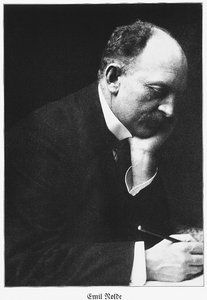
1867–1956, Taani
Emil Nolde
Emil Nolde elu ja identiteet 7. augustil 1867 sündinud Hans Emil Hansen, kes sai hiljem tuntuks nimega Emil Nolde, kasvas Schleswig-Holsteinile kuulvas Schleswigi hirmutavas ja ilu täis looduskeskkonnas, lähedal Nolde küla piiridel. Tema varajased aastad olid vormitud tema pere agrarilisest ja rühitudud maaelust, kus rütm oli määratud looduse ja põllutöö loogikaga. Kuid ta otsustas eventually sellest teele kõrvalähkuda, valides tee puuseppena ja mööblikaunistajana.
Ka Emil Nolde teosed
 Sunset
 Sea with Red Sky
 Couple on the beach1903
 Masks1911
Essee teemadel Prophet
 Stone and Sinew: The Sculptural Foundations of Modigliani’s PortraitsExplore the sculptural roots and structural mastery of Modigliani's portraits. Discover the secrets behind his iconic, carved style now.
 Expressionism vs. New Objectivity: Emotion vs. Precision in German ArtMaster the tension between Expressionist emotion and New Objectivity precision. Explore the soul of German modern art now.
 Emile Nolde: A Journey into Expressionist Nature & the Primal SelfExplore the powerful Expressionism of Emile Nolde – a pioneer of emotive landscapes & spiritual themes. Discover his journey, influences, a…