- Avaleht

- Trükk lõendile
- Egon Schiele
- agony 1912
 Tellimaks maali Osta digipilt
 Saada
Saada
 Jaga
Jaga
 Teave teose kohta
 Lisa lemmikutesse

 Laadi alla
 Sarnased teosed
 Röntgenuuring
 Slaidietendus
agony 1912

 Loe lähemalt
Giclée / Kunstiprint
Muuseumikvaliteediga giclée- või kangasprint kiire tootmisega ja paindlikud viimistlusvõimalused.




P118B $10

P118H $10

P118W $10

P438Z $10

P508JH $12

P508YH $12

P805H $10

P805Z $10

P919BZ $10

P919G $10

P919XJ $10

P959ZH $10

P968JZ $12

W106C $8

W218G $10

W218JH $8

W218Y $10

W307PJ $10

W316G $10

W316PJ $8

W316Y $10

W398PJ $8

W4111J $10

W500HY $15

W500JH $15

W692G $12

W849H $8

W940BG $15

W953PJ $8




Vali meie eelmääratud suurused, mis vastavad teose algupärastele proportsioonidele.

Saate sisestada oma mõõdud, et need sobiks konkreetse raami või ruumi sisse. Kui valitud suurus ei vasta originaalteose proportsioonidele, lõigame teose ära või laiendame pilti peegeldatud või ühtlase servaga. Enne tootmisprotsessi algust saadetakse Teie kinnitamiseks digitaalne näidis.
Palun märka, et ekraanil kuvatav eelvaade ei kajasta tegelikku lõigamist või laiendamist. Ainult näidis kujutab täpselt lõplikku kompositsiooni.
Kuigi erimõõdu on saadaval, soovitame originaaproportsioonide säilitamiseks valida mõõt ette määratud nimekirjast.
Ülemaailmne tarne () 2 nädala jooksul, tavalise 4/5 nädala asemel. (20 juuli)

Tasuta ekspresssaatmine üle maailma

Kõrgekvaliteediline linakangas

Täielik transpordikindlustus

Tollimaksude tagastamise garantii

Värvitoime täpsuse garantii

60-päevane tagastusõig: ainult tootmisdefektide korral

100% raha tagasi garantii

Hulgusoodustus
 Klaasivalik on saadaval ainult suuruses kuni 110 cm

agony 1912
Giclée / Kunstiprint
Reproduktsiooni suurus
-


Kogusumma
-
Kogumuse kirjeldus
A Descent Into Darkness: Exploring Egon Schiele’s ‘Agony’
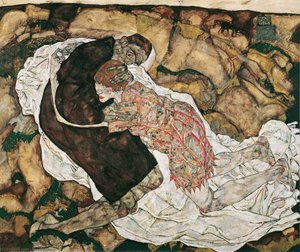
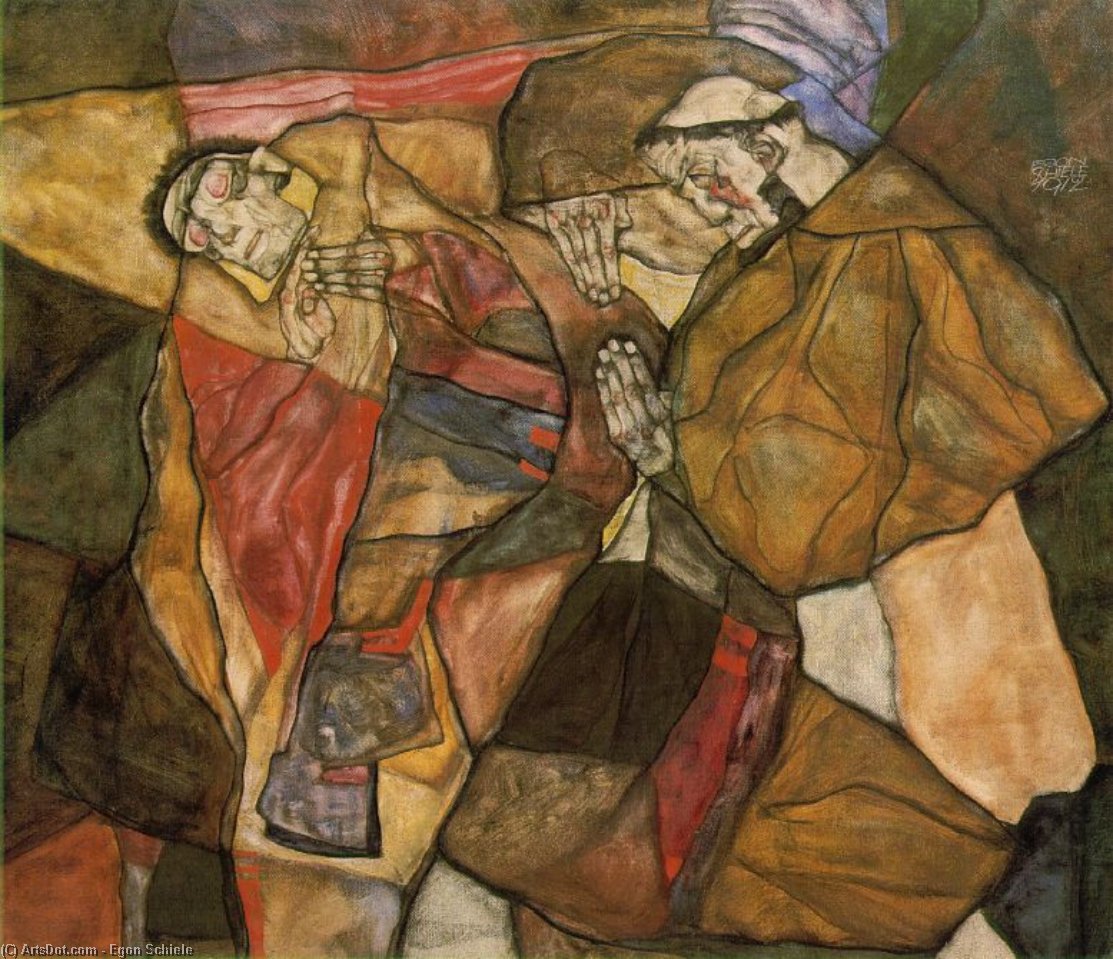
‘Agony,’ painted in 1912 by Austrian Expressionist artist Egon Schiele, isn't merely a depiction of figures; it’s an unflinching confrontation with primal fear and psychological torment. Created during the turbulent period following World War I, this haunting monochrome canvas embodies the core tenets of Expressionism – prioritizing emotional intensity over objective representation—a movement born from disillusionment and grappling with the anxieties of modernity. Schiele's work immediately distinguishes itself through its unsettling gaze, reflecting a preoccupation with themes of vulnerability, suffering, and the inescapable awareness of mortality that permeated Viennese art circles at the time.The Expressionist Vision: Beyond Surface Appearance
Expressionism sought to liberate art from academic conventions, rejecting idealized beauty in favor of raw emotion. Artists like Schiele deliberately distorted forms—the figures are rendered with angular lines and unsettling proportions—to convey inner turmoil rather than capturing a realistic likeness. Bold contrasts of black and white heighten the dramatic effect, emphasizing the oppressive atmosphere and amplifying the psychological drama unfolding before the viewer’s eyes. The influence of artists such as Edvard Munch and Oskar Kokoschka is palpable, demonstrating Schiele's engagement with broader artistic dialogues concerning emotional honesty and confronting uncomfortable truths.A Portrait of Vulnerability: Composition and Symbolism
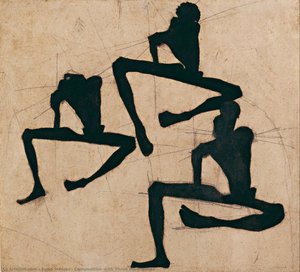
The painting’s composition is deliberately unsettling. Two men dominate the canvas, one kneeling in apparent submission while the other stands above him with forceful hands gripping his head. This posture speaks volumes about power dynamics and control—a recurring motif in Schiele's oeuvre—but crucially underscores the vulnerability of the kneeling figure. The inclusion of a book nearby adds another layer of complexity; it represents knowledge and contemplation, juxtaposed against the overwhelming force of emotion and physical dominance. Some scholars interpret the scene as representing the struggle between intellect and instinct, highlighting the artist’s fascination with confronting existential anxieties.Technical Mastery: Schiele's Unique Approach
Schiele employed a meticulous technique characterized by thick impasto—heavy application of paint—creating palpable textural surfaces that contribute to the painting’s visceral impact. The careful layering of pigment ensures that every brushstroke retains its expressive quality, mirroring the artist’s intention to capture not just what he saw but how he *felt*. This dedication to craftsmanship elevates ‘Agony’ beyond mere visual representation; it becomes a conduit for conveying profound psychological states—a testament to Schiele's artistic prowess and his unwavering commitment to exploring the darkest recesses of human experience.Legacy and Resonance: Experiencing ‘Agony’ Today
‘Agony’ continues to captivate audiences today, serving as an enduring emblem of Expressionist art’s ability to provoke contemplation and elicit emotional responses. Its stark aesthetic and psychologically charged imagery resonate powerfully with viewers grappling with themes of trauma, repression, and the confrontation with mortality—issues that remain relevant in contemporary culture. A high-quality reproduction from OriginalUniqueArt.com allows you to immerse yourself in Schiele's vision without compromising on artistic integrity, preserving the painting’s unsettling beauty and conveying its profound emotional depth. Explore more about Egon Schiele’s work and other Expressionist artists at https://OriginalUniqueArt.com/ADC/Art.nsf/O/6WHKF6/$File/Egon_Schiele-agony_1912.jpgKunstniku elulugu
Egon Schiele: Austrian Expressionist Painter
Egon Schiele’s artistic journey began in Tulln an der Donau, Austria, where he was born on June 12, 1890 – a town steeped in Habsburg history and renowned for its baroque architecture. His early life was marked by profound sorrow; his father, Adolf Eugen Schiele, succumbed to syphilis when Egon was just fourteen, leaving him orphaned and grappling with the devastating impact of familial illness. Raised initially by his mother, Marie Schiele Soukup, and subsequently under the guardianship of his uncle Leopold Czihaczek—a man who exerted considerable influence over Schiele’s upbringing—his childhood lacked the stability typical of Viennese bourgeois families. Yet amidst these hardships, Schiele cultivated an unwavering spirit of independence and a fervent fascination with trains – a motif that would subtly permeate his later paintings, symbolizing movement, escape, and perhaps even the relentless march toward mortality. From a young age, Schiele demonstrated exceptional artistic talent, sketching diligently from the railway station of Tulln and capturing the essence of passing locomotives with remarkable precision. Recognizing this innate ability, Ludwig Karl Strauch—Schiele’s teacher at secondary school—encouraged him to pursue his passion for drawing, recognizing it as a vital counterbalance to the pressures of academic conformity. This formative experience instilled within Schiele a sensitivity and emotional depth that would become defining characteristics of his artistic expression – a constant confrontation with themes of life, death, and the human condition. Schiele’s formal artistic training commenced at the Kunstgewerbeschule in Vienna, where he initially encountered resistance from instructors who adhered to traditional stylistic conventions. Dissatisfied with this rigid academic approach, he swiftly transferred to the Akademie der bildenden Künste (Academy of Fine Arts), only to find himself disillusioned by its uncompromising dogma. Driven by a desire for artistic freedom and fueled by his conviction that true creativity demanded rejection of established norms, Schiele abandoned formal training altogether—a bold decision that underscored his unwavering commitment to pursuing his own vision. A pivotal influence on Schiele’s formative years was Gustav Klimt – whose opulent decorative style captivated young Schiele's imagination. Admiring Klimt’s masterful use of symbolism and exploration of aesthetic beauty, Schiele benefited from Klimt’s mentorship, absorbing stylistic cues that would shape his artistic development. However, Schiele soon diverged from Klimt’s path, forging a distinctive Expressionist style characterized by its stark honesty and psychological intensity—a style marked by elongated figures, contorted poses, and expressive lines that conveyed profound emotional turmoil. This divergence solidified Schiele's reputation as one of the most daring artists of his time – challenging societal expectations and confronting taboo subjects with unflinching courage. Schiele’s artistic breakthrough occurred during his enrollment at the Akademie der bildenden Künste in Vienna—where he clashed vehemently with Professor Christian Griepenkerl over stylistic disagreements. Recognizing Schiele's refusal to conform to academic conventions, Griepenkerl dismissed him as an unsuitable student—a decision that fueled Schiele’s determination to pursue artistic autonomy and reject restrictive pedagogical practices. Together with fellow students disillusioned by the academy’s rigid traditions, Schiele established the Neues Wiener Kunstgruppe (New Viennese Art Group)—a collective dedicated to exploring avant-garde aesthetics and rejecting prevailing artistic conventions. This group—composed of artists like Anton Faistauer, Rudolf Kalvach, Franz Wiegele, Hans Ehrlich, and Löwenstein—embraced a rebellious spirit that mirrored Schiele’s own conviction in the transformative power of art. Schiele's oeuvre is distinguished by its exploration of profound psychological themes – confronting mortality, sexuality, isolation, and anxiety with uncompromising honesty. His distinctive style—characterized by elongated figures, contorted poses, expressive lines, and raw emotion—challenged conventional artistic norms and captivated audiences with its unsettling realism and visceral intensity. Schiele’s masterful use of line—often conveying emotional tension and psychological complexity—became a hallmark of his artistic expression. Recurring motifs such as the *Physalis plant* – symbolizing death and transience with its delicate, papery husk – underscored Schiele's preoccupation with existential concerns. His self-portraits—rendered in striking detail and imbued with palpable vulnerability—offered intimate glimpses into his inner world—a world marked by loneliness, doubt, and a relentless quest for artistic truth. Schiele’s legacy extends far beyond the confines of Viennese Expressionism—influencing subsequent generations of artists who embraced psychological exploration and challenged societal conventions. His bold approach to form and subject matter continues to resonate with audiences today—making him one of the most important and influential figures in early 20th-century art. Schiele’s paintings—held in prominent museum collections worldwide—stand as enduring testaments to his artistic genius—affirming his unwavering conviction that art possesses the capacity to confront existential dilemmas with courage, honesty, and visionary insight. He died tragically young during the Spanish flu pandemic in 1918 – leaving behind a body of work that transcends time—inspiring artists and captivating viewers alike with its profound emotional depth and uncompromising aesthetic vision.
Egon Schiele
1890 - 1918 , Austria
Lühikesed faktid
- Artistic Movement Or Style: Expressionism
- Artists Who Influenced This Artist: ['Gustav Klimt']
- Date Of Birth: 1890
- Date Of Death: 1918
- Full Name: Egon Schiele
- Nationality: Austrian
- Notable Artworks:
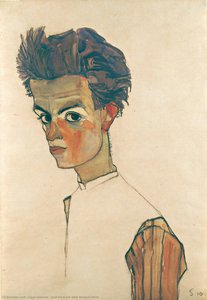
- Self-Portrait with Physalis
- Couple Embracing
- Place Of Birth: Tulln, Austria
Seotud artiklid

The Vienna Secession: A Rebellion of Form & Spirit in Fin-de-Siècle Art
Discover the revolutionary Vienna Secession art movement! Explore Klimt, Olbrich & more. Learn about its history, characteristics & lasting influence on modern art. High-quality reproductions available.
Beyond Ephemerality: Hand-Painted Art Reproductions as a Paradigm of Sustainable Luxury in Contemporary Décor
Discover museum-quality hand-painted art reproductions crafted with sustainable practices & ethical sourcing. Elevate your décor with timeless beauty – expertly created and customized to your vision. Explore our collection today!
Pop Spirit: Infusing Luxury Villas with the Boldness of Modern Art – A Guide to Inspired Reproductions, Curatorial Strategies, and Aesthetic Harmony
Elevate your luxury villa with vibrant Pop Art! Discover expert curation tips, museum-quality reproductions & bespoke commissions at OriginalUniqueArt. Transform your space today.
Acrylic Canvas Masters: 10 Paintings That Redefined Modern Art |
Explore 10 legendary 'Acrylic On Canvas' masterpieces by artists like Rothko, Warhol & Frankenthaler. Discover the stories behind these iconic paintings and their impact on modern art. Find museum-quality reproductions at – elevate your home with timeless beauty.
OriginalUniqueArt.com F.A.Q.: Originaalkunstiteos vs. Käsitööna Valminud Reproduktsioonid – Kollektsionääri Juhend Kvaliteedi ja Väärtuse Erinevusteks
Avastage originaalkunstiteoste ja OriginalUniqueArt.com käsitööna valmistatud reproduktsioonide erinevused. Saate ekspertkonsultatsioonid, kohandatud maalid ja investeerimisnõuanded kollektsionääri perspektiivist. Kvaliteet garanteeritud!