- Avaleht

- Trükk lõendile
- Edward Hopper
- untitled (3714)
 Tellimaks maali Osta digipilt
 Saada
Saada
 Jaga
Jaga
 Teave teose kohta
 Lisa lemmikutesse

 Laadi alla
 Sarnased teosed
 Röntgenuuring
 Slaidietendus
untitled (3714)


 Loe lähemalt
Giclée / Kunstiprint
Muuseumikvaliteediga giclée- või kangasprint kiire tootmisega ja paindlikud viimistlusvõimalused.




P118B $10

P118H $10

P118W $10

P438Z $10

P508JH $12

P508YH $12

P805H $10

P805Z $10

P919BZ $10

P919G $10

P919XJ $10

P959ZH $10

P968JZ $12

W106C $8

W218G $10

W218JH $8

W218Y $10

W307PJ $10

W316G $10

W316PJ $8

W316Y $10

W398PJ $8

W4111J $10

W500HY $15

W500JH $15

W692G $12

W849H $8

W940BG $15

W953PJ $8




Vali meie eelmääratud suurused, mis vastavad teose algupärastele proportsioonidele.

Saate sisestada oma mõõdud, et need sobiks konkreetse raami või ruumi sisse. Kui valitud suurus ei vasta originaalteose proportsioonidele, lõigame teose ära või laiendame pilti peegeldatud või ühtlase servaga. Enne tootmisprotsessi algust saadetakse Teie kinnitamiseks digitaalne näidis.
Palun märka, et ekraanil kuvatav eelvaade ei kajasta tegelikku lõigamist või laiendamist. Ainult näidis kujutab täpselt lõplikku kompositsiooni.
Kuigi erimõõdu on saadaval, soovitame originaaproportsioonide säilitamiseks valida mõõt ette määratud nimekirjast.
Ülemaailmne tarne () 2 nädala jooksul, tavalise 4/5 nädala asemel. (19 juuli)

Tasuta ekspresssaatmine üle maailma

Kõrgekvaliteediline linakangas

Täielik transpordikindlustus

Tollimaksude tagastamise garantii

Värvitoime täpsuse garantii

60-päevane tagastusõig: ainult tootmisdefektide korral

100% raha tagasi garantii

Hulgusoodustus
 Klaasivalik on saadaval ainult suuruses kuni 110 cm

untitled (3714)
Giclée / Kunstiprint
Reproduktsiooni suurus
-


Kogusumma
-
Kogumuse kirjeldus
A Silent Symphony of Urban Isolation: Edward Hopper’s “Untitled (3714)”
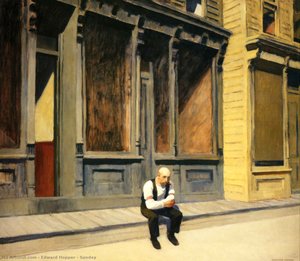
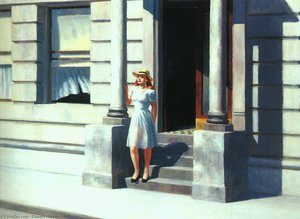
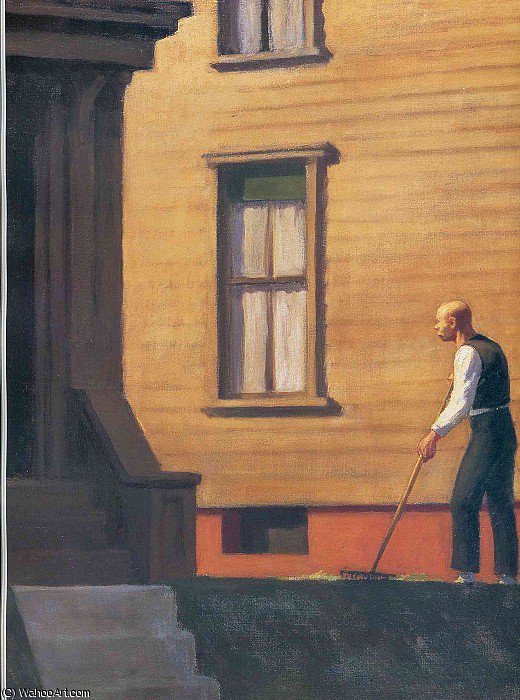
Edward Hopper's "Untitled (3714)," painted in 1942, isn’t merely a depiction of a diner interior; it’s a distilled essence of modern American loneliness. This deceptively simple scene—an elderly man perched on the steps of a modest house, leaning heavily on a cane—resonates with an almost unbearable quietude, a feeling that has become inextricably linked to Hopper's artistic vision and the anxieties of his era. The painting captures a fleeting moment of solitude, a tableau of human existence stripped bare of connection, rendered in a palette of muted earth tones and punctuated by the stark geometry of urban architecture.
Hopper’s mastery lies not just in observation but in translating that observation into a potent emotional experience. He wasn't interested in grand narratives or dramatic action; instead, he focused on the subtle gestures, the unspoken anxieties, and the pervasive sense of detachment that characterized much of 20th-century American life. The composition is meticulously controlled—the vertical thrust of the building, the horizontal sweep of the steps, all contribute to a feeling of contained stillness. The man’s posture, his slight stoop and the weight of the cane, immediately convey vulnerability and a quiet resignation. It's a portrait not of a specific individual, but of a universal experience: the feeling of being adrift in a vast, impersonal world.
A Study in Light and Shadow – The Painter’s Technique
The painting’s power is deeply rooted in Hopper’s distinctive technique. He employed a predominantly realistic style, yet infused it with a modernist sensibility—a deliberate simplification of forms and an acute awareness of light and shadow. Notice how the diffused afternoon light streams through the windows, casting long, soft shadows that flatten the space and heighten the sense of isolation. The use of ochre, brown, and yellow creates a warm, aged atmosphere, suggesting both time and decay. Hopper’s brushwork is remarkably smooth, almost impersonal—a deliberate choice that reinforces the painting's detached mood. He favored oil paints on canvas, allowing for rich color saturation and subtle gradations of tone.
The meticulous rendering of the building’s facade – the slightly weathered siding, the precise lines of the windows – speaks to Hopper’s painstaking attention to detail. Yet, this precision serves not to create a realistic representation but rather to emphasize the rigidity and artificiality of the urban environment. The rectangular shapes dominate the composition, creating a sense of order that ironically underscores the underlying feeling of alienation.
Symbolism and the American Psyche
“Untitled (3714)” is rich in symbolic resonance. The elderly man himself represents aging, vulnerability, and perhaps even mortality. The cane isn’t simply a walking aid; it's a symbol of dependence and a reminder of time passing. The house, modest and unassuming, suggests a longing for stability and connection—a desire that remains unfulfilled. The darkened street outside the diner further amplifies this sense of isolation, creating a visual barrier between the man and the world beyond.
Hopper’s work frequently explored themes of loneliness, alienation, and the search for meaning in a rapidly changing society. “Untitled (3714)” is a quintessential example of this preoccupation, capturing the quiet desperation of individuals struggling to find their place in an increasingly impersonal world. It's a painting that invites contemplation—a silent conversation about the human condition.
A Legacy of Quiet Observation
Edward Hopper’s influence on American art and culture is undeniable. “Untitled (3714)” stands as one of his most iconic works, embodying his signature style and thematic concerns. Reproductions of this painting continue to resonate with viewers today, offering a poignant glimpse into the complexities of modern life. Its enduring appeal lies in its ability to evoke a powerful emotional response—a sense of melancholy, introspection, and perhaps even a touch of recognition for the quiet solitude that resides within us all.
Kunstniku elulugu
Edward Hopper: A Master of American Realism
Edward Hopper, a name inextricably linked to the quietude and subtle melancholy that permeated 20th-century American life, wasn’t simply a painter of scenes; he was a poet of light and shadow, a chronicler of modern isolation. Born in Nyack, New York, in 1882, to middle-class parents of Dutch ancestry, Hopper's early years provided a stable upbringing that nurtured his artistic inclinations. From childhood sketches meticulously dated and signed, it became evident that keen observation and an innate talent for drawing were central to his being. Though initially encouraged towards commercial illustration – a pragmatic suggestion from his parents – Hopper’s ambitions leaned toward fine art, leading him to the New York School of Art where he studied under William Merritt Chase and Robert Henri. These formative years instilled not only technical skill but also an appreciation for realism and a commitment to depicting the world as he saw it—unvarnished and honest. The writings of Ralph Waldo Emerson resonated deeply with Hopper, reinforcing his sense of individualism and acute observation – qualities that would become hallmarks of his artistic vision. Early travels to Paris exposed him to Impressionism, yet Hopper quickly diverged from its fleeting brushstrokes, forging a path uniquely his own.Early Life and Artistic Beginnings
Hopper’s formative years were marked by a quiet determination to pursue his passions despite familial expectations. He demonstrated exceptional drawing skills from a young age, capturing landscapes and portraits with remarkable accuracy—a testament to his innate talent for visual representation. Despite initial inclinations toward commercial illustration, Hopper steadfastly adhered to his conviction that true artistic expression demanded engagement with the complexities of fine art. His studies at the New York School of Art under Chase and Henri profoundly shaped his aesthetic sensibilities, fostering a commitment to realism and influencing his stylistic choices throughout his career. These mentors championed observation as paramount to artistic achievement—a principle Hopper embraced wholeheartedly, prioritizing meticulous detail and capturing the essence of reality with unwavering fidelity. William Merritt Chase encouraged Hopper to focus on tonal harmony and expressive brushwork, while Robert Henri instilled in him a rebellious spirit and a desire to challenge conventional artistic norms.Finding His Voice: Realism and the American Scene
Hopper’s artistic journey wasn't immediate or effortless. He grappled with discovering his distinctive voice, experimenting with various styles before settling into the realism that would define his career. This wasn’t mere replication of reality; it was a distillation of its essence, stripping away extraneous detail to reveal underlying emotional truths. His paintings began to focus on everyday scenes – houses, diners, offices, hotel rooms – imbued with a sense of stillness and often, loneliness. He possessed an extraordinary ability to capture the psychological states of his subjects, hinting at narratives without explicitly stating them. The precise rendering of light and shadow became crucial, not merely as descriptive elements but as emotional cues, creating atmospheres that were both captivating and unsettling. House by the Railroad (1925), an early masterpiece, exemplifies this approach—a seemingly simple composition radiating a profound sense of isolation and mystery. Hopper’s printmaking, often overlooked, ran parallel to his painting, sharing similar themes and stylistic qualities, demonstrating his mastery across mediums. He wasn't interested in grand historical narratives or allegorical symbolism; he focused on the mundane, elevating it through careful observation and emotional resonance.Iconic Visions: Nighthawks and Beyond
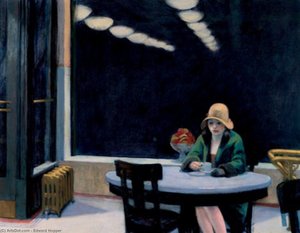
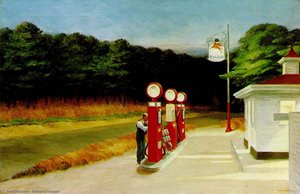
While Hopper’s career unfolded gradually, certain works catapulted him to widespread recognition. Nighthawks (1942), arguably his most famous painting, became an instant icon of American culture. The late-night diner scene, bathed in stark fluorescent light, perfectly encapsulates the alienation and anonymity of modern urban life. The figures within are lost in their own thoughts, disconnected from one another despite their proximity—a poignant commentary on the human condition. Gas (1940), with its striking portrayal of a roadside gas station, showcases Hopper’s fascination with American landscapes and the burgeoning automobile culture. Other notable works like *Automat*, *Office in a Small City*, and *Summertime* each offer unique insights into the complexities of 20th-century American society. These paintings weren't merely depictions of places; they were explorations of mood, psychology, and the subtle dramas unfolding within ordinary settings. His wife, Josephine Nivison Hopper, played a vital role not only as his lifelong companion but also as a frequent model, contributing significantly to the characterization of his female figures.Legacy and Influence
Edward Hopper’s enduring legacy rests upon his profound contribution to American art history—a contribution characterized by unwavering realism, psychological depth, and an unparalleled sensitivity to capturing the nuances of human experience. His paintings continue to resonate with audiences today because they speak to universal themes of loneliness, isolation, and the search for meaning in a rapidly changing world. Hopper’s stylistic innovations profoundly influenced subsequent artists, establishing him as one of the most important figures in modern American art—a legacy cemented by his iconic works and their enduring presence in museums worldwide. His ability to transform commonplace scenes into evocative explorations of emotion solidified his place as a visionary artist who captured the spirit of his time—and continues to inspire contemplation and wonder generations later. Hopper’s influence extends beyond painting, permeating film and literature, demonstrating the breadth of his artistic impact on cultural expression.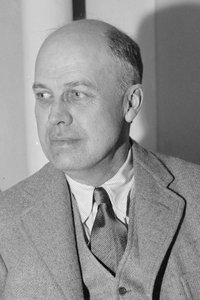
Edward Hopper
1931 - 1967 , USA
Lühikesed faktid
- Artistic Movement Or Style: Realism
- Artists Who Influenced This Artist:
- William Merritt Chase
- Robert Henri
- Date Of Birth: July 22, 1882
- Date Of Death: May 15, 1967
- Full Name: Edward Hopper
- Nationality: American
- Notable Artworks:
- Nighthawks
- House by the Railroad
- Gas
- Place Of Birth: Nyack, USA
Seotud artiklid
The Ashcan School: Realism, Urban Life & the Democratization of American Art
Explore the revolutionary Ashcan School! Discover how artists like Henri & Sloan challenged tradition with gritty realism, capturing urban life in early 20th-century America. Learn about their impact on American art history.
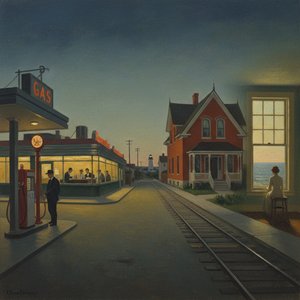
Edward Hopperi 25 parimat teost: Valgus, vari ja ameerika hingus seinakaunistuseks | OriginalUniqueArt
Avastage Edward Hopperi 25 parimat teost! Sukelduge valgusest ja varjust täis maailma, mis peegeldab ameerika hingust. Leidke inspiratsiooni kodukaunistuseks ja kvaliteetsed kunstireproduktsioonid OriginalUniqueArt.com-ist. Vaadake kogu kollektsiooni online!
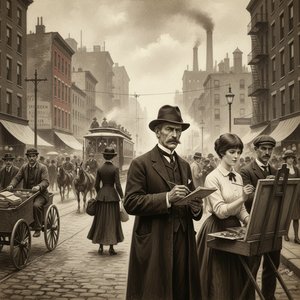
Robert Henri & the Spirit of American Realism: A Legacy of Urban Life and Artistic Independence
Explore the life & legacy of Robert Henri, a pivotal figure in American Realism. Discover his captivating portraits, influence on the Ashcan School, and enduring impact on art history. Learn more at OriginalUniqueArt.
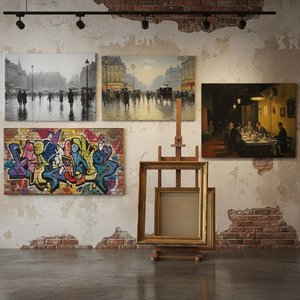
Echoes of Urban Life: A Visual Exploration of Street Scenes in Art History
Explore the captivating world of realism in art history! Discover iconic street scenes & genre paintings from masters like Courbet & Brown. Expert analysis & museum-quality reproductions at OriginalUniqueArt.
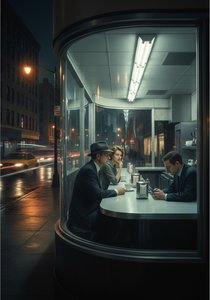
Edward Hopper: American Realism, Urban Isolation & the Poetics of Modern Loneliness
Explore the profound world of Edward Hopper's American realism. Discover the symbolism, themes & enduring legacy of this iconic artist – from 'Nighthawks' to his lesser-known masterpieces. Expert analysis and insights.