

 Eelvaade
 Saada
Saada Jaga
Jaga
 Teave teose kohta

 Laadi alla
 Sarnased teosed
 Röntgenuuring
 Slaidietendus
Drawing for Transient Rainbow
 2003
2003 455.0 x 405.0 cm
 Loe lähemalt
Ostke kõrglahutusel ja täiustatud digitaalne pilt, mis on oluliselt parem kui veebilehel näidatud eelvaade.
Iga fail on meie spetsialistide poolt hoolikalt ette valmistatud, kasutades kaasaegseid tööriistu ja professionaalset käsitsi retušeerimist. Tagame, et igal pildil on erakordne selgus, täpne värvitäpsus ja peen detail.
Lõplik fail saadetakse e-posti teel 72 tunni jooksul, olles optimeeritud koheseks kasutamiseks professionaalsetes, toimetuslikes ja trüki keskkondades. See on sama kvaliteet, mida usaldavad tipptasemel disainistuudiod, kirjastused ja galeriid.
Digitaalne kunstiteos
Laadi alla kõrge resolutsiooniga fail isiklikuks vaatamiseks, trükkimiseks ja loomingulisteks projektideks. ( Osta print Osta käsitsi maalitud maal)
Sisse kuulub iga digitaalse pildi tellimusega
Eksperdi digitaalne kohaletoimetamine, garanteeritud
Valides OriginalUniqueArt.com, ei saa sa lihtsalt pilti – saad professionaalselt parandatud digitaalse teose, mida on valmistatud täpsusega ja mis on toetatud rahuldamatusgarantiiga. Siin on kõik, mis sinu tellimusega automaatselt kaasneb:

Kiire digitaalne saatmine
Teie kõrge resolutsiooniga digitaalne pildifail saadetakse teile e-posti 72 tunni jooksul pärast tellimist – kohe kasutamiseks valmis.

Tehisintellektiga täiustatud digitaalne fail
Teie teos on professionaalselt optimeeritud arenenud tehisintellekti tööriistade ja käsitsi redigeerimise abil, tagades maksimaalse detailitaseme, selguse ja värvitäpsuse.

Tasuta eluaegne uuesti saatmine
Kas kustutasid faili kogukalu unustamisel või kustutamisel? Puudub mure – saad selle uuesti igal ajal ilma lisatasuta.

Puuduvad importimaksed – alati
Nautige oma teoseid koheselt ilma tolli-, maksude või tarnimaskuludeta – digiletchargused on alati maksuvabadud.

Värvitäpsuse garantii
Me tagame, et teie digitaalne pilt kajastaks originaali värve professionaalsete tööriistade ja värvihalduse abil võimalikult täpselt.

60-päevane rahulolu garantii
Kui te ei ole oma digipildiga rahul, parandame seda või tagastame 100% summast 60 päeva jooksul – küsimusi ei esita.

100% raha tagastamise garantii
Ei ole rahul? Saate täielise tagastaja 60 päeva jooksul pärast digitaalse faili kättesaamist – küsimata.

Suurema tellimuse soodustused
Osta 3 pilti, säästa 10% - Osta 5, säästa 15% - Osta 10+, säästa 20%. Sobib suurepäraselt loomingulisteks projektideks, galeriideks ja agentuurideks.
Kunstniku biograafia
A Life Forged in Fire: The Explosive Art of Cai Guo-Qiang
Cai Guo-Qiang’s journey is one of audacious experimentation, a relentless pursuit to reconcile the ancient traditions of his Chinese heritage with the dynamic currents of contemporary art. Born in 1957 in Quanzhou, China, his early life was deeply imprinted by a nation undergoing profound transformation. His father, Cai Ruiqin, a calligrapher and traditional painter, nurtured within him an appreciation for both Eastern aesthetics and Western literature – a duality that would become central to his artistic vision. Growing up during the tumultuous Cultural Revolution, young Cai witnessed firsthand the power of collective fervor and societal control, experiences that subtly informed his later explorations of ideology and utopian ideals. Perhaps surprisingly, this formative period also included early exposure to performance through participation in demonstrations and parades, alongside a brief foray into martial arts films – *The Spring and Fall of a Small Town* and *Real Kung Fu of Shaolin*. These seemingly disparate influences laid the groundwork for an artist who would consistently challenge boundaries and embrace unexpected juxtapositions. The ever-present imagery of gunpowder, utilized both in celebratory fireworks and as a tool of conflict, also began to take root in his subconscious, foreshadowing its eventual emergence as his signature medium.From Stage Design to Explosive Visions
Cai’s formal artistic training commenced at the Shanghai Theater Academy from 1981 to 1985, where he studied stage design. This period proved pivotal in developing his understanding of spatial arrangement, interactivity, and collaborative work – skills that would later be crucial in orchestrating his large-scale “explosion events.” Dissatisfied with the constraints of conventional artistic practices, Cai began experimenting with gunpowder drawings in the 1980s. These weren’t merely images *of* explosions; they were created *by* controlled detonations, using gunpowder as a direct drawing tool. This radical approach was a deliberate rejection of established artistic norms and a search for spontaneity and expressive freedom. He spent nearly a decade living in Japan from 1986 to 1995, further refining his technique and developing the conceptual framework that would define his career. It was during this time he truly began to harness the power of gunpowder not just as a medium but as a metaphor for destruction, creation, and the ephemeral nature of existence. His work increasingly drew inspiration from diverse sources – fengshui, Chinese medicine, traditional shanshui paintings, scientific principles, flora and fauna, portraiture, and, of course, the dazzling spectacle of fireworks themselves.A Global Stage: Recognition and Innovation
Cai Guo-Qiang’s artistic breakthrough arrived with international acclaim in 1999 when he was awarded the Golden Lion at the Venice Biennale – a watershed moment that propelled him onto the global art stage. This recognition was followed by numerous prestigious awards, including the Hiroshima Art Prize in 2007, honoring his commitment to peace and understanding through art; the Fukuoka Asian Culture Prize in 2009 for promoting cultural exchange; and the esteemed Praemium Imperiale in 2012, recognizing a lifetime of achievement. In the same year, he received the U.S. Department of State Medal of Arts, acknowledging his dedication to international cultural diplomacy. However, perhaps his most visible contribution to global culture came as Director of Visual and Special Effects for both the opening and closing ceremonies of the 2008 Beijing Summer Olympics and the 2022 Winter Olympics. These spectacular displays showcased his mastery of pyrotechnics on an unprecedented scale, captivating audiences worldwide. Throughout this period, Cai’s work was featured in solo exhibitions at major museums including the Metropolitan Museum of Art and the Solomon R. Guggenheim Museum in New York, solidifying his position as a leading figure in contemporary art.Blending East and West: A Legacy of Impermanence
Cai Guo-Qiang’s artistic style is characterized by its unique synthesis of Eastern philosophical concepts and Western contemporary practices. He doesn't simply *represent* Chinese culture; he embodies it, reinterpreting ancient traditions through a modern lens. His explosion events are inherently ephemeral – fleeting moments of beauty captured primarily through photography and video. This emphasis on impermanence reflects core tenets of Buddhist philosophy and the Taoist understanding of the universe as constantly in flux. Beyond aesthetics, Cai’s work often engages with profound social and political themes, particularly those related to China's history, cultural identity, and the complexities of modernization. He is a pioneer in site-specific art, creating installations that respond directly to their environment, engaging with local histories and cultures. His influence on contemporary art is undeniable; he has inspired countless artists to explore new materials, embrace large-scale installations, and confront challenging themes with boldness and originality. More recently, Cai Guo-Qiang continues to push boundaries, exploring the intersection of art and technology through projects like his blockchain divination project *EET* and his artificial intelligence art project *cAI™*, as well as continuing his exploration of Eastern and Western artistic traditions in exhibitions such as *Individual’s Journey Through Western Art History*. His work is a testament to the power of art to transcend cultural boundaries, provoke dialogue, and remind us of the beauty inherent in both creation and destruction.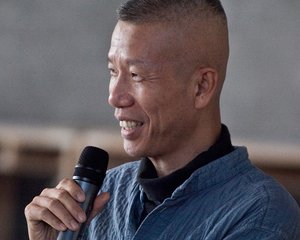
Cai Guo-Qiang
1957 -

