Lülita trükkitoodetele
 Loe lähemalt







































 Kunstiteoste või reproduktsioonide puhul, mille üks külg on üle 105 cm (umbikmolt 41 tolli), saadetakse raam kirjal asendis, la Dismantlitud komplektina. See meetod tagab ohutuse kohaletoimetamisel ja väldib transpordil tekkivaid kahjustusi.


A Glimpse into Social Dynamics: Diogenes Seeks a True Man
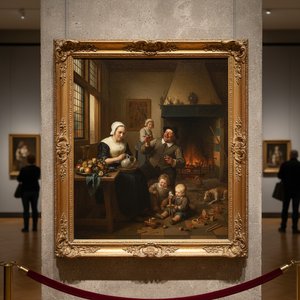
To stand before this canvas is to step directly into the vibrant, sometimes chaotic heart of 17th-century Dutch social life. Caesar van Everdingen’s depiction, "Diogenes Seeks a True Man," is far more than a mere gathering of figures; it is a richly textured tableau vivant, capturing a moment charged with human interaction and underlying philosophical tension. The scene unfolds before what appears to be the facade of a church, suggesting that even in moments of communal celebration or inquiry, the weight of belief and community structure looms large. Observe the central grouping: individuals dressed in varying degrees of formality—some sporting modern ties, others clad in styles hinting at different strata of society—all converging into a dynamic knot of humanity.
Mastery of Genre and Atmosphere
Van Everdingen, known for his keen eye for genre scenes and portraiture, employs a masterful technique that breathes life into every corner of the composition. The brushwork, characteristic of the Dutch Golden Age masters, is both meticulous in its detail—noticeable in the folds of clothing or the sheen on the horse’s coat—and remarkably loose when capturing the ephemeral quality of light and movement. The inclusion of animals, particularly the two watchful dogs flanking the scene and the stately presence of the horse near the center, grounds the human drama within a tangible, lived-in world. This skillful blending of portraiture with genre elements allows the viewer to feel not just what happened, but the very air that hung between these assembled souls.
The Echoes of Philosophy: Symbolism in the Crowd
The title itself, "Diogenes Seeks a True Man," immediately elevates the painting from simple social commentary to profound allegory. Diogenes, the Cynic philosopher, represents radical authenticity and skepticism toward societal artifice. His presence within this bustling crowd—a group seemingly preoccupied with wine, fashion, or mere socializing—creates an immediate visual friction. The man holding the wine glass seems caught between participation and contemplation. This tension suggests that the search for genuine connection, for truth unvarnished by social expectation, remains a timeless human quest. It invites us, the modern viewer, to question our own gatherings: are we truly connecting, or merely performing for an audience?
A Collector's Perspective on Reproduction
For those seeking to bring this sophisticated narrative into your home or gallery space, understanding the depth of Van Everdingen’s vision is key. A high-quality reproduction allows you to possess a piece that speaks volumes without demanding the reverence reserved for an original masterpiece. The scale of 76 x 104 cm ensures that the complexity of the crowd and the subtle gestures are visible up close, while its overall composition maintains breathtaking impact from across a room. It serves not only as decorative art but as a sophisticated conversation starter—a piece that rewards prolonged study and thoughtful discussion among admirers.
Korduvad küsimused
Millist tehnikat teose „Diogenes Seeks a True Man“, autor Caesar Van Everdingen valmistamisel kasutati?
Teos "Diogenes Seeks a True Man" on valmistatud tehnika Oil On Canvas.
Milline on teose "Diogenes Seeks a True Man" atmosfäär?
Teose „Diogenes Seeks a True Man“, autor Caesar Van Everdingen meeleolu on kirjeldatud kui Classic. See klassifikatsioon võib aidata leida teosele sobiva sisekujunduse.
Mis on teose „Diogenes Seeks a True Man“, autor Caesar Van Everdingen tegelik suurus?
Teose "Diogenes Seeks a True Man" originaalmõõdud on 76 x 104 cm. Algdimensioonid on kasulik viide reproduktsiooni suuruse valimisel.
 Eelvaade
 Saada
Saada Jaga
Jaga
 Teave teose kohta
 Juhend

 Laadi alla
 Sarnased teosed
 Röntgenuuring
 Slaidietendus
 KÜSIMUSED JA VASTUSID
 Statistika