Lülita trükkitoodetele
 Loe lähemalt







































 Kunstiteoste või reproduktsioonide puhul, mille üks külg on üle 105 cm (umbikmolt 41 tolli), saadetakse raam kirjal asendis, la Dismantlitud komplektina. See meetod tagab ohutuse kohaletoimetamisel ja väldib transpordil tekkivaid kahjustusi.


The Arresting Power of the Everyday
In the vibrant landscape of 1963, Andy Warhol unleashed a visual provocation that would forever alter the trajectory of modern art. Untitled (3181) is not merely a depiction of a common street fixture; it is an intentional disruption of the viewer's gaze. A singular, crimson stop sign dominates the canvas, its bold red hue acting as a visceral command to pause and contemplate. Behind this iconic symbol, a muted cityscape unfolds—a delicate, almost ghostly architecture that provides a somber contrast to the foreground's intensity. This juxtaposition creates a profound tension between the familiar, regulated world of urban life and the raw, unyielding energy of Pop Art, inviting anyone who stands before it to find extraordinary meaning within the ordinary.
The Mechanics of Mass Production
To understand the soul of this piece, one must look through the lens of Warhol’s revolutionary technique. Eschewing the traditional, heavy layers of oil paint favored by the Abstract Expressionists, Warhol embraced the silkscreen printing process—a method borrowed directly from the world of commercial advertising and industrial manufacturing. By transferring photographic images onto acetate and rolling them repeatedly over paper, he achieved a level of uniformity that mirrored the mass-produced goods of the era. The subtle presence of halftone dots creates a textured surface that mimics the grain of newsprint or magazine advertisements, blurring the line between fine art and consumer media. This calculated use of repetition serves as a profound commentary on the burgeoning culture of replication, where the unique is replaced by the infinitely reproducible.
A Reflection of a Changing World
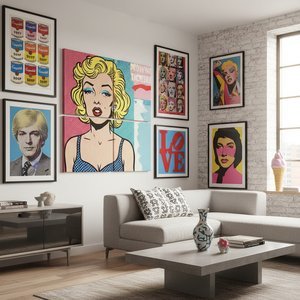
Emerging during the height of the Kennedy administration, Untitled (3181) captures the pulse of an America caught between unprecedented economic prosperity and a growing fascination with celebrity and mass media. Warhol’s work acts as a mirror to a society increasingly defined by what it consumes. By elevating a mundane traffic sign to the status of a masterpiece, he challenged the elitism of the art world, suggesting that the true icons of our age are found in the streets and on the supermarket shelves. For the contemporary collector or interior designer, this piece offers more than just a striking visual; it provides a sophisticated dialogue between history and modernity. Its bold colors and graphic clarity make it an unparalleled centerpiece for any space, injecting a sense of historical weight and avant-garde spirit into a modern aesthetic.
Korduvad küsimused
Millisesse ruumi on „untitled (3181)“, autor Andy Warhol soovituslik paigutada?
Teose „untitled (3181)“, autor Andy Warhol paigutamiseks on soovitatav kasutada ruumi Living Room. See soovituse on tehtud teose sisu, värvide ja meeleolu põhjal.
Kes müüb teose "„untitled (3181)“, autor Andy Warhol" käsitsi maaldatud koopiaid?
Teose „untitled (3181)“, autor Andy Warhol käsitsi maaldatud reproduktsiooni saab tellada otse selle Käsitsi maalatud reproduktsioon lehelt: käsitsi maalatud õlireproduktsioon linaelapale, valmistatud tellimusest.
Kui palju inimesi vaatab teost "untitled (3181)"?
Teose „untitled (3181)“, autor Andy Warhol statistika on saadaval teose lehel Statistika: teose kuukaudsed külastused, kunstniku teoste külastused ning viimaste külastajate riikide ja keelte jaotus.
 Eelvaade
 Saada
Saada Jaga
Jaga
 Teave teose kohta
 Juhend

 Laadi alla
 Sarnased teosed
 Röntgenuuring
 Slaidietendus
 KÜSIMUSED JA VASTUSID
 Statistika