Jan Marcin Bansemer and Piotr Falkenhagen Zaleski: Cartographers of a Lost Homeland The 1837 “Atlas Containing Ten Maps of Poland” stands as more than just a geographical record; it’s a poignant testament to Polish resilience, exile, and the enduring...
Before a nation can be seen on a canvas, it must first be defined by its borders. For much of the 19th century, those borders were intentionally erased from the political map of Europe. The partitions of Poland by Russia, Prussia, and Austria did more than shift territories; they attempted to dismantle a collective identity. In this era of displacement, the act of drawing a map became a profound gesture of resistance.
In London, far from the occupied territories, Jan Marcin Bansemer and Piotr Falkenhagen Zaleski worked as refugees to reconstruct what had been lost. Their 1837 Atlas Containing Ten Maps of Poland was not merely a geographical record but a political tool. By meticulously charting the landscape between 1772 and 1831, they provided a visual anchor for a diaspora that could no longer claim their land through law. This cartographic precision served to remind the world that the nation still existed in spirit and shape.
This same impulse to document and preserve can be seen in the work of modern archivists. Just as Bansemer and Zalski used ink to defy erasure, institutions like POLONIKA work today to safeguard the cultural footprints left by emigrants across the globe. Both efforts share a single goal: ensuring that memory remains anchored to a tangible reality, regardless of how much time or distance separates us from the source.
The Poetic Pulse: How Romantic Literature Defined the Visual Era
Romanticism in Poland, a literary, artistic and intellectual period in the evolution of Polish culture, began around 1820, coinciding with the publication of Adam Mickiewicz's first poems in 1822. It ended with the suppression of the January 1863 Upr...
The shift toward Romanticism in the early 1800s brought a new way of perceiving the world, moving away from Enlightenment rationality toward emotion and intuition. In Poland, this movement was inseparable from the struggle for sovereignty. The literature of the time, led by figures such as Adam Mickiewicz, provided the emotional vocabulary that painters would later translate into color and form.
The poetry of Mickiewicz, particularly his epic Pan Tadeusz, expressed a profound longing for a homeland that felt like "good health"—something precious only once it was lost. This literary preoccupation with nostalgia and the idealization of the past directly informed the visual arts. The Romantic era embraced the supernatural, folklore, and the sublime, creating a landscape where the physical world was often a mirror for the internal soul.
We see this echo in the way we approach art today through our custom commissions. When a client asks us to transform a modern photograph into a 17th-century style portrait, they are participating in a form of "period shifting." They are using the tools of the present to evoke the emotional weight and aesthetic grandeur of a bygone era, much like the Romantics used verse to resurrect the glory of the Polish past.
Symbolic Shadows: Translating National Struggle into Metaphor
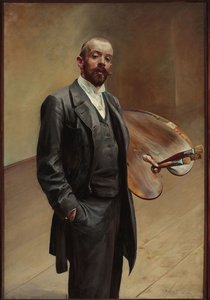
A Life Imbued with Polish Longing Jacek Malczewski, born in 1854 in Radom, a city then nestled within the Russian-controlled Congress Poland, was more than simply a painter; he was a visual embodiment of Polish national identity and a profound voice ...
As the 19th century progressed, the directness of Romanticism evolved into something more complex and layered. The rise of Symbolism allowed artists to move beyond literal depictions of history and instead use metaphor to communicate the psychological state of a nation under occupation. This period was characterized by an exploration of the unseen—dreams, myths, and spiritual truths.
Jacek Malczewski stands as the primary figure in this transition. His work does not simply show a battle or a landscape; it uses symbolic figures to represent the Polish struggle for self-determination. Influenced by his father’s patriotism and the dramatic intensity of artists like Artur Grottger, Malczewski created compositions where the boundaries between reality and myth are blurred. His paintings function as visual enigmas, requiring the viewer to decode the layers of national suffering and hope.
This reliance on symbolism finds a modern parallel in our AI Masterpiece tool. By allowing users to reconstruct their own images through the lens of Cubism or Surrealism, we facilitate a similar movement from the literal to the metaphorical. It is an invitation to look past the surface of a photograph to find a more profound, stylized truth underneath.
Chasing Light: The Arrival of Impressionism on Polish Soil
Polish Impressionism was an art movement inspired by French Impressionism. Władysław Podkowiński is generally credited with introducing the movement to Poland after a trip to Paris in 1889, where he was profoundly influenced by French Impressionist p...
While much of Polish art was preoccupied with history and symbol, a new wave of light and immediacy arrived from France in the late 19th century. Impressionism, with its focus on the transient effects of sunlight and the beauty of everyday life, offered a different way to engage with the world. This movement brought a sense of freshness and a departure from the heavy, dark tones of previous decades.
Artists like Władysław Podkowiński and Olga Boznańska were instrumental in this shift. Podkowiński, influenced by his studies in Paris, introduced the technique of visible brushstrokes and open compositions to Poland. Meanwhile, Boznańska developed a highly personal style, using muted, dark green and grey tones to imbue her portraits with a sense of nostalgia and quiet sorrow. Her work demonstrates that Impressionism could be both light-drenched and deeply emotive.
The fascination with light and texture remains central to our studio's philosophy. Our handmade oil reproductions are created specifically to highlight the tactile nature of paint—the impasto, the ridges, and the way light hits a physical surface. We aim to provide a depth of tonal range that a flat print cannot achieve, honoring the very "momentary" quality that the Impressionists sought to capture.
Architectural Sanctuaries: Museums as Guardians of Cultural Memory
A Window Into Polish History and Culture: The Polish Museum in Rapperswil Nestled within the majestic Rapperswil Castle—a testament to centuries of Swiss heritage—The Polish Museum in Rapperswil presents a singular opportunity to delve into Poland’s ...
The survival of art is often dependent on the strength of the walls that house it. Throughout history, when nations faced the threat of erasure, museums and castles became much more than repositories for objects; they became sanctuaries for a culture's very soul. The architecture of these spaces provides a physical weight to the history they contain.
The Polish Museum in Rapperswil-sur-Rippe is a profound example of this. Housed within the medieval stone walls of Rapperswil Castle, the museum was established by Count Władysław Broel-Plater as a way to safeguard Polish identity during eras of upheaval. The castle itself, with its Romanesque and Gothic elements, serves as a dramatic backdrop for works that span five centuries, linking the history of Switzerland and Poland through a shared tradition of refuge and collaboration.
This concept of the museum as a bridge between cultures is something we strive to replicate in our digital presence at OriginalUniqueArt.com. We aim to provide an accessible, educational space where anyone, anywhere, can connect with the historical context of a painting. Whether through a physical gallery or a carefully curated online collection, the goal remains the same: to ensure that the stories behind these works are never forgotten.
Monumental Narratives: History Painting and the Weight of Heritage
History painting is a genre in painting defined by its subject matter rather than any artistic style or specific period. History paintings depict a moment in a narrative story, most often (but not exclusively) Greek and Roman mythology and Bible stor...
At the peak of the academic tradition, history painting stood as the most prestigious genre in the Western hierarchy. These large-scale works were intended to be visual epics, capturing pivotal moments of religious, mythological, or secular significance. In Poland, this genre became a vital tool for maintaining a sense of continuity and national pride.
Jan Matejko, often referred to as the "national painter," used this medium to create monumental portrayals of significant Polish events. His works were not merely decorations; they were pedagogical tools designed to educate and inspire a population that was often denied its own history in textbooks. By painting the scale and drama of past triumphs and tragedies, he ensured that the collective memory remained vivid and unshakeable.
Today, we continue to celebrate this tradition of large-format storytelling. Our studio specializes in creating massive murals and ceiling frescoes for homes and hotels, allowing our clients to recreate the grandeur of historical ceilings like those found in European palaces. By bringing these large-scale narratives into modern architectural spaces, we help maintain the enduring power of history painting in the contemporary world.
Explore the groundbreaking art of Jan Gossaert (Mabuse), a pioneer of Renaissance painting in the Low Countries. Discover his Romanist style, stunning portraits, and influence on Northern European art history.
Explora la fuerza del Romanticismo a través de 10 obras maestras de Goya, Delacroix y Turner. Descubre historias de emoción, luz y drama con reproducciones de calidad museo para tu colección o diseño de interiores. Explora la colección completa en OriginalUniqueArt.com.
Explore the passionate world of Romanticism! Discover masterpieces by Friedrich & Goya, delve into the sublime, and understand the movement's lasting impact on art history. Expert analysis & insights at OriginalUniqueArt.
Explora la pasión y el sublime del Romanticismo a través de 10 obras maestras de Goya, Turner y Friedrich. Encuentra inspiración y reproducciones al óleo de calidad museo para tus espacios. Descubre todas las obras maestras en OriginalUniqueArt.com.
OAsistente de estudioEn línea · responde en un minuto
¡Hola! Puedo ayudarte a elegir una obra de arte, realizar el seguimiento de un pedido o resolver tus dudas sobre la garantía. ¿En qué puedo ayudarte hoy?

 Jan Marcin Bansemer And Piotr Falkenhagen Zaleski
 Jacek Malczewski
 Polish Impressionism
 The Polish Museum in Rapperswil
 History painting