
 Enviar
 Compartir
 Detalles
 Guía
Guía

 Descargar
 Similares
 Presentación de diapositivas
 Estadísticas
Persian
 Ceramics
- Arts and Crafts
 1897
1897 46.0 x 15.0 cm
 Museo de Arte del Condado de Los Ángeles
 Ver más
Giclée / Impresión de arte
Impresiones giclée o en lienzo de calidad de museo con producción rápida y opciones de acabado flexibles. ( Comprar pintura hecha a mano Cambiar a imagen digital)




































Elija entre nuestros tamaños predefinidos que respetan las proporciones originales de la obra.

Introduzca el ancho y el alto que necesite para adaptarse a su marco o pared. Una impresión solo puede recortarse, nunca hacerse más grande que la imagen original, por lo que un tamaño con una forma distinta perderá parte de la obra. Le enviaremos una maqueta digital para su aprobación antes de realizar cualquier impresión. La imagen que se muestra en esta página no refleja el recorte real; solo la maqueta lo hace.
Envío a todo el mundo () en 2 semanas en lugar de las 4/5 semanas estándar. (26 octubre)

Envío exprés gratuito a todo el mundo

Lienzo de lino de alta calidad

Seguro de envío total

Garantía de reembolso de aranceles aduaneros

Garantía de fidelidad cromática exacta

Política de devolución de 100 días (solo por defectos)

Garantía de devolución del 100% del dinero

Descuento por cantidad
 La opción de vidrio solo está disponible en tamaños inferiores a 110 cm.

Persian
Giclée / Impresión de arte
Dimensiones de la reproducción
-


Precio total final
€ 70
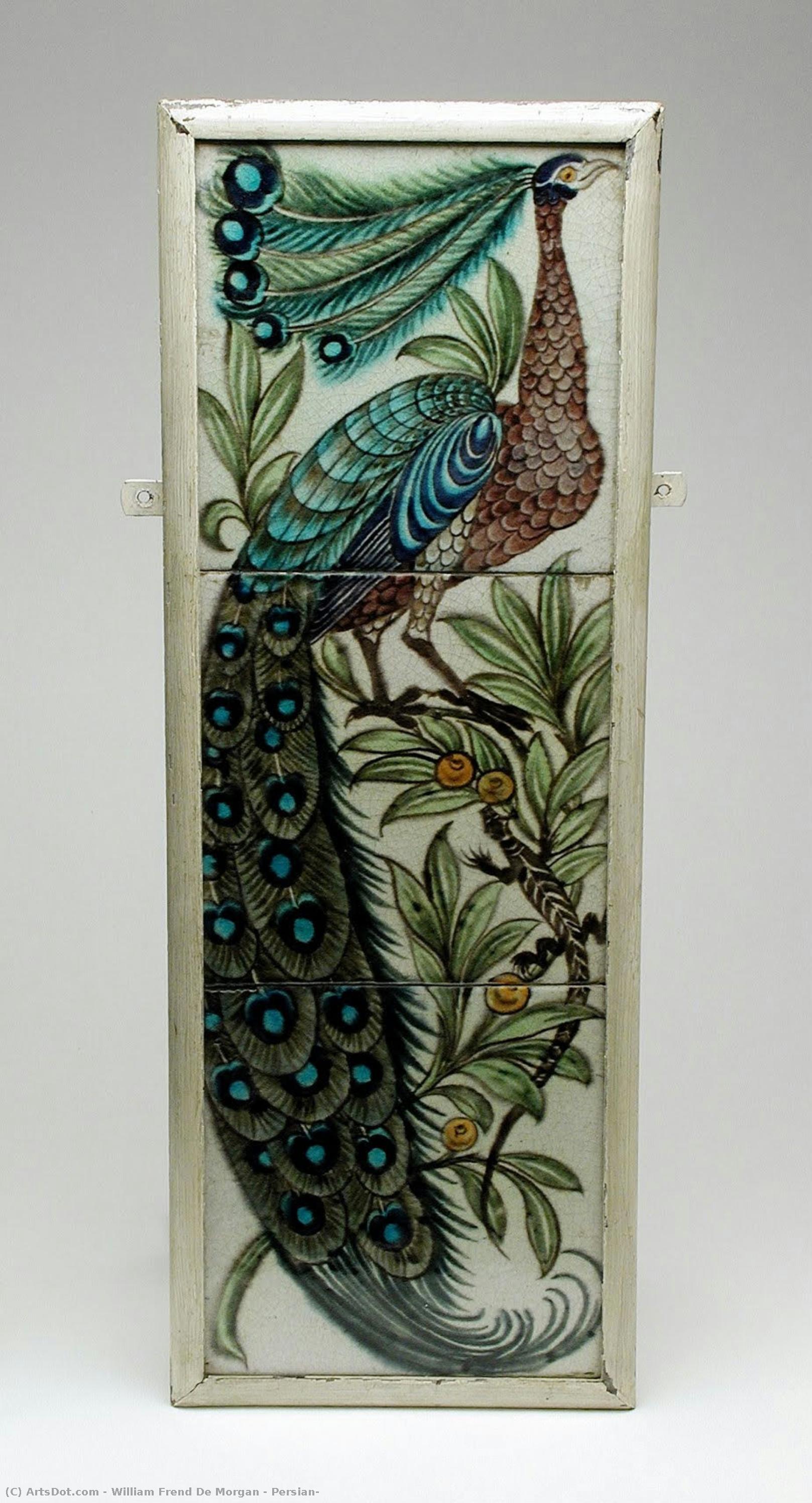
A Vision of the Orient: The Allure of William Frend De Morgan's "Persian"
Within the rich tapestry of 19th-century decorative arts, few pieces possess the captivating blend of artistry and exoticism as William Frend De Morgan’s “Persian” tile panel. Created in 1888-1897 during his prolific period at Merton Abbey, this work transcends mere ornamentation; it's a portal to a reimagined East, infused with Victorian sensibilities and a profound understanding of ancient artistic traditions. More than just a decorative object, it’s a testament to De Morgan’s innovative spirit and his ability to synthesize diverse influences into a singularly beautiful whole.
The panel immediately draws the eye with its vibrant palette – deep blues reminiscent of Persian Iznik ware, punctuated by turquoise highlights, manganese purples hinting at ancient dyes, and the warm glow of Indian red. These colors aren’t simply applied; they are meticulously layered to create a luminous depth that seems to shift and shimmer in the light. The intricate design is dominated by stylized peacocks, their tails spread in an explosion of feathers, each feather rendered with painstaking detail. Surrounding these majestic birds are delicate floral motifs – lotus blossoms, irises, and stylized leaves – all arranged within a complex geometric framework. This combination of natural forms and structured patterns speaks to De Morgan’s fascination with both the organic beauty of nature and the order inherent in ancient civilizations.
The Roots of Inspiration: Victorianism Meets Islamic Art
De Morgan's “Persian” panel is a product of its time, deeply rooted in the artistic currents of the late Victorian era. The Arts and Crafts movement, with its emphasis on handcrafted quality and rejection of mass-produced goods, provided the intellectual framework for his work. However, De Morgan’s inspiration extended far beyond England; he was profoundly influenced by the art and architecture of the Islamic world, particularly the exquisite ceramics of Persia (modern-day Iran). He meticulously studied examples of Iznik tiles – renowned for their vibrant colors and intricate designs – recognizing their potential to create a similar effect on English earthenware.
This fascination with the East wasn’t merely aesthetic; it reflected a broader cultural shift. The Victorian era witnessed a growing interest in Orientalism—a Western fascination with, and often romanticized depiction of, Eastern cultures. De Morgan skillfully navigated this trend, avoiding simplistic stereotypes and instead creating a nuanced representation that celebrated the beauty and sophistication of Persian art while firmly grounding it within his own artistic vision.
Technique and Craftsmanship: A Master at Work
The creation of “Persian” involved a complex and demanding process. De Morgan’s studio employed a combination of traditional and innovative techniques. The tiles themselves were typically made from biscuit-fired earthenware, providing a sturdy base for the intricate decoration. The lustrous glaze—the hallmark of this piece—was achieved through a painstaking layering of colored oxides applied to the wet clay before firing. This process required immense skill and control, as even slight variations in temperature or humidity could dramatically affect the final result.
The use of multiple layers of color created an almost three-dimensional effect, with the colors seeming to float above the surface of the tile. The intricate detailing—the feathers of the peacocks, the delicate petals of the flowers—was achieved through a combination of hand-painting and stenciling. De Morgan’s assistants played a crucial role in this process, meticulously applying the pigments and ensuring that each element of the design was executed with precision.
A Legacy of Beauty: De Morgan's Enduring Influence
William Frend De Morgan’s “Persian” tile panel stands as a remarkable achievement—a testament to his artistic vision, technical skill, and deep understanding of art history. It embodies the spirit of the Arts and Crafts movement while simultaneously celebrating the beauty and sophistication of Persian art. Today, reproductions of this iconic piece continue to captivate audiences with their vibrant colors, intricate designs, and evocative symbolism. It remains a powerful reminder of the enduring legacy of Victorian decorative arts and the transformative power of artistic inspiration.
Preguntas y respuestas
¿Qué tono predominante recorre "Persian" de William Frend De Morgan?
Un tono Green to Violet Spectrum recorre "Persian" de William Frend De Morgan.
¿Cómo se construye la composición cromática de "Persian" de William Frend De Morgan?
El análisis cromático de "Persian" de William Frend De Morgan presenta un Statement contraste y una Strong Color Unity armonía.
¿Cómo equilibra la luz y la sombra "Persian"?
"Persian" de William Frend De Morgan presenta un nivel de brillo de brilliant, con una luminancia de Bright Balance.
Biografía del artista
Una vida inmersa en el patrón y la innovación
William Frend De Morgan, nacido en Londres en 1839, fue una figura que desafió cualquier categorización sencilla. No era simplemente un alfarero, ni meramente un diseñador de azulejos, ni tampoco solo un novelista; era un polímata cuyo espíritu artístico permeó múltiples disciplinas. Nacido en un entorno intelectualmente estimulante —su padre, Augustus De Morgan, era un renombrado matemático, y su madre, Sophia Elizabeth Frend, una pensadora y escritora progresista—, el joven William recibió el aliento necesario para perseguir sus inclinaciones creativas. Aunque inicialmente se matriculó en las Royal Academy Schools, pronto apareció un sentimiento de desilusión que lo condujo hacia un camino más colaborativo y estéticamente afín. Este giro crucial se produjo con su encuentro con William Morris, una reunión que moldearía profundamente la trayectoria artística de De Morgan y lo sumergiría en el floreciente movimiento Arts and Crafts.De la vitralería a la revelación cerámica
Las primeras exploraciones de De Morgan se centraron en la vidriería, trabajando junto a Morris & Co. y aportando diseños imbuidos de narrativas medievales y mitológicas. Sin embargo, fue la fascinación por el lustre —esa cualidad brillante e iridiscente que se encuentra en la antigua cerámica hispanomusulmana y la mayólica italiana— lo que verdaderamente encendió su pasión artística. Se dedicó a redescubrir las técnicas perdidas de la loza con lustre, experimentando meticulosamente con esmaltes y procesos de cocción. Esta búsqueda no consistía simplemente en replicar una estética; era una investigación científica impulsada por una curiosidad insaciable. Para 1872, De Morgan se había comprometido plenamente con la cerámica, estableciendo su propia alfarería en Chelsea. La década siguiente resultó notablemente fructífera, aunque marcada por desafíos técnicos. Combinó hábilmente azulejos de producción comercial con sus propias creaciones, desarrollando especialmente un azulejo de bizcocho de alta calidad, celebrado por sus irregularidades y durabilidad. Sus diseños durante este período comenzaron a cohesionarse en torno a motivos recurrentes: criaturas fantásticas, galeones, peces e intrincados patrones florales, todo ello plasmado en una distintiva paleta "persa" de azules profundos, turquesas, púrpura manganeso, verdes, rojo indio y amarillo limón.Influencias orientales y florecimiento artístico
La visión artística de De Morgan estuvo profundamente informada por su profundo interés en el arte oriental, particularmente en la azulejería islámica. Esta fascinación no era una imitación superficial, sino un aprecio genuino por los complejos patrones geométricos, los colores vibrantes y la riqueza simbólica de estas tradiciones. Absorbió estas influencias, traduciéndolas a un lenguaje visual único que mezclaba la estética medieval con motivos orientales. Entre 1882 y 1900, De Morgan recibió encargos significativos, destacando la producción de elaborados paneles de azulejos para doce transatlánticos de la P&O bajo la dirección de T.E. Colcotto, así como trabajos anteriores para el yate Livadia del Zar Alejandro II. Estos proyectos a gran escala demostraron su capacidad para traducir diseños intrincados en esquemas decorativos expansivos. Su alfarería también floreció, abarcando platos grandes, cuencos para arroz y jarrones, a menudo dotados de vida gracias a las manos expertas de decoradores como Charles Passenger, Fred Passenger, Joe Juster y Miss Babb, artistas que ejecutaron fielmente los conceptos visionarios de De Morgan.Un legado más allá de la cerámica
Aunque su alfarería y sus diseños de azulejos siguen siendo sus logros más celebrados, la energía creativa de William De Morgan se extendió al ámbito de la literatura. En sus últimos años, emprendió una segunda carrera como novelista, publicando nueve obras entre 1906 y 1917. Sus novelas, caracterizadas por diálogos realistas y un perspicaz comentario social, fueron bien recibidas durante su vida. El impacto de De Morgan resuena a través del atractivo perdurable de su arte. No se limitaba a replicar estilos históricos; estaba innovando, experimentando y forjando una estética única que continúa cautivando al público hoy en día. El Centro De Morgan en Londres se erige como un testimonio de su legado, preservando y exhibiendo sus notables contribuciones a las artes decorativas victorianas. Su obra encarna el espíritu del movimiento Arts and Crafts: un compromiso con la artesanía, la integridad artística y la integración armoniosa del arte en la vida cotidiana.Fechas clave y obras notables
- 1839: Nacimiento en Gower Street, Londres.
- 1863: Comienzo de sus experimentos con vidriería y incursión en la alfarería.
- 1872: Establecimiento de su propia alfarería en Chelsea.
- 1882-1900: Encargos para producir paneles de azulejos para barcos de la P&O y el yate del Zar.
- 1906-1917: Publicación de nueve novelas.
- 1917: Fallecimiento en Londres.
- The Annunciation (presentado en OriginalUniqueArt.com)
- Sunrise, Inverness Copse (de Paul Nash, presentado en OriginalUniqueArt.com)
- Music Cabinet
- The Welsh Bible

William Frend De Morgan
1839 - 1917 , Reino Unido
Datos clave
- Artistas Que Influyeron En Este Artista: ['William Morris']
- Fecha De Fallecimiento: 15 de enero de 1917
- Fecha De Nacimiento: 16 de noviembre de 1839
- Lugar De Nacimiento: Londres, Reino Unido
- Movimiento O Estilo Artístico: Arts and Crafts
- Nacionalidad: Británica
- Nombre Completo: William Frend De Morgan
- Obras Notables:
- La Anunciación
- Gabinete de música
- La Biblia galesa
Artículos relacionados

Goya: Las 25 Obras Maestras del Genio Español | Reproducciones de Arte en OriginalUniqueArt
Descubre las 25 obras maestras de Goya, el genio español. Explora retratos icónicos, 'Los Caprichos' y 'Las Pinturas Negras'. Reproducciones de arte en lienzo de alta calidad para decorar tu hogar con estilo. ¡Encuentra tu obra favorita en OriginalUniqueArt.com!

The Alchemy of Clay: A Collector's Guide to the Mastery, Texture, and Timeless Form of Ceramic Art
Discover the profound beauty of ceramic art. Our expert guide explores the alchemy of clay, texture, and glaze, offering collectors deep insights into mastering earth and fire to create timeless, sculptural masterpieces for any curated collection.
The Art of Ceramics: A Guide to Mastery, Texture, and Timeless Form for the Discerning Collector
Explore the profound elegance of ceramic art. From master glazes to sculptural forms, our expert guide offers discerning collectors deep insights into the mastery, texture, and timeless value of fine ceramics for sophisticated collections and luxury interiors.
Frederick Morgan: A Study in Aestheticism & Victorian Beauty
Explore the captivating world of Frederick Morgan, a key figure in Victorian Aestheticism. Discover his beautiful paintings, recurring themes, and lasting legacy with our expert analysis. Learn more today!

Acerca de nosotros
Descubre nuestra historia! Llevamos el arte de clase mundial a tu vida gracias a una selección experta, creaciones personalizadas y vistas previas gratuitas. Aprobado por particulares y empresas desde el año 2000.
