 Vista previa
 Compartir
 Compartir
 Ver detalles
 Guía
Guía

 Descargar
 Ver artículos similares
 Radiografía
 Presentación de diapositivas
 Estadísticas
Isaac Newton
 Acrílico sobre lienzo
- Arte de pared
- Romanticismo
 1795
1795- Renacimiento
 460.0 x 600.0 cm
 Tate Gallery
 Leer más
Reproducción al óleo hecha a mano
Óleo sobre lienzo pintado a mano en el tamaño y marco de su elección, realizado por encargo por nuestros artistas. ( Cambiar a formato impreso Ver versión en imagen digital)




P118B €10

P118H €10

P118W €10

P438Z €10

P508JH €12

P508YH €12

P805H €10

P805Z €10

P919BZ €10

P919G €10

P919XJ €10

P959ZH €10

P968JZ €12

W106C €8

W218G €10

W218JH €8

W218Y €10

W307PJ €10

W316G €10

W316PJ €8

W316Y €10

W398PJ €8

W4111J €10

W500HY €15

W500JH €15

W692G €12

W849H €8

W940BG €15

W953PJ €8




Elija entre nuestros tamaños predefinidos que respetan las proporciones originales de la obra.

Escriba el ancho y el alto que necesite para adaptarse a su marco o a su pared. Al ser una obra pintada a mano, para un tamaño con una forma distinta, el artista puede pintar un poco más alrededor de la imagen o recortar un poco; usted elige. Le enviaremos una maqueta digital para su aprobación antes de comenzar la pintura. La imagen que se muestra en esta página no refleja el resultado real; solo la maqueta lo hace.
Tras realizar el pedido, el equipo de OriginalUniqueArt.com enviará un correo electrónico al cliente para solicitar instrucciones y proporcionarle una vista previa del boceto.
Envío a todo el mundo () en 3-4 semanas en lugar de las 5 semanas estándar. (21 octubre). Sin comprometer la calidad.

Envío exprés gratuito a todo el mundo

Lienzo de lino de alta calidad

Seguro de envío completo

Garantía de reembolso de impuestos aduaneros

Garantía de fidelidad cromática exacta

Política de devolución de 100 días (solo por defectos)

Garantía de devolución del 100% del dinero

Oferta por volumen
 La opción de vidrio solo está disponible en tamaños inferiores a 110 cm.

Isaac Newton
Técnica de reproducción
Tamaño de la reproducción
-


Precio total
€ 262
Isaac Newton
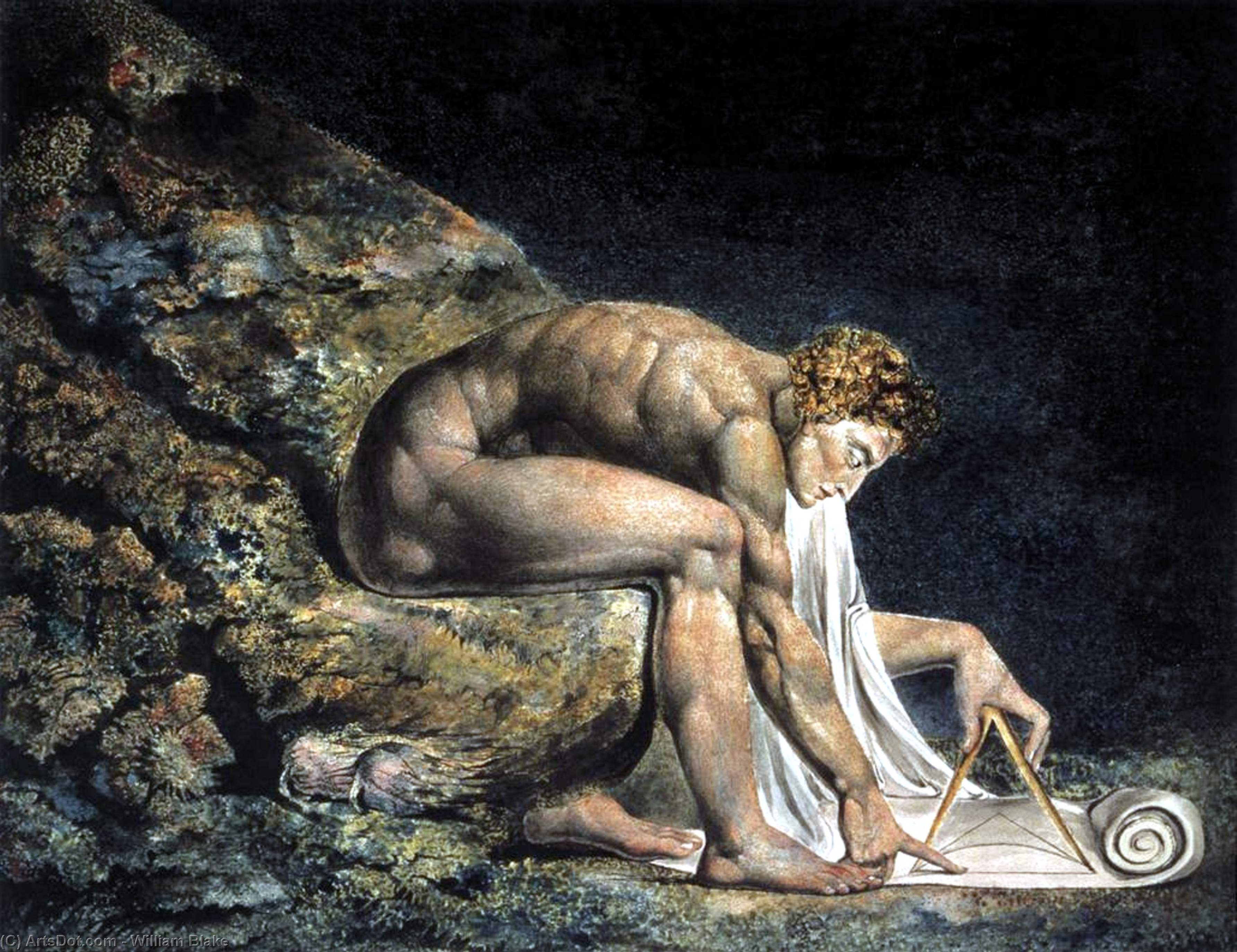
William Blake's Isaac Newton, created in 1795, is a captivating and thought-provoking engraving that showcases the artist's unique blend of mysticism and critique of scientific rationalism. This piece is part of the esteemed collection at the Tate Gallery in London, United Kingdom.Blake’s depiction of Newton is not a traditional portrait but rather an allegorical representation. The figure of Newton is shown sitting on a rock, his back turned to the viewer, engrossed in his work. He is surrounded by elements that symbolize his scientific endeavors, such as a compass and a piece of cloth. The bird perched atop the rock adds a touch of mysticism, suggesting a connection between the natural world and human knowledge.
The Artistic Vision Blake's use of symbolism in Isaac Newton is multifaceted. The rock upon which he sits can be seen as a symbol of solidity and permanence, contrasting with the fluid, ever-changing nature of human understanding. Blake's work often explores the tension between reason and imagination, and Isaac Newton is no exception.
Symbolism and Interpretation Blake’s use of symbolism in Isaac Newton is multifaceted. The figure of Newton represents the epitome of scientific rationality, yet his posture and surroundings suggest a critique of the limitations of such an approach. Blake's work often explores the tension between reason and imagination, and Isaac Newton is no exception.
Artistic Techniques and Style The engraving technique used by Blake adds a layer of depth and texture to the piece. The intricate details and the play of light and shadow create a sense of dimensionality, drawing the viewer into the world of the painting. This style is characteristic of Romanticism, emphasizing emotion, imagination, and individualism.
Context and Influence Blake's work was influenced by various artistic movements, including Romanticism and Neoclassicism. His unique blend of mysticism and critique of scientific rationalism places him at the forefront of innovative artists who challenged conventional norms. For those interested in exploring more of Blake’s works, William Blake:Isaac Newton and William Blake:Newton are available on OriginalUniqueArt. Additionally, the museum where this piece is housed, Tate Gallery, is discussed in detail at Discovering the Masterpieces of Tate Britain, United Kingdom.
Conclusion Isaac Newton by William Blake is a masterpiece that not only reflects the artist’s vision but also challenges the viewer to ponder the relationship between science and imagination. This engraving stands as a testament to Blake's innovative style and his contribution to the world of art.
Photo Description The image is a painting of a man sitting on a rock with his back turned to the viewer. He appears to be wearing a loincloth and has a piece of cloth in his hand. The man seems to be working on something, possibly writing or crafting. In addition to the main figure, there are two other people visible in the painting. One person is located near the top left corner of the image, while the other is situated towards the right side of the scene. There is also a bird perched atop the rock where the man sits.
Size 460 x 600 cm
Date 1795
Preguntas y respuestas
¿Qué técnica se utilizó para "Isaac Newton" y cuándo fue creado?
"Isaac Newton" fue creada en 1795 mediante la técnica de Acrílico sobre lienzo. El material y la fecha describen cómo y cuándo se realizó la obra original.
¿Qué alias o nombres alternativos tiene William Blake?
William Blake aparece bajo los nombres alternativos Guillermo Blake.
¿Qué tan intensos son los colores de "Isaac Newton"?
Los colores de "Isaac Newton" de William Blake muestran una saturación Apagado con una intensidad Monocromático.
Biografía del artista
una vida marcada por un espíritu creativo
william blake, un artista, poeta e grabador visionario, dejó una marca indeleble en el mundo del arte. Nacido en Londres el 28 de noviembre de 1757 y fallecido el 12 de agosto de 1827, la vida de Blake fue un testimonio de su profundo espíritu creativo.vida temprana e influencias
Los primeros años de Blake estuvieron marcados por una profunda conexión con las artes. Su padre, william blake sr., un hosier, y su madre, catherine wright, influyeron en sus inclinaciones espirituales y artísticas. Esto llevó a su aprendizaje bajo la tutela de francisco bartolozzi, un grabador.evolución artística y obras notables
El viaje artístico de Blake abarcó diversos medios, incluyendo la pintura, la poesía y la grabado. Algunas de sus obras más notables incluyen:- the tyger (1795) - una obra maestra de la literatura romántica, que muestra la mezcla única de Blake entre lo místico y lo real.
- the sickle (1803) - un ejemplo conmovedor de su destreza en el grabado, que refleja su profunda conexión con la naturaleza.
- the ghost of a flea (c. 1819–1820) - un testimonio del enfoque innovador de Blake en el arte, que difumina las líneas entre la realidad y la fantasía.
museos que exhiben obras de Blake
- blake museum, reino unido - un destino imprescindible para cualquier entusiasta de Blake, que alberga una extensa colección de sus obras de arte. [https://OriginalUniqueArt.com/@/william-blake](https://OriginalUniqueArt.com/@/william-blake)
- fulham public library, reino unido - aunque no es un museo dedicado exclusivamente a Blake, presenta varias de sus obras notables, ofreciendo una perspectiva única del arte británico. [https://OriginalUniqueArt.com/@@/a@d3bma9-discovering-the-artworks-of-fulham-public-library-united-kingdom](https://OriginalUniqueArt.com/@@/a@d3bma9-discovering-the-artworks-of-fulham-public-library-united-kingdom)
legado e impacto
La influencia de Blake en el arte británico es innegable. Su mezcla única de lo místico, lo profético y lo imaginativo ha inspirado a generaciones de artistas. Como precursor del movimiento romántico, la obra de Blake continúa desafiando cualquier categorización fácil, convirtiéndolo en una piedra angular de la literatura y el arte británicos.lecturas adicionales
Para más información sobre William Blake y sus obras, explore:
William Blake
1757 - 1827 , Reino Unido
Datos clave
- Artistas Influenciados:
- Pre-Rafaelitas
- Simbolismo
- Modernismo
- Artistas Que Influyeron:
- Raphael
- Miguel Ángel
- Fecha De Muerte: 12 de agosto de 1827
- Fecha De Nacimiento: 28 de noviembre de 1757
- Lugar De Nacimiento: Londres, Reino Unido
- Movimiento Artístico: Romanticismo
- Nacionalidad: Británico
- Nombre Completo: William Blake
- Obras Notables:
- El Tigre (1795)
- La Segadora (1803)
- El Fantasma de una Pulga
- Canciones de Inocencia
- Jerusalén (1804-1820)
Artículos relacionados

El Intricado Mundo del Grabado: Técnica, Expresión y Legado Histórico
Descubre la fascinante historia del grabado calcográfico: técnicas ancestrales, maestros como Goya y su impacto en el arte y la ciencia. Guía experta para coleccionistas y amantes del arte.

William Blake: Romantic Visionary & Mystical Genius of the Imagination
Explore the mystical art & poetic genius of William Blake (1757-1827). Discover his revolutionary illuminated printing, rich symbolism, and lasting influence on Romanticism. Find handmade reproductions at OriginalUniqueArt.

Engraving: A Historical Survey of Technique, Artistic Expression & Enduring Legacy
Explore the rich history of engraving with OriginalUniqueArt. Discover techniques, iconic artists like Dürer & Callot, collecting tips, and expert guidance for preserving your art investment. Learn about intaglio printing & more!
The Art of Engraving: Mastering Precision and Detail in the Intaglio Tradition
Explore the profound mastery of engraving and intaglio printmaking. Delve into the rich history, technical precision of the burin, and the enduring legacy of fine art techniques that shaped the world's most iconic masterpieces.
Los 10 Grabados Legendarios que Transformaron la Historia del Arte | OriginalUniqueArt
Descubre los 10 grabados legendarios de Dürer, Rembrandt y Goya que revolucionaron el arte. Explora la historia, técnicas y belleza atemporal de estas obras maestras. Reproducciones de alta calidad en OriginalUniqueArt.com para decorar tu hogar con arte clásico.