

 Ver en contexto
 Enviar
 Compartir
 Detalles

 Descargar
 Similares
 Radiografía
 Presentación de diapositivas
Lamentation
 86.0 x 71.0 cm
 Museo Mayer van den Bergh
 Ver más
Adquiera una imagen digital de alta resolución y optimizada, muy superior a la vista previa en línea.
Cada archivo es preparado meticulosamente por nuestros especialistas internos mediante el uso de herramientas avanzadas y un experto retoque manual. Nos aseguramos de que cada imagen posea una claridad excepcional, una precisión cromática impecable y un detalle minucioso.
El archivo final se entrega por correo electrónico en un plazo de 72 horas, optimizado para su uso inmediato en entornos profesionales, editoriales y de impresión. Esta es la misma calidad en la que confían los estudios de diseño, las editoriales y las galerías de primer nivel.
Imagen Digital
Descarga un archivo de alta resolución para exhibición personal, impresión y proyectos creativos. ( Comprar impresión Comprar pintura hecha a mano)
Incluido en cada pedido de imágenes digitales
Entrega digital experta, garantizada.
Al elegir OriginalUniqueArt.com, no solo está adquiriendo una imagen; está recibiendo una obra de arte digital mejorada profesionalmente, elaborada con precisión y respaldada por una garantía de satisfacción. Esto es todo lo que incluye su pedido, automáticamente:

Entrega rápida por email
Recibirá su archivo de imagen digital en alta resolución por correo electrónico en un plazo de 72 horas tras realizar su pedido, listo para su uso inmediato.

Archivo digital optimizado por IA
Su obra de arte se optimiza profesionalmente mediante herramientas avanzadas de IA y edición manual, garantizando el máximo detalle, claridad y precisión cromática.

Reenvío gratuito de por vida
¿Has borrado o perdido tu archivo por error? No te preocupes: te lo volveremos a enviar en cualquier momento, sin coste adicional.

Sin gastos de importación, siempre
Disfrute de su obra de arte al instante sin aduanas, aranceles ni gastos de envío; las descargas digitales siempre están libres de impuestos.

Garantía de fidelidad de color
Garantizamos que su imagen digital refleje los colores originales con la mayor fidelidad posible, mediante el uso de herramientas profesionales y gestión del color.

Garantía de satisfacción de 60 días
Si no está satisfecho con su imagen digital, la revisaremos o le reembolsaremos el 100% en un plazo de 60 días, sin preguntas.

100% Garantía de devolución de dinero
¿No está satisfecho? Obtenga un reembolso completo dentro de los 60 días posteriores a la recepción de su archivo digital, sin necesidad de explicaciones.

Descuentos por pedidos grandes
Compra 3 imágenes, ahorra 10% - Compra 5, ahorra 15% - Compra 10+, ahorra 20%. Ideal para proyectos creativos, galerías y agencias.
Biografía del artista
The Gentle Heir of Netherlandish Grandeur
In the golden, luminous era of Early Netherlandish painting, few names resonate with as much quiet dignity as Vrancke van der Stockt. While history often casts a brilliant, sometimes blinding light upon his mentor, the legendary Rogier van der Weyden, Van der Stockt emerged not merely as a shadow, but as a vital successor who carried the torch of Flemish emotional depth into a new generation. Born in Leuven before 1420, his life was woven into the very fabric of the Burgundian Netherlands, a period defined by unparalleled technical mastery and a profound spiritual intensity that sought to bridge the gap between the earthly and the divine.
Van der Stockt’s artistic journey began within the disciplined walls of his father’s workshop. Under the tutelage of Jan van der Stockt, he mastered the meticulous craftsmanship required by the era's high standards, learning to manipulate oil pigments to capture the subtle textures of velvet, the cold glint of metal, and the soft glow of skin. This foundational training provided him with the technical vocabulary that would later allow him to serve as a direct heir and popularizer of the Weyden style. His association with Rogier van der Weyden was perhaps the most defining chapter of his career; as an assistant and collaborator, he absorbed the master's ability to sculpt human grief and spiritual ecstasy onto wooden panels, yet he began to infuse these lessons with a uniquely restrained elegance.
A Legacy of Devotion and Civic Grace
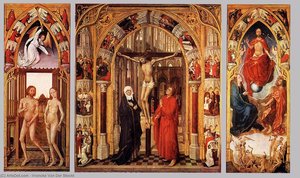
As his career matured, Van der Stockt’s work became characterized by a certain gentle sensitivity. Where Weyden might employ dramatic, sweeping gestures to convey agony, Van der Stockt often favored a more poised and graceful aesthetic. This is nowhere more evident than in his celebrated Triptych of the Redemption. In this monumental work, one finds a breathtaking narrative journey that guides the viewer through the sacred cycle of Christ's sacrifice. He possessed a miraculous ability to ground cosmic theological events in the recognizable human experience, populating his divine landscapes with tiny, meticulously rendered figures engaged in quiet, everyday activities—a technique that makes the sacred feel tangibly present and intimately reachable.
Beyond the confines of his studio, Van der Stockt was a man of significant civic importance. His life was marked by a profound engagement with the community of Leuven and Brussels, reflecting the high social standing of successful master painters in the 15th century. His achievements extended far beyond the easel:
- Mastery of the Guild: In 1445, he achieved the prestigious status of master within the Brussels Guild of St. Luke, a testament to his technical skill and professional standing.
- Civic Leadership: He served with distinction on the Leuven Town Council during several terms, including 1465, 1472, and 1475, demonstrating his influence in the political life of the city.
- Religious Stewardship: His leadership as the head of the Confraternity of St. Eloy between 1471 and 1473 highlighted his deep integration into the religious and social structures of his time.
- Official Recognition: Following the death of Rogier van der Weyden in 1464, Van der Stockt ascended to the position of the official painter of Leuven, a role that solidified his reputation as a premier artist of the region.
The Enduring Echo of a Master
Though the passage of centuries has left certain gaps in our biographical knowledge—a frustrating lacuna for modern art historians—the stylistic fingerprints of Vrancke van der Stockt remain indelible. His ability to balance the monumental with the minute, and the dramatic with the serene, ensures his place in the pantheon of the Northern Renaissance. He did not seek to eclipse the giants upon whose shoulders he stood; instead, he sought to refine their vision, offering a more tempered, graceful window into the soul of the late medieval world. Today, when we gaze upon his Lamentation or the intricate panels of his triptychs, we do not merely see a follower of Weyden, but a master in his own right, whose gentle hand helped define the very heartbeat of Netherlandish art.
vrancke van der stockt
1420 - 1495
Breves datos
- Artistic Movement Or Style: Early Netherlandish Painting
- Artists Or Movements Influenced By This Artist: ['Rogier van der Weyden']
- Artists Who Influenced This Artist: ['Rogier van der Weyden']
- Date Of Death: 14 June 1495
- Full Name: Vrancke van der Stockt
- Nationality: Dutch
- Notable Artworks:
- Triptych of the Redemption
- Lamentation
- Pietà
- Place Of Birth: Brussels, Belgium

