Obra al óleo
 Todo sobre SAINT JULIEN







































 Para obras de arte o reproducciones que midan más de 105 cm (aproximadamente 41 pulgadas) en cualquiera de sus lados, el marco se enviará como un kit desmontado. Este método garantiza una entrega segura y evita daños durante el transporte.


Identification of the Portrait of Saint Julien
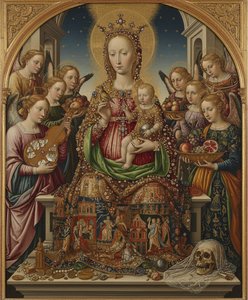
SAINT JULIEN is a portrait-like representation of an Italian saint, executed by the Early Renaissance painter Vittore Crivelli. The work focuses on the figure of the saint, presenting him in a manner that emphasizes his individual presence against a dark, minimalist background.
The subject is identified through specific iconographic attributes. He is depicted holding a staff and a bundle of grass, objects that characterize his traditional representation. These elements provide the primary visual cues for his identity within the devotional tradition.
Composition and Visual Elements
The vertical panel arrangement centers the figure of the saint against a dark, receding background. This placement creates a portrait-like focus, isolating the subject to emphasize his presence. A simple landscape provides the setting, featuring stylized foliage that suggests a natural environment without requiring deep perspectival complexity. The saint is identified by specific attributes: a staff held in one hand and a bundle of grass in the other.
The color palette relies on a series of warm tones. Gold, red, blue, and brown dominate the visual field, creating a devotional atmosphere. These colors define the figure's form and the folds of the drapery. The use of gold leaf adds a sense of opulence to the composition, contrasting with the darker, more muted tones of the background. Light appears diffused, as if emanating from a single, steady source like candlelight.
Technique and Material Composition
The work is executed in tempera on a wood panel. The artist employed a binding medium of egg tempera to achieve a precise, controlled application of pigment. This method requires meticulous layering of colors to build depth and form, particularly within the drapery and the figure's anatomy. Such technical rigor ensures a smooth surface texture, though subtle variations in the application suggest the deliberate movement of the brush.
The palette relies on high-quality pigments to establish a sense of divine luminosity. Notable materials include ultramarine blue and red lake, which provide deep, saturated tones. To enhance the visual impact and create a sense of sacred space, the panel is likely gilded. This use of gold leaf contributes to the opulent atmosphere characteristic of the period's devotional objects.
Artistic Style and Visual Characteristics
The work is characteristic of Early Renaissance Venetian art, maintaining a balance between decorative tradition and emerging naturalism. A prominent feature is the meticulous rendering of clothing, where precise lines define the figure's form and the complex folds of the drapery. These linear details provide a sense of structure to the saint's silhouette against the dark background. The application of gold leaf adds a layer of material opulence, typical of the period's devotional aesthetic.
Lighting is handled with a certain flatness, simulating a diffused light source similar to candlelight. This approach avoids dramatic shadows, instead creating a steady, even illumination across the subject. Such lighting, combined with the centered composition, produces an atmosphere of solemnity and reverence. The visual language relies on these controlled elements to direct the viewer's focus toward the saint's attributes, specifically the staff and the bundle of grass.
Preguntas y respuestas
¿Es SAINT JULIEN una obra pintada a mano o una impresión?
Pintado a mano: un pintor profesional recrea SAINT JULIEN al óleo sobre lienzo de lino.
¿Qué tamaño debo elegir para SAINT JULIEN?
Los tamaños van desde 54.6 x 18.3 cm (€199) hasta 246.5 x 82.8 cm (€865); la tabla de esta página detalla las opciones principales y sus precios.
¿Cuánto tarda el envío?
El plazo de entrega es de 4 a 5 semanas, con envío exprés gratuito a todo el mundo; en esta página se ofrece una opción de producción urgente. Puede realizar la devolución en un plazo de 100 días para obtener un reembolso completo, sin condiciones.
¿Dónde se encuentra la obra original SAINT JULIEN?
La obra original forma parte de la colección del Musée du Petit Palais, Avignon.
¿Qué técnica utilizó Vittorio Crivelli para SAINT JULIEN?
Tempera On Panel
 Ver en contexto

 Enviar
 Compartir
 Detalles
 Ficha técnica


 Descargar
 Similares
 Radiografía
 Presentación de diapositivas
 Preguntas y respuestas

 Estadísticas