Cambiar a impresiones
 Ver más







































 Para obras de arte o reproducciones que midan más de 105 cm (aproximadamente 41 pulgadas) en cualquiera de sus lados, el marco se enviará como un kit desmontado. Este método garantiza una entrega segura y evita daños durante el transporte.


Victor ManBorn in Cluj-Napoca, Romania, in 1974.He lives and works in Berlin, Germany, and Cluj-Napoca.Only gradually does the eye find its bearings as the contours of the images emerge from the black, gray, and green tones of Victor Man’s intimate, small-format paintings. This gradual process of recognition transforms these images into a threshold, a place of transition into another, inner reality. The space that opens up under the cover of darkness within Man’s works leads viewers into a mysterious world that merges the mundane and the fantastical, mythology and fetish, individual experience and art-historical references, male and female, man and beast. This magical cosmos includes portraits and still lifes as well as beautiful, occult-like, and even erotic subjects. The paintings, attracting and drawing the viewer into their worlds, however, never provide explanations. Instead in their play of suggestions and references, the possibility is ever present to reverse their meaning in the eye of the viewer. In that sense a seemingly harmless still life depicting a bunch of slender, moderate branches in a vase, as in his Virgács (St. Nicolas) (2011), transforms into an object of fear after decoding the reference in the title to Saint Nicholas and his counterpart Krampus, who punishes those who have been bad. When Man draws from literary sources and art he usually favors sources that deal with the thresholds of human existence. The human body—transformed, constrained, tortured, amputated—is often at the center of his timeless and mysterious paintings. A recurring motif is that of decapitation: a seated figure, cut off at the neck by the painting’s format, holds a disembodied head in its lap. Whether the figure is female or male remains unclear. This motif evokes images of Judith and Holofernes or Salome and John the Baptist. The gender ambiguity of the main figure reveals Man’s interest in the Surrealists and their experiments with gender-bending imagery. Some of Man’s
Victor Joseph DeManet (1895-1964) fue un escultor belga nacido en Bruselas, Bélgica, donde falleció el 7 de febrero de 1964. Su obra participó en los Juegos Olímpicos de verano de 1924, los Juegos Olímpicos de verano de 1932 y los Juegos Olímpicos de verano de 1936.
La escultura de DeManet se caracteriza por una sensibilidad expresionista que busca capturar la esencia emocional del sujeto representado. Sus obras exploran temas complejos como el sufrimiento humano, la transformación física y psicológica, y la relación entre hombre y naturaleza, utilizando materiales como el mármol y el oro para crear esculturas monumentales pero también íntimas.
- Estilo: Surrealismo
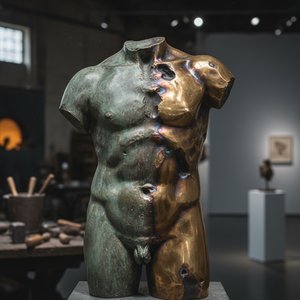
- Técnica: Escultura en piedra blanca con dorado
- Origen artístico: Influenciado por artistas como Auguste Rodin y Edvard Munch
“Untitled (after Giorgione)” es una obra maestra que invita a la reflexión sobre la condición humana. La composición oscura y simbólica refleja la inquietud existencial del artista, quien utiliza elementos vegetales estilizados para representar la fragilidad de la vida y la lucha entre el bien y el mal.
La pintura captura un momento de silencio y contemplación, donde la figura masculina permanece inmóvil en medio de una atmósfera cargada de misterio. Esta imagen poderosa transmite una sensación de vulnerabilidad y desafío ante las fuerzas oscuras del universo.
El artista emplea una combinación magistral de colores apagados y líneas precisas para crear una escultura que posee una belleza inquietante y una profundidad emocional sorprendente. Esta pieza artística permanece como testimonio de la capacidad humana para expresar sentimientos complejos y explorar los límites de la percepción sensorial.
Preguntas y respuestas
¿Qué lugar ocupa "Sin título (tras Giorgione)" dentro de la obra de Victor Joseph Demanet?
"Sin título (tras Giorgione)" comparte con otras obras de Victor Joseph Demanet su estilo Surrealist Symbolism y sus temas recurrentes: surrealist references, mythological imagery, psychological exploration, ritualistic motifs, olympics legacy, artistic experimentation, human suffering, symbolic transformation.
¿Qué tema y atmósfera combina "Sin título (tras Giorgione)" de Victor Joseph Demanet?
"Sin título (tras Giorgione)" de Victor Joseph Demanet representa mythology, transformation, decapitation, symbolism, darkness, fear, ritual, human body, con un ambiente Dramático. El tema y la atmósfera describen juntos la obra.
¿Dónde puedo comprar reproducciones pintadas a mano de "Sin título (tras Giorgione)" de Victor Joseph Demanet?
Puede solicitar una reproducción pintada a mano de "Sin título (tras Giorgione)" de Victor Joseph Demanet directamente en su página de Reproducción al óleo pintada a mano: una reproducción al óleo pintada a mano sobre lienzo de lino, realizada bajo pedido.
 Ver en contexto
 Enviar
 Compartir
 Detalles
 Guía
Guía

 Descargar
 Similares
 Radiografía
 Presentación de diapositivas
 Preguntas y respuestas
 Estadísticas