Vista previa
 Compartir
 Compartir
 Ver detalles
 Guía
Guía

 Descargar
 Ver artículos similares
 Radiografía
 Presentación de diapositivas
 Estadísticas
Eight-Pointed Stars
 Print
Print- WallArt
- Conceptual Minimalism
 137.0 x 137.0 cm
 Museo de Arte Chrysler
 Leer más
La obra de arte que se muestra en esta página está protegida por las leyes de propiedad intelectual, lo que significa que no podemos crear ni vender legalmente una reproducción idéntica. Esta protección se hace cumplir en virtud de acuerdos internacionales como el Convenio de Berna y por las leyes nacionales, incluidas aquellas establecidas por el Ley de derechos de autor de los EE. UU. - Título 17.
Este método cumple plenamente con las normativas de derechos de autor, ya que no implica la copia ni la duplicación de la obra protegida. En su lugar, se trata de una reinterpretación creativa: una nueva pintura influenciada por la original, pero que no es idéntica a ella.
Giclée / Impresión de arte
Impresiones giclée o en lienzo de calidad de museo con producción rápida y opciones de acabado flexibles. ( Encargar reproducción pintada a mano Ver versión en imagen digital)




P118B €10

P118H €10

P118W €10

P438Z €10

P508JH €12

P508YH €12

P805H €10

P805Z €10

P919BZ €10

P919G €10

P919XJ €10

P959ZH €10

P968JZ €12

W106C €8

W218G €10

W218JH €8

W218Y €10

W307PJ €10

W316G €10

W316PJ €8

W316Y €10

W398PJ €8

W4111J €10

W500HY €15

W500JH €15

W692G €12

W849H €8

W940BG €15

W953PJ €8




Elija entre nuestros tamaños predefinidos que respetan las proporciones originales de la obra.

Introduzca el ancho y el alto que necesite para adaptarse a su marco o pared. Una impresión solo puede recortarse, nunca hacerse más grande que la imagen original, por lo que un tamaño con una forma distinta perderá parte de la obra. Le enviaremos una maqueta digital para su aprobación antes de realizar cualquier impresión. La imagen que se muestra en esta página no refleja el recorte real; solo la maqueta lo hace.
Envío a todo el mundo () en 2 semanas en lugar de las 4/5 semanas estándar. (22 octubre)

Envío exprés gratuito a todo el mundo

Lienzo de lino de alta calidad

Seguro de envío completo

Garantía de reembolso de impuestos aduaneros

Garantía de fidelidad cromática exacta

Política de devolución de 100 días (solo por defectos)

Garantía de devolución del 100% del dinero

Oferta por volumen
 La opción de vidrio solo está disponible en tamaños inferiores a 110 cm.

Eight-Pointed Stars
Giclée / Impresión de arte
Tamaño de la reproducción
-


Precio total
€ 70
Sol LeWitt’s “Eight Pointed Stars”: A Geometric Meditation on Order and Chaos
Solomon Lewitt's "Eight Pointed Stars," created in 1996, isn’t merely a print; it’s an invitation into the meticulously ordered yet profoundly dynamic universe of one of Minimalism’s most influential figures. This work, part of a set of thirty-six embossed relief prints, embodies LeWitt’s core philosophy – that art resides not in the execution itself, but in the precise definition of its underlying concept. The piece unfolds as a grid of eight-and-a-half-inch squares, each filled with an infinite combination of colors: white, gray, black, red, yellow, and blue. These aren’t random splashes; they are governed by a strict set of instructions, meticulously documented by LeWitt himself, ensuring that the final outcome is entirely predictable yet endlessly fascinating.
LeWitt's approach to art was revolutionary. He famously stated, “The idea precedes the execution,” shifting the focus from the artist’s hand to the conceptual framework. This principle is vividly demonstrated in "Eight Pointed Stars." The work draws heavily on geometric principles – specifically, the combinatorial possibilities of two-part combinations. It's a testament to the beauty found within mathematical systems and their translation into visual form. The choice of colors isn’t arbitrary; it contributes to a subtle tension between order and chaos. The stark contrast of black and white, for instance, creates a powerful sense of definition against a backdrop of muted tones, while the vibrant reds and yellows inject moments of unexpected energy.
Craftsmanship and Process: A Collaborative Creation
The creation of "Eight Pointed Stars" was a complex undertaking, involving a dedicated team of artisans working under LeWitt’s precise guidance. The prints were executed on Twinrocker handmade paper, chosen for its tactile quality and ability to capture the subtle nuances of the embossed technique. David Lasry, a master printer at Two Palms Press in New York, played a crucial role in translating LeWitt's instructions into reality. Each panel was meticulously hand-dyed, then milled onto an aluminum plate before being carefully inked and pressed – a process demanding immense skill and attention to detail. The edition size of fifteen underscores the rarity and exclusivity of this work, highlighting the labor involved in its creation.
The collaborative nature of the project is significant. LeWitt’s conceptual framework was realized through the expertise of craftspeople, demonstrating his belief that art is a shared endeavor. This process mirrors his broader approach to creating structures – often involving multiple individuals working together to bring an idea to life. The sheer number of variations possible within the set of thirty-six panels speaks volumes about the complexity and depth of LeWitt’s vision.
Symbolism and Emotional Resonance
While seemingly simple in its geometric arrangement, “Eight Pointed Stars” resonates with deeper symbolic meanings. The star itself is a universal symbol of hope, guidance, and aspiration – an archetype found across countless cultures and throughout history. LeWitt’s use of color further amplifies this symbolism. White represents purity and clarity, while black can signify mystery or the unknown. The inclusion of red evokes passion and energy, and yellow suggests optimism and enlightenment. The repetition of these elements within a structured grid creates a sense of balance and harmony, suggesting an underlying order that transcends the apparent chaos of color combinations.
Beyond its symbolic weight, “Eight Pointed Stars” offers a profound meditation on the relationship between order and chaos. The meticulously defined rules governing the creation of each panel ultimately lead to an infinite number of possibilities – a visual representation of the inherent dynamism within seemingly static systems. It’s a work that invites contemplation, prompting viewers to consider the beauty found in both structure and spontaneity.
A Legacy of Conceptual Innovation
Sol LeWitt's "Eight Pointed Stars" stands as a pivotal example of Minimalist art and conceptual practice. Its enduring appeal lies not only in its aesthetic qualities but also in its intellectual rigor and profound exploration of artistic principles. The work’s influence can be seen in countless contemporary artists who continue to push the boundaries of creative expression by prioritizing ideas over traditional techniques. Owning a reproduction, or even experiencing this print firsthand, offers a tangible connection to one of the 20th century's most visionary and influential artists – a testament to the power of simplicity and the enduring fascination with geometric forms.
Preguntas y respuestas
¿Existe una guía para "Eight-Pointed Stars" de Solomon Lewitt?
La guía de "Eight-Pointed Stars" es la página Guía de la obra: una ficha imprimible que muestra la pieza con su pie de foto, línea de crédito y tabla de identidad (artista, fechas, técnica, tamaño original, colección).
¿Tiene "Eight-Pointed Stars" una vista previa en realidad aumentada?
Puedes visualizar "Eight-Pointed Stars" de Solomon Lewitt en tu propia pared con la página de Vista previa AR de la obra, utilizando realidad aumentada en un dispositivo compatible.
¿Cuál es el tono predominante de "Eight-Pointed Stars" de Solomon Lewitt?
"Eight-Pointed Stars" se inclina hacia un tono Golden Yellow Range.
Biografía del artista
El arquitecto de las ideas: la vida y el legado de Sol LeWitt
En el vasto paisaje del modernismo del siglo XX, pocas figuras proyectan una sombra tan extensa o intelectualmente profunda como Solomon LeWitt. Nacido el 9 de septiembre de 1928 en Hartford, Connecticut, en el seno de una familia de inmigrantes judíos procedentes de Rusia, la trayectoria de LeWitt estuvo definida por la búsqueda del pensamiento puro por encima de la mera ejecución física. Sus primeros años estuvieron marcados por una rigurosa curiosidad analítica, un rasgo cultivado durante sus estudios en la Universidad de Syracuse entre 1945 y 1949. Esta base académica en matemáticas y geometría se convertiría más tarde en el latido mismo de su lenguaje artístico, permitiéndole despojarse de los excesos decorativos del arte tradicional para revelar la belleza esquelética de la lógica y la estructura.
La evolución de LeWitt como artista no fue una ruptura repentina, sino una migración deliberada de lo tangible hacia lo conceptual. Si bien sus primeras exploraciones involucraron la naturaleza táctil de la pintura y el dibujo, pronto se sintió cada vez más atraído por la idea que subyace al trazo, en lugar del trazo mismo. Este cambio marcó el nacimiento de un pionero que cerraría la brecha entre el Minimalismo y el Arte Conceptual. Comenzó a ver al artista no como un artesano limitado por la mano, sino como un arquitecto de instrucciones. Al priorizar el plano mental sobre el objeto terminado, LeWitt desafió la definición misma de autoría, sugiriendo que una vez concebida una idea, su manifestación física es simplemente una consecuencia secundaria.
La revolución del dibujo mural
A finales de la década de 1960, el arte contemporáneo fue testigo de una de sus transformaciones más radicales con la aparición de los icónicos dibujos murales de LeWitt. Al rechazar la permanencia y lo precioso de la escultura tradicional, introdujo las "estructuras" —un término que prefería sobre "esculturas" para enfatizar su esencia matemática— y una serie de instrucciones que podían ser ejecutadas por cualquier persona capacitada para seguirlas. Estas obras no eran meros adornos, sino experiencias vivas, a menudo compuestas por patrones geométricos precisos, arcos y formas entrelazadas que infundían vida a los espacios arquitectónicos que habitaban.
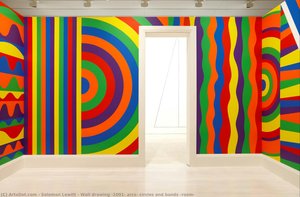
Presenciar un dibujo mural de LeWitt es ver la lógica transformada en poesía. Ya fuera la repetición austera y rítmica que se encuentra en Black with White Lines, Vertical Not Touching o la energía vibrante y exuberante de Wall Drawing #1091: arcs, circles and bands, su obra utilizaba el poder de la línea para dominar el espacio. Estas piezas a menudo dependían de un sistema de instrucciones lógicas, frecuentemente matemáticas, que guiaban a asistentes o instaladores de museos en su producción. Este método democratizó el acto de la creación y, al mismo tiempo, elevó la importancia del concepto, asegurando que la obra de arte existiera fundamentalmente como una chispa intelectual antes siquiera de tocar una pared.
Una huella imborrable en la modernidad
A lo largo de su prolífica carrera, que abarcó décadas e incluyó el dominio del grabado, la fotografía y la instalación, LeWitt se mantuvo firme en su compromiso con la claridad y la precisión. Su capacidad para hallar una belleza profunda en las formas más simples —como la impactante Pirámide blanca o los complejos y coloridos ritmos de sus obras murales a base de crayón— redefinió los límites estéticos de finales del siglo XX. Demostró que el arte podía ser despojado de su ego y de su ornamento, y aun así conservar un alma que resuena profundamente con el deseo humano de orden y descubrimiento.
La importancia histórica de Sol LeWitt es incalculable. Él proporcionó el vocabulario para que generaciones de artistas exploraran las fronteras entre el pensamiento y la materia. Su legado perdura en cada museo y galería donde la línea entre el creador y el ejecutor se desdibuja, y donde la fuerza de una idea es reconocida como el medio definitivo. Al contemplar su vida, desde sus inicios en Hartford hasta sus últimos días en la ciudad de Nueva York en 2007, vemos a un hombre que no solo hizo arte, sino que nos enseñó a ver la profunda arquitectura del pensamiento mismo.

Solomon Lewitt
1928 - 2007 , Estados Unidos
Datos clave
- Artistic Movement Or Style: Minimalismo y Arte Conceptual
- Artists Who Influenced This Artist: ['Frank Lloyd Wright']
- Date Of Birth: Septiembre 9, 1928
- Full Name: Solomon Lewitt
- Nationality: Americano
- Notable Artworks:
- Distorsionados Cubos
- Estructuras
- Place Of Birth: Hartford, Estados Unidos
Artículos relacionados

Echoes of Time: Exploring the Enduring Appeal & Historical Context of Vintage Art Prints
Explore the captivating world of vintage art prints! Discover their history, collecting tips & enduring appeal. Expert insights on chromolithography and building a legacy collection with OriginalUniqueArt.

Abstracción Geométrica: 10 Obras Maestras que Transformaron el Arte Moderno | OriginalUniqueArt
Descubre las 10 obras maestras de la abstracción geométrica que revolucionaron el arte moderno. Explora a Mondrian, Malevich y Kandinsky en OriginalUniqueArt.com. Reproducciones de alta calidad para tu hogar.

The Enduring Legacy of Fine Art Prints: Technique, History & Aesthetic Impact
Explore the rich history & techniques of fine art prints. Discover investment potential, assess authenticity, and learn how to preserve your collection with expert guidance. Trusted insights for discerning collectors.

Giclée Prints: Archival Quality & Aesthetic Nuances for the Discerning Collector
Explore the world of giclée prints with OriginalUniqueArt. Learn about archival quality, aesthetic nuances & investment potential. Expert guidance for discerning art collectors seeking museum-quality reproductions and lasting value.

The Power of Less: A Definitive Guide to the Minimalism Movement and Geometric Abstraction
Explore the profound impact of Minimalism and Geometric Abstraction. From Mondrian to Malevich, discover how stripping art to its essential forms revolutionized modern aesthetics through our expert-led historical guide.