

 Ver en contexto
 Enviar
 Compartir
 Detalles
 Guía
Guía

 Descargar
 Similares
 Radiografía
 Presentación de diapositivas
 Estadísticas
Salida de la luna


 Ver más
Reproducción al óleo hecha a mano
Óleo sobre lienzo pintado a mano en el tamaño y marco de su elección, realizado por encargo por nuestros artistas. ( Cambiar a impresiones Cambiar a imagen digital)




P118B €10

P118H €10

P118W €10

P438Z €10

P508JH €12

P508YH €12

P805H €10

P805Z €10

P919BZ €10

P919G €10

P919XJ €10

P959ZH €10

P968JZ €12

W106C €8

W218G €10

W218JH €8

W218Y €10

W307PJ €10

W316G €10

W316PJ €8

W316Y €10

W398PJ €8

W4111J €10

W500HY €15

W500JH €15

W692G €12

W849H €8

W940BG €15

W953PJ €8




Elija entre nuestros tamaños predefinidos que respetan las proporciones originales de la obra.

Indique el ancho y el alto que necesite para adaptarse a su marco o pared. Al tratarse de una obra pintada a mano, si requiere un tamaño con una proporción distinta, el artista puede pintar un poco más alrededor de la imagen o recortarla ligeramente; usted elige. Le enviaremos una maqueta digital para su aprobación antes de comenzar la pintura. La imagen que se muestra en esta página no refleja el resultado real; solo la maqueta lo hace.
Tras realizar el pedido, el equipo de OriginalUniqueArt.com enviará un correo electrónico al cliente para solicitar instrucciones y proporcionarle una vista previa del boceto.
Envío a todo el mundo () en 3-4 semanas en lugar de las 5 semanas estándar. (28 octubre). Sin comprometer la calidad.

Envío exprés gratuito a todo el mundo

Lienzo de lino de alta calidad

Seguro de envío total

Garantía de reembolso de aranceles aduaneros

Garantía de fidelidad cromática exacta

Política de devolución de 100 días (solo por defectos)

Garantía de devolución del 100% del dinero

Descuento por cantidad
 La opción de vidrio solo está disponible en tamaños inferiores a 110 cm.

Salida de la luna
Técnica de reproducción
Dimensiones de la reproducción
-


Precio total final
€ 264
Una visión capturada en el crepúsculo: Explorando Salida de la luna de Samuel Palmer
Contemplar esta representación de Salida de la luna es cruzar el umbral hacia un reino donde el mundo tangible se disuelve en el resplandor etéreo de la contemplación espiritual. Pintada en 1826, esta obra de Samuel Palmer captura mucho más que una simple escena nocturna; encapsula un profundo anhelo por lo sublime, ese momento en el que el velo entre lo terrenal y lo divino parece imposiblemente delgado. El paisaje local de Shoreham, en Sussex, que sirvió como inspiración, no fue un mero telón de fondo, sino un catalemo para la visión, llevando a Palmer a describir tales lugares como un verdadero «Valle de la Visión».
La alquimia de la luz y la sombra
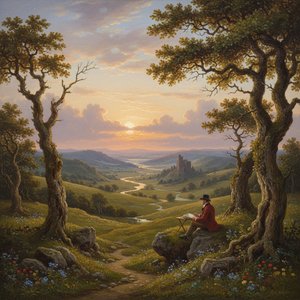
Desde el punto de vista técnico, la pieza resuena con la delicada belleza de la gouache sobre papel, otorgándole una sensación inmediata de antigüedad y una preciosa fragilidad. La composición está dominada por la presencia luminosa de la luna, que pende como un faro celestial sobre las formas oscuras y silueteadas del bosque. Estos árboles, plasmados en tonos profundos y misteriosos, enmarcan la escena, creando rincones de sombra profunda que invitan al espectador a adentrarse en el misterio de la pintura. Dispersas por esta tranquila extensión se encuentran figuras pequeñas, casi incidentales frente a la grandeza de la naturaleza y el cielo. Estas no reclaman atención a través del retrato, sino por su propia presencia, sugiriendo un asombro compartido entre aquellos que se han detenido a presenciar tan encantadora confluencia de luz.
Resonancia espiritual e influencia blakeana
El contexto histórico que rodea a esta pintura es inseparable del propio despertar espiritual del artista. El encuentro de Palmer con William Blake resultó transformador, alejando su mirada artística de la mera observación hacia una interpretación de la naturaleza mucho más imaginativa y profundamente espiritual. Esta obra encarna ese cambio. Habla de la búsqueda de toda una vida de Palmer por una síntesis: un matrimonio armonioso entre el mundo natural y la vida interior. La propia luz de la luna se vuelve simbólica; no es solo iluminación, sino una fuerza purificadora que hace eco de sus propias descripciones poéticas de la «infabulosa alquimia» del alma.
Creando una atmósfera de encantamiento
Para el coleccionista o diseñador que busca infundir profundidad y contemplación silenciosa en un espacio, Salida de la luna ofrece una calidad atmosférica sin igual. No es meramente decorativa; es evocadora. Imagine esta pieza aportando su resplandor sereno y misterioso a un estudio o salón, un lugar donde uno podría detenerse en medio del clamor de la vida moderna para sentir el peso de la historia y la ligereza de la pura imaginación. El impacto emocional general es de una profunda tranquilidad mezclada con un innegable sentido de maravilla, invitando a la reflexión tranquila bajo una mirada celestial.
Preguntas y respuestas
¿A qué movimiento y a qué época pertenece "Salida de la luna" de Samuel Palmer?
En "Salida de la luna" de Samuel Palmer, el movimiento Romanticismo se funde con la era Siglo XIX.
¿En qué etapa de la trayectoria de Samuel Palmer se sitúa "Salida de la luna", dada su fecha?
Dada su fecha de 1826, "Salida de la luna" se sitúa en el Periodo de influencia de Blake de Samuel Palmer.
¿Qué tamaño de impresión de "Salida de la luna" de Samuel Palmer se adapta mejor a la habitación recomendada?
Para un Salón principal, se recomienda imprimir "Salida de la luna" en un tamaño de Tamaño mediano.
Biografía del artista
Early Life and the Seeds of Vision
Samuel Palmer, born in London in 1805, emerged from a world steeped in both intellectual curiosity and spiritual seeking. His father, a bookseller and Baptist minister, instilled in him a love for literature and a contemplative nature, while his early artistic inclinations manifested remarkably early – by the age of twelve, he was already diligently painting churches, demonstrating an innate talent for observation and detail. This precocious ability quickly gained recognition; at just fourteen years old, Palmer exhibited works inspired by J.M.W. Turner at the Royal Academy, signaling a promising start to his artistic journey. Though receiving limited formal training – a brief stint at Merchant Taylors' School offered little in the way of structured art education – his path was irrevocably altered by a pivotal encounter with William Blake in 1824, facilitated through the landscape painter John Linnell. This meeting proved transformative, as Blake’s visionary style and profound spiritual depth resonated deeply within Palmer, becoming a cornerstone of his artistic identity.The Shoreham Period: A Realm of Mystical Pastoral
The years spent near Shoreham, Kent (1826-1835), represent the most intensely creative and distinctive phase of Samuel Palmer’s career. He purchased a humble cottage, affectionately nicknamed “Rat Abbey,” and it was here, amidst the rolling hills and ancient woodlands, that he forged his unique artistic voice. This period wasn't merely about depicting landscapes; it was about *transforming* them into realms of mystical beauty and spiritual resonance. Palmer’s Shoreham paintings are characterized by their evocative use of sepia tones, creating a sense of timelessness and melancholy, and often bathed in the ethereal glow of moonlight. These weren’t simply representations of nature but idealized visions, imbued with personal symbolism and a deep connection to the land. He wasn't alone in this pursuit; Palmer became associated with a group of like-minded artists known as “the Ancients,” including George Richmond and Edward Calvert, all drawn to Blake’s mystical leanings and seeking to revive a spiritual dimension within their art. This collective fostered an environment of shared ideas and mutual inspiration, solidifying Palmer's commitment to visionary pastoral painting. His distinctive style—characterized by luminous washes of color over textured surfaces—captured the sublime grandeur of the English countryside while simultaneously conveying profound emotional depth. Notable works from this period include *Garden in Shoreham*, *The Ancients* (a collaborative etching group), and *Cornfield by Moonlight*.Shifting Tides: London, Italy, and the Pursuit of Stability
In 1835, Palmer returned to London, marking a turning point in his artistic trajectory. The intensely mystical style of his Shoreham paintings began to give way to more conventional landscapes and watercolors, a shift partly dictated by financial necessity and pragmatic advice from his father-in-law, John Linnell, who urged him to cater to prevailing public tastes. While he continued to paint prolifically, Palmer increasingly relied on watercolor as a means of income, a popular medium in England at the time but one that perhaps didn’t fully satisfy his artistic ambitions. A honeymoon trip to Italy with his wife, Hannah Linnell, in 1837-1839 broadened his palette and introduced brighter colors into his work, though these sometimes resulted in hues considered overly vivid by contemporaries. To supplement his income, Palmer worked as a private drawing master, a demanding occupation that limited the time he could dedicate to his own artistic pursuits. Financial difficulties plagued him throughout this period, exacerbated by the unfortunate actions of his brother, who pawned many of his early paintings – forcing Palmer to redeem them at considerable expense.Later Years and Enduring Legacy
A move to Furze Hill House in Redhill, Surrey, in 1862 brought a degree of financial stability to Palmer’s life, allowing him to revisit the visionary style of his earlier Shoreham paintings, albeit with a more mature and refined technique. His later works include exquisite illustrations for Milton’s poems *L'Allegro* and *Il Penseroso*, demonstrating his continued mastery of line and composition, as well as a series of evocative etchings illustrating Virgil. The Lonely Tower, completed in 1879, is widely considered one of his finest later achievements, showcasing his exceptional skill in etching and capturing a mood of poignant solitude. The death of his son, Thomas More Palmer, in 1861 cast a long shadow over these final years, adding a layer of melancholy to his work. Samuel Palmer passed away in 1881, leaving behind a body of work that, while initially overlooked, has since been recognized as profoundly significant within the context of British Romanticism. He stands as a key figure in visionary art, demonstrating the lasting impact of William Blake’s artistic and philosophical ideas and helping to foster a revival of interest in spiritual themes during the 19th century. His unique ability to blend meticulous observation with imaginative vision continues to captivate audiences today, solidifying his place as an enduringly important artist.
Samuel Palmer
1805 - 1881 , Reino Unido
Datos clave
- Artistic Movement Or Style: Romanticismo
- Artists Or Movements Influenced By This Artist: ['Los Ancients']
- Artists Who Influenced This Artist:
- William Blake
- J.M.W. Turner
- Date Of Birth: 27 enero 1805 Londres, Inglaterra
- Full Name: Samuel Palmer
- Nationality: Británico
- Notable Artworks:
- Cornfield by Moonlight
- Self-Portrait
- Harvesting
- The Lonely Tower
- Place Of Birth: Londres, Reino Unido
Artículos relacionados

William Blake: Romantic Visionary & Mystical Genius of the Imagination
Explore the mystical art & poetic genius of William Blake (1757-1827). Discover his revolutionary illuminated printing, rich symbolism, and lasting influence on Romanticism. Find handmade reproductions at OriginalUniqueArt.

Paisajes Románticos: 10 Obras Maestras que Definieron un Movimiento Artístico
Descubre los 10 paisajes románticos más influyentes de artistas como Caspar David Friedrich y Turner. Explora la belleza, el simbolismo y las técnicas del movimiento romántico. Reproducciones de arte exclusivas en OriginalUniqueArt.com.

John Constable: Las 25 Obras Maestras del Paisaje Inglés | OriginalUniqueArt
Descubre las 25 obras maestras de John Constable, el pintor romántico inglés que capturó la belleza del paisaje. Explora su técnica, historia y significado en OriginalUniqueArt.com. Reproducciones de arte de alta calidad para tu hogar.
John Varley I: Intimate Observation & the British Romantic Landscape
Explore the serene landscapes of John Varley I, a key figure in British Romanticism. Discover his unique watercolour style, collaboration with William Blake & lasting artistic legacy. Learn about collecting Varley's work.

Evocations of Place: A Historical Journey Through Landscape Art
Explore the rich history of landscape art with OriginalUniqueArt. Discover renowned artists, movements like Impressionism & Romanticism, and expert guidance for collecting timeless pieces. Find your perfect serene escape today!

