Vista previa
 Compartir
 Compartir
 Ver detalles
 Guía
Guía

 Descargar
 Ver artículos similares
 Radiografía
 Presentación de diapositivas
 Estadísticas
espejo -4


 Leer más
La obra de arte que se muestra en esta página está protegida por las leyes de propiedad intelectual, lo que significa que no podemos crear ni vender legalmente una reproducción idéntica. Esta protección se hace cumplir en virtud de acuerdos internacionales como el Convenio de Berna y por las leyes nacionales, incluidas aquellas establecidas por el Ley de derechos de autor de los EE. UU. - Título 17.
Como una alternativa respetuosa y legal, ofrecemos obras de arte personalizadas y pintadas a mano inspiradas en la original. Nuestros expertos y profesionales del arte estudian cuidadosamente el estilo, el sentimiento y la esencia artística de la obra original para crear una pieza nueva y única que evoque la misma sensación, siendo al mismo tiempo una creación original por derecho propio.
Este método cumple plenamente con las normativas de derechos de autor, ya que no implica la copia ni la duplicación de la obra protegida. En su lugar, se trata de una reinterpretación creativa: una nueva pintura influenciada por la original, pero que no es idéntica a ella.
Reproducción al óleo hecha a mano
Óleo sobre lienzo pintado a mano en el tamaño y marco de su elección, realizado por encargo por nuestros artistas. ( Cambiar a formato impreso Ver versión en imagen digital)




P118B €10

P118H €10

P118W €10

P438Z €10

P508JH €12

P508YH €12

P805H €10

P805Z €10

P919BZ €10

P919G €10

P919XJ €10

P959ZH €10

P968JZ €12

W106C €8

W218G €10

W218JH €8

W218Y €10

W307PJ €10

W316G €10

W316PJ €8

W316Y €10

W398PJ €8

W4111J €10

W500HY €15

W500JH €15

W692G €12

W849H €8

W940BG €15

W953PJ €8




Elija entre nuestros tamaños predefinidos que respetan las proporciones originales de la obra.

Escriba el ancho y el alto que necesite para adaptarse a su marco o a su pared. Al ser una obra pintada a mano, para un tamaño con una forma distinta, el artista puede pintar un poco más alrededor de la imagen o recortar un poco; usted elige. Le enviaremos una maqueta digital para su aprobación antes de comenzar la pintura. La imagen que se muestra en esta página no refleja el resultado real; solo la maqueta lo hace.
Tras realizar el pedido, el equipo de OriginalUniqueArt.com enviará un correo electrónico al cliente para solicitar instrucciones y proporcionarle una vista previa del boceto.
Envío a todo el mundo () en 3-4 semanas en lugar de las 5 semanas estándar. (21 octubre). Sin comprometer la calidad.

Envío exprés gratuito a todo el mundo

Lienzo de lino de alta calidad

Seguro de envío completo

Garantía de reembolso de impuestos aduaneros

Garantía de fidelidad cromática exacta

Política de devolución de 100 días (solo por defectos)

Garantía de devolución del 100% del dinero

Oferta por volumen
 La opción de vidrio solo está disponible en tamaños inferiores a 110 cm.

espejo -4
Técnica de reproducción
Tamaño de la reproducción
-


Precio total
€ 262
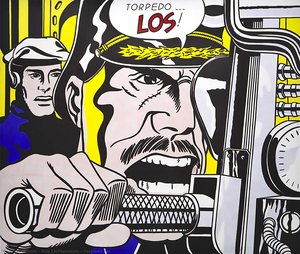
A Reflection on Modernity: Roy Lichtenstein’s “Mirror -4”
Roy Lichtenstein's "Mirror -4," created in 1970, is not a depiction of literal reflection but rather an exploration of perception itself—a visual puzzle rendered with the artist’s signature Pop Art vocabulary. This work, part of a larger series, moves beyond Lichtenstein’s earlier appropriations of comic book imagery to delve into the very mechanisms by which we see and interpret the world around us. The composition centers on a bold yellow and black circle, stark against a white background, immediately drawing the eye inward. Within this graphic frame resides a stylized tennis racket, not as an object in space but as a flattened, almost symbolic element. This isn’t about a game of tennis; it's about the representation *of* a tennis racket, its essence distilled into lines and color. The surface is intentionally textured with small dots – a hallmark of Lichtenstein’s technique mimicking the Ben-Day dot printing process used in mass-produced comics—creating a visual vibration that adds depth and complexity to what might otherwise be a simple geometric form.- Technique: Lichtenstein employed the Ben-Day dot printing process, meticulously applying dots of color onto canvas to simulate the halftone shading found in comic books.
- Color Palette: The artwork utilizes a striking contrast between yellow and black, amplifying visual impact and conveying a sense of urgency.
- Composition: Geometric shapes dominate the piece—a circle and a flattened tennis racket—creating an intriguing interplay of form and space.
Deconstructing Representation
The “Mirror” series, as a whole, represents a fascinating turning point in Lichtenstein's artistic journey. Having achieved fame for his large-scale paintings of comic book panels, he began to investigate the ways images are constructed and how they interact with our understanding of reality. The mirrors themselves aren’t reflecting recognizable scenes; instead, they present fragmented compositions—abstracted shapes, bold colors, and graphic elements—that force us to question what we're actually seeing. Is it a reflection? An illusion? Or simply a carefully orchestrated arrangement of forms? This ambiguity is central to the work’s power. Lichtenstein wasn’t interested in replicating reality; he was interested in dissecting it, revealing the underlying structures and conventions that shape our visual experience. The tennis racket within “Mirror -4” acts as a focal point, a recognizable object placed within this constructed space, further emphasizing the tension between representation and reality. Symbolism: The tennis racket symbolizes not just sport but also the act of representation itself—the artist’s deliberate manipulation of visual elements to convey meaning beyond the literal. The mirror serves as a conceptual device prompting contemplation on how we perceive and interpret images.Pop Art & Beyond: A Historical Context
To understand "Mirror -4," it’s crucial to situate it within the broader context of Pop Art and the cultural landscape of the late 1960s and early 1970s. Emerging in the mid-20th century, Pop Art challenged traditional notions of fine art by embracing imagery from popular culture—advertising, comic books, everyday objects. Lichtenstein was a leading figure in this movement, alongside artists like Andy Warhol and Claes Oldenburg. However, while Warhol often focused on celebrity and consumerism, Lichtenstein’s work frequently engaged with questions of perception, representation, and the nature of art itself. “Mirror -4” builds upon this foundation, moving beyond simple appropriation to a more conceptual exploration of visual language. The piece reflects a growing self-awareness within Pop Art—a questioning of its own methods and assumptions. It's a moment where the movement begins to look inward, examining not just *what* is being represented but *how*. Influence: Inspired by Picasso’s Cubist innovations and influenced by Surrealism, Lichtenstein pushed boundaries in his exploration of visual language—a pioneering step toward redefining artistic expression.An Emotional Resonance
Despite its cool, graphic aesthetic, “Mirror -4” evokes a surprisingly emotional response. The stark contrast between the yellow and black, the precise lines, and the deliberate texture create a sense of visual energy that is both stimulating and unsettling. There’s a feeling of detachment, as if we are observing something from a distance—a reflection in a mirror, perhaps. This distance invites contemplation, prompting us to consider our own role in the act of seeing. The work isn’t about providing answers; it’s about raising questions. It challenges us to look beyond the surface and to question the assumptions that shape our perception of reality. For collectors and interior designers, a reproduction of “Mirror -4” offers not just a striking visual statement but also an invitation to engage in a deeper dialogue with art and its power to transform our understanding of the world around us. It’s a piece that rewards careful observation and encourages ongoing interpretation—a timeless reflection on the complexities of modern life.Preguntas y respuestas
¿Está disponible una descarga para "espejo -4"?
Puede descargar "espejo -4" de Roy Lichtenstein desde la página de Descargar de la obra, como descarga de una imagen digital en alta resolución.
¿Quién es el autor y en qué año se creó "espejo -4"?
"espejo -4" fue creada por Roy Lichtenstein en 1970.
¿Qué edad tenía Roy Lichtenstein cuando creó "espejo -4" en 1970?
Roy Lichtenstein tenía 47 años cuando creó "espejo -4" en 1970. La edad se calcula a partir del año de nacimiento del artista, 1923.
Biografía del artista
vida temprana y educación
Roy Fox Lichtenstein, un destacado artista pop estadounidense, nació el 27 de octubre de 1923 en la ciudad de Nueva York. Creció en una familia judía de clase media alta, con su padre como corredor de bienes raíces y su madre como ama de casa. El interés de Lichtenstein por el arte y el diseño comenzó como un pasatiempo durante sus años escolares.Carrera artística
Después de completar su educación secundaria en la Dwight School en 1940, Lichtenstein asistió a la Art Students League of New York bajo la tutela de Reginald Marsh. Luego continuó con una licenciatura en artes visuales de la Universidad de Ohio, que fue interrumpida por un servicio militar de tres años durante la Segunda Guerra Mundial.- Look Mickey (1961, Galería Nacional de Arte, Washington D.C.), una de las primeras obras pop art de Lichtenstein, marcó el comienzo de su influyente carrera.
- Su trabajo estuvo fuertemente influenciado por los estilos de publicidad y cómics populares, con obras notables como Wham!, Drowning Girl y Oh, Jeff... I love you too... but...
- La obra más cara de Lichtenstein, Masterpiece, se vendió por 165 millones de dólares en enero de 2017.
Enseñanza e influencias
Lichtenstein enseñó en varias instituciones, incluyendo la Universidad Estatal de Nueva York en Oswego y la Universidad Rutgers. Su trabajo fue influenciado por Allan Kaprow, un colega profesor en Rutgers, lo que reavivó su interés en las imágenes proto-pop. Exposiciones notables:- The Museum Chambre de Commerce (Tolosa, Francia), que presentaba varias obras de arte, incluyendo aquellas del movimiento pop art.
- El trabajo de Lichtenstein fue exhibido en la Leo Castelli Gallery en la ciudad de Nueva York, con su primera exposición individual en 1962 siendo comprada por completo por coleccionistas influyentes antes de que abriera.
Legado e impacto
Roy Lichtenstein falleció el 29 de septiembre de 1997, dejando atrás un legado como figura destacada del movimiento pop art. Su obra continúa siendo celebrada por su innovadora mezcla de arte alto y bajo, haciendo que sea accesible a una audiencia más amplia.- Explore más obras de Lichtenstein en OriginalUniqueArt.com
- Descubra el mundo del pop art y sus influyentes artistas en Pop Art y más allá: navegando los estilos contemporáneos con OriginalUniqueArt.com
- Wikipedia: Roy Lichtenstein
- The Museum Chambre de Commerce (Tolosa, Francia) en OriginalUniqueArt.com

Roy Lichtenstein
1923 - 1997 , Estados Unidos de América
Datos clave
- Artistas Que Influyeron:
- Reginald Marsh
- Allan Kaprow
- Fecha De Muerte: 29 de septiembre de 1997
- Fecha De Nacimiento: 27 de octubre de 1923
- Lugar De Nacimiento: Manhattan, EE. UU.
- Movimiento Artístico: Pop Art
- Nacionalidad: Estadounidense
- Nombre Completo: Roy Lichtenstein
- Obras Notables:
- Look Mickey
- Whaam!
- Drowning Girl
- Masterpiece
Artículos relacionados

Abstracción Geométrica: 10 Obras Maestras que Transformaron el Arte Moderno | OriginalUniqueArt
Descubre las 10 obras maestras de la abstracción geométrica que revolucionaron el arte moderno. Explora a Mondrian, Malevich y Kandinsky en OriginalUniqueArt.com. Reproducciones de alta calidad para tu hogar.
Roy Lichtenstein: Las 25 Obras Maestras del Pop Art que Transformaron el Arte y la Decoración
Descubre las 25 obras maestras de Roy Lichtenstein, ícono del Pop Art. Explora su innovadora técnica, colores vibrantes y el impacto cultural de sus cuadros más famosos. Reproducciones de arte exclusivas en OriginalUniqueArt.com.

Neo-Abstract Art: The High-Impact Evolution of Modern Visual Energy and Geometric Sophistication
Discover the power of Neo-Abstract art. Explore how bold geometric forms and high-impact visual energy are redefining modern design. Learn to curate sophisticated, high-energy spaces with the latest trends in contemporary abstraction and structural color.

Kandinsky: Las 25 Obras Maestras del Pionero de la Abstracción | OriginalUniqueArt
Descubre las 25 obras maestras de Wassily Kandinsky, pionero del arte abstracto. Explora su expresionismo, composiciones únicas y la historia detrás de cada cuadro. Reproducciones de alta calidad para decorar tu hogar con arte moderno en OriginalUniqueArt.com.

Beyond Form & Color: Geometric Abstraction's Evolution in 20th/21st Century Art
Explore the evolution of geometric abstraction from Cubism to contemporary art. Discover key artists like Malevich & Mondrian, investment insights, and expert collecting advice at OriginalUniqueArt.