Cambiar a impresiones
 Ver más







































 Para obras de arte o reproducciones que midan más de 105 cm (aproximadamente 41 pulgadas) en cualquiera de sus lados, el marco se enviará como un kit desmontado. Este método garantiza una entrega segura y evita daños durante el transporte.


Melancholy after Durer
Ronald Brooks Kitaj’s “Melancholy after Dürer,” completed in 1989, stands as a poignant meditation on artistic creation and the inescapable shadow of intellectual influence—a reflection not only of Kitaj's own personal struggles but also of a broader cultural conversation surrounding melancholy itself. This monumental canvas, measuring 123.5 x 122.5 cm and housed in the British Council Collection, immediately draws attention to its arresting juxtaposition: a woman seated thoughtfully at a desk, illuminated by diffused light, alongside a telephone receiver and a book—elements deliberately chosen to echo Albrecht Dürer’s iconic engraving “Melancholia I” (c.1511). This deliberate reference isn't merely decorative; it underscores Kitaj’s conviction that artistic endeavors are invariably shaped by the ideas and emotions of those who precede them, establishing a dialogue between past and present.- Style: The painting embodies a distinctive blend of Surrealist and Pop Art sensibilities. While retaining Dürer's meticulous geometric precision—evident in the subtle structuring of the room—Kitaj abandons rigid formalism for expressive brushstrokes and layered textures, characteristic of his signature style.
- Technique: Executed in oil on canvas, “Melancholy after Dürer” showcases Kitaj’s masterful control over color and form. The muted palette – dominated by reds and browns – reflects the pervasive mood of sorrow and contemplation, mirroring the Romantic ideal of melancholy as a state of profound introspection.
- Historical Context: Dürer's engraving served as a cornerstone in shaping the artistic understanding of melancholy throughout the centuries. It represented not just sadness but also intellectual disillusionment—a recognition that human endeavor is inevitably fraught with frustration and failure. Kitaj’s work directly engages with this legacy, presenting it as a crucial element of the artist’s psychological landscape.
Preguntas y respuestas
¿Qué tan armoniosos son los colores de "Melancolía después de Durero" de Ronald Brooks Kitaj?
"Melancolía después de Durero" de Ronald Brooks Kitaj presenta una armonía de color Gran unidad cromática.
¿Dónde y para qué uso se recomienda "Melancolía después de Durero"?
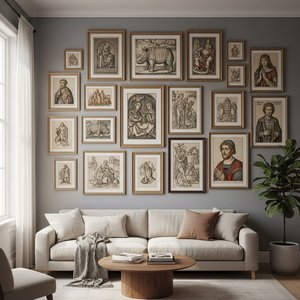
Se sugiere "Melancolía después de Durero" para Acento cromático, y el espacio recomendado es un Salón principal.
¿Para qué se recomienda una reproducción de "Melancolía después de Durero" de Ronald Brooks Kitaj?
Se recomienda utilizar una impresión de "Melancolía después de Durero" para Acento cromático.
 Ver en contexto
 Enviar
 Compartir
 Detalles
 Guía
Guía

 Descargar
 Similares
 Radiografía
 Presentación de diapositivas
 Preguntas y respuestas
 Estadísticas