Ver en contexto
 Enviar
 Compartir
 Detalles

 Descargar
 Similares
 Radiografía
 Presentación de diapositivas
Tam Gan


 Ver más
Reproducción al óleo hecha a mano
Óleo sobre lienzo pintado a mano en el tamaño y marco de su elección, realizado por encargo por nuestros artistas. ( Comprar impresión Comprar imagen)




P118B $10

P118H $10

P118W $10

P438Z $10

P508JH $12

P508YH $12

P805H $10

P805Z $10

P919BZ $10

P919G $10

P919XJ $10

P959ZH $10

P968JZ $12

W106C $8

W218G $10

W218JH $8

W218Y $10

W307PJ $10

W316G $10

W316PJ $8

W316Y $10

W398PJ $8

W4111J $10

W500HY $15

W500JH $15

W692G $12

W849H $8

W940BG $15

W953PJ $8




Elija entre nuestros tamaños predefinidos que respetan las proporciones originales de la obra.

Puede ingresar sus propias dimensiones para adaptarse a un marco o espacio específico. Si el tamaño seleccionado no coincide con las proporciones de la imagen original, recortaremos la obra o extenderemos la pintura con elementos adicionales pintados a mano. Se le enviará una maqueta digital para su aprobación antes de comenzar la producción.
Tenga en cuenta que la vista previa en pantalla no refleja el recorte o la extensión reales. Solo la maqueta mostrará con precisión la composición final.
Si bien existen tamaños personalizados, recomendamos seleccionar una dimensión de la lista predefinida para preservar las proporciones originales.
Tras realizar el pedido, el equipo de OriginalUniqueArt.com enviará un correo electrónico al cliente para solicitar instrucciones y proporcionarle una vista previa del boceto.
Envío a todo el mundo () en 3-4 semanas en lugar de las 5 semanas estándar. (7 septiembre). Sin comprometer la calidad.

Envío exprés gratuito a todo el mundo

Lienzo de lino de alta calidad

Seguro de envío total

Garantía de reembolso de impuestos aduaneros

Garantía de fidelidad cromática exacta

Política de devolución de 100 días (solo por defectos)

Garantía de devolución del 100% del dinero

Descuento por cantidad
 La opción de vidrio solo está disponible en tamaños inferiores a 110 cm.

Tam Gan
Técnica de reproducción
Dimensiones de la reproducción
-


Precio total final
$ 300
The Quiet Resonance of American Realism
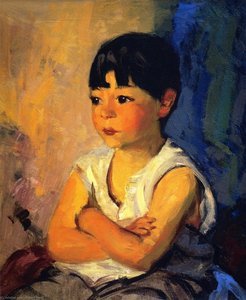
To stand before Robert Henri's Tam Gan is to encounter a moment suspended in time—a breath held between the observer and the observed. Painted in 1914, this oil on canvas portrait transcends mere likeness; it captures an inner landscape. Robert Henri, a master of American Realism, possessed a singular gift for distilling the very spirit of his subjects. His brushwork, often described as bold and expressive, never sacrifices emotional truth at the altar of perfect academic finish. Instead, he uses visible strokes to suggest life lived—a vibrant tapestry woven from light, shadow, and palpable human emotion. The painting invites the viewer not just to look, but to feel the quietude emanating from the young subject.
A Study in Serenity: Subject and Composition
The focal point, undeniably, is the girl herself. Dressed in a serene blue garment, she sits with an almost regal composure, her black hair styled into a neat ponytail that frames a face of profound stillness. Her gaze, directed outward toward the viewer, is neither challenging nor retiring; it is simply present. This direct yet gentle connection draws the eye deep into the painting's core. While two other figures occupy the background, they recede gracefully, serving only to deepen the sense of intimacy surrounding the main subject. The artist masterfully employs a subdued background palette, ensuring that all visual energy converges upon the girl’s expression—a testament to Henri's understanding of pictorial hierarchy.
The Brushstroke as Biography: Technique and Style
Henri’s technique in Tam Gan is a perfect marriage of realism and expressive freedom. One can observe the loose, confident application of paint that characterizes his style. These are not hesitant touches; they are declarations. The interplay between the rich blues of her dress and the subtle tones defining her skin speaks to an advanced handling of oil paint. This commitment to visible brushwork is what elevates the piece beyond mere portraiture into a study of artistic process itself. It suggests that the act of seeing, and the act of painting, are inseparable from the subject's very being.
Historical Echoes and Enduring Appeal
As an artifact of American art history, Tam Gan marks a significant moment in the shift toward more emotionally resonant artistic expression. It stands as a powerful counterpoint to rigid academic traditions, championing instead the raw, beating heart of American experience. For the collector or designer seeking art that speaks with depth, this piece offers both historical weight and immediate emotional resonance. Owning a reproduction allows one to bring this palpable sense of calm—this quiet, enduring spirit—into a modern living space, making it an object of contemplation as much as decoration.
Biografía del artista
Orígenes y Primeros Años
Robert Henri, nacido Robert Henry Cozad el 24 de junio de 1865 en Cincinnati, Ohio, tuvo una infancia marcada por la turbulenta relación entre sus padres, John Jackson Cozad, un jugador y promotor inmobiliario, y Theresa Gatewood Cozad. Un evento significativo en 1882 alteró el curso de su vida familiar. La familia se trasladó a Nebraska durante la época del Homestead Act, pero regresaron al Este después de un incidente que llevó a un cambio de identidad para evitar problemas legales. Robert Henry Cozad adoptó el nombre Henri cuando tenía 17 años.Formación Artística y Primeras Influencias
Su formación artística comenzó en 1886 en la Academia de Bellas Artes de Pensilvania en Filadelfia, bajo la tutela de Thomas Anshutz. Posteriormente, viajó a París en 1888 para estudiar en la Académie Julian, donde recibió influencias de William-Adolphe Bouguereau y François Millet, inicialmente abrazando el impresionismo. Henri se interesó por los artistas realistas holandeses y comenzó a experimentar con la pintura al aire libre, capturando escenas urbanas espontáneas.El Ashcan School y "The Eight"
Robert Henri emergió como una figura clave del Ashcan School de realismo americano y fue un organizador de "The Eight", una asociación informal de artistas que protestaron contra las prácticas restrictivas de exposición de la poderosa y conservadora National Academy of Design. Este grupo incluía a William Glackens, George Luks, Everett Shinn y John Sloan. Henri promovió una estética que se centraba en representar la vida cotidiana urbana con honestidad y vitalidad, alejándose de los temas idealizados tradicionales.Enseñanza e Influencia en Nuevas Generaciones
Henri comenzó a enseñar en la Escuela de Diseño para Mujeres de Filadelfia en 1892. Su enfoque pedagógico se caracterizaba por fomentar la observación directa y la expresión individual. Entre sus destacados alumnos se encuentran Joseph Stella, Edward Hopper, Rockwell Kent, George Bellows, Norman Raeben, Louis D. Fancher y Stuart Davis. Henri animó a sus estudiantes a desarrollar su propio estilo y a pintar lo que veían con honestidad, independientemente de las convenciones artísticas establecidas.Madurez Artística y Legado
En 1898, Henri se casó con Linda Craige, una alumna de su clase privada. Tras la muerte de Linda en 1905, se volvió a casar con Marjorie Organ en 1908. Su obra más conocida incluye "Mujer con Manteau" (1899) y "La Nieve" ("The Snow"), adquirida por el gobierno francés para su exhibición en el Musée du Luxembourg. Robert Henri falleció en 1929, dejando un legado duradero como defensor del realismo americano e influyente maestro que inspiró a una generación de artistas. Su énfasis en la observación directa y la expresión individual contribuyó significativamente al desarrollo del arte moderno estadounidense.
Robert Henri
1865 - 1929 , Estados Unidos de América
Datos clave
- Artistas Influenciados:
- Edward Hopper
- Rockwell Kent
- George Bellows
- Artistas Que Influyeron:
- William-Adolphe Bouguereau
- François Millet
- Thomas Anshutz
- Fecha De Nacimiento: 24 de junio de 1865
- Lugar De Nacimiento: Cincinnati, EE. UU.
- Movimiento Artístico: Ashcan School, Realismo americano
- Nacionalidad: Estadounidense
- Nombre Completo: Robert Henri
- Nombres Alternativos: Robert Henry Cozad
- Obras Notables:
- Mujer con manteau (1899)
- La nieve
Artículos relacionados
Robert Henri & the Spirit of American Realism: A Legacy of Urban Life and Artistic Independence
Explore the life & legacy of Robert Henri, a pivotal figure in American Realism. Discover his captivating portraits, influence on the Ashcan School, and enduring impact on art history. Learn more at OriginalUniqueArt.
Henri Matisse: Las 25 Obras Maestras que Definieron un Genio del Color | OriginalUniqueArt
Descubre las 25 obras maestras de Henri Matisse, el rey del color y padre del fauvismo. Explora su arte moderno, lienzos vibrantes y la historia detrás de cada pintura icónica. Encuentra reproducciones de alta calidad en OriginalUniqueArt.com.

Realismo Estadounidense: 10 Obras Maestras que Cambiaron el Arte y la Decoración
Descubre 10 obras maestras del Realismo Estadounidense: Winslow Homer, Edward Hopper y más. Explora la historia, técnica y emoción de estos icónicos cuadros. Encuentra reproducciones de arte de museo en OriginalUniqueArt.com.

The Unvarnished Truth: A Cultural Journey Through the Soul of American Realism
Explore the profound beauty of American Realism. From the Ashcan School's urban grit to intimate portraits, discover how artists captured the authentic soul of a nation through unvarnished truth and masterful observation.
Realismo Americano: Comentario Social y Representación Artística en la Pintura del Siglo XX
Explora el Realismo Americano del siglo XX: un análisis profundo de sus artistas clave (Vertis Hayes, William Aiken Walker), técnicas y su poderoso comentario social. Descubre cómo este movimiento plasmó la identidad estadounidense.